Facts
The four petitioners were appointed as Gangmen/Laborers on a daily-wage basis between 1998 and 1999 under the Public Works Department (National Highway Division), Ambikapur
Source reference: p. 2Having completed over 25 years of continuous service, they claimed entitlement to regularization based on State Government circulars and judicial precedents
Source reference: p. 2They submitted representations to the Executive Engineer (Respondent No. 3) in August 2024, which remained pending
Source reference: p. 2The petitioners approached the High Court seeking a mandamus to compel the respondents to consider their cases for regularization as a one-time measure
Source reference: p. 1-2Issues
Whether the petitioners are entitled to a time-bound consideration for regularization of their services after 25 years of continuous daily-wage employment
Source reference: p. 2 / p. 16Law Applied
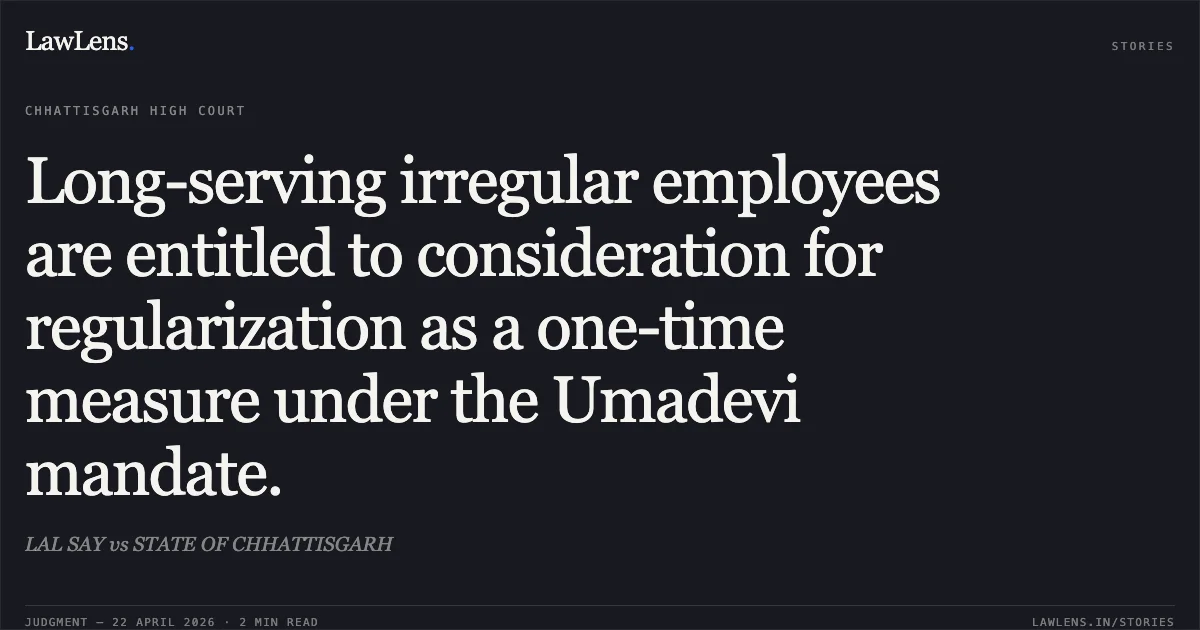
The Court primarily applied the principles of regularization established in Secretary, State of Karnataka v. Umadevi, (2006) 4 SCC 1, which distinguishes between "illegal" and "irregular" appointments and mandates a one-time regularization measure for employees with over 10 years of service in sanctioned posts
Source reference: para. 5It further relied on recent Supreme Court precedents, including Jaggo v. Union of India (2024), Shripal v. Nagar Nigam, Ghaziabad (2025), and Dharam Singh v. State of UP (2025), which deprecate "ad-hocism," criticize the misuse of temporary labels for perennial work, and emphasize the State's duty as a "model employer" under Articles 14, 16, and 21 of the Constitution
Source reference: para. 7-10Additionally, the court cited the State of Chhattisgarh’s circular dated 05.03.2008, which outlines the procedure for regularizing Class III and IV daily-wage employees
Source reference: para. 6Reasoning
The Court observed that the petitioners have rendered more than two decades of service, suggesting their roles are integral to the department's functioning
Source reference: p. 2Following the reasoning in Jaggo and Bhola Nath v. State of Jharkhand, the Court noted that prolonged temporary engagement for work of a perennial nature constitutes an unfair labor practice and that contractual labels cannot bypass constitutional protections
Source reference: para. 8-9The Court highlighted that under the Umadevi doctrine, if the initial appointments were merely irregular (not illegal) and against sanctioned posts, the State is obligated to conduct a regularization exercise
Source reference: para. 5-6Since the petitioners had not yet approached the high-level authorities (Respondents No. 1 2) with their grievances, the Court determined that a directed representation was the appropriate procedural step to ensure the State evaluates the merits of their service history against the legal framework
Source reference: p. 16Holding
The Court disposed of the writ petition without adjudicating on merits, instead permitting the petitioners to submit a comprehensive representation to the Secretary (PWD) and the Engineer-in-Chief
The Court directed Respondents No. 1 and 2 to consider and decide upon said representation in light of the cited Supreme Court judgments and State circulars within a period of six months from the date of receipt
Source reference: p. 16Holding follows the principle that the State must lead by example in providing stable employment and cannot indefinitely retain workers on daily wages for perennial duties
Source reference: para. 10-11Acts & Sections Cited
2 provisions across 1 statute referred to in this judgment. Linked provisions open on LawLens.
U.P. Industrial Disputes Act, 19472
Original Court PDF
LAL SAYvsSTATE OF CHHATTISGARH
Click to open original judgment
Original judgment, available to read, download and summarize on LawLens.in