Facts
The 133 applicants were engaged as casual laborers by Bharat Sanchar Nigam Limited (BSNL) between 1997 and 1999 to address administrative exigencies in the North East-II circle
Source reference: p. 20, para. 2They performed duties equivalent to Group-D employees and remained in service for over two decades
Source reference: p. 20, para. 2Although BSNL had implemented a "Casual Labourers (Grant of Temporary Status and Regularization) Scheme" in 1989 (extended to those recruited up to 01.08.1998), the applicants were excluded from regularization
Source reference: p. 20, para. 3; p. 21, para. 4Previous litigation included OA No. 85/2013, where the Tribunal directed consideration of their claims, but BSNL rejected them in 2015
Source reference: p. 21, para. 5The respondents contended that the applicants did not meet the "10-year continuous service" criteria as of the 2006 Uma Devi judgment and that the Tribunal cannot direct the framing of a regularization scheme
Source reference: p. 23-24, para. 8-9Issues
1. Whether the continuous engagement of casual laborers for several decades, despite the ruling in Secretary, State of Karnataka v. Uma Devi, creates a right to regularization when the work is of a perennial nature
Source reference: p. 27, para. 14; p. 28, para. 162. Whether the respondents can use the Uma Devi judgment as a shield to deny regularization to employees who have been exploited through long-term adhocism
Source reference: p. 28-29, para. 17-18; p. 33, para. 25Law Applied
Constitution Bench decision in Secretary, State of Karnataka v. Uma Devi (3) [(2006) 4 SCC 1], which permitted a one-time regularization measure for irregular appointments where employees served for over 10 years in sanctioned posts
Source reference: p. 30, para. 19State of Jammu and Kashmir v. District Bar Association, Bandipora [(2017) 3 SCC 410], which clarified that Uma Devi does not denude the State of its power to frame regularization schemes
Source reference: p. 31, para. 22Nihal Singh v. State of Punjab [(2013) 14 SCC 65], holding that the State must create sanctioned posts if the need for work is perennial
Source reference: p. 34, para. 27Jaggo v. Union of India (2024) and Shripal v. Nagar Nigam, Ghaziabad (2025), which established that Uma Devi cannot be used to justify exploitative long-term casual engagement
Source reference: p. 33-34, para. 24-25Reasoning
The Tribunal reasoned that while the applicants did not strictly satisfy the 1989 Scheme's cutoff or the specific 10-year window mentioned in Uma Devi, the respondents continued to engage them for decades after the 2006 judgment
Source reference: p. 27-28, para. 15-16This continuous engagement serves as evidence that the applicants' services were indispensable and the work was perennial
Source reference: p. 28, para. 16The court rejected the respondents' defense that the appointments were "illegal" due to a ban, noting that the authorities who engaged them were never penalized, thus characterizing the appointments as "irregular" at most
Source reference: p. 29, para. 18Applying the ratio from Jaggo and Dharam Singh, the Tribunal held that a "constitutional employer" cannot balance budgets by exploiting casual laborers while sidestepping fair engagement practices
Source reference: p. 34, para. 26Following Nihal Singh, the Tribunal dismissed the lack of "sanctioned posts" as a defense, stating that the need for such posts is a rational assessment the State must make for long-term functions
Source reference: p. 34-35, para. 27Holding
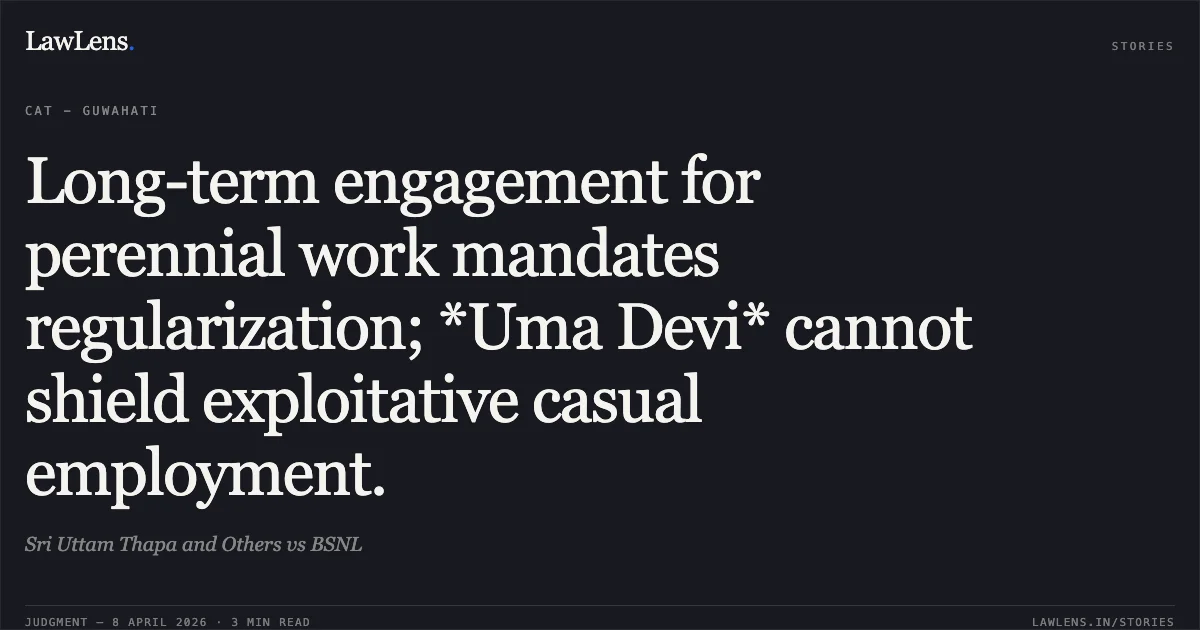
The Tribunal allowed the Original Application, holding that Uma Devi cannot be deployed to justify the exploitation of laborers who have rendered decades of service
The court found that the applicants' long-term service ripened into a right for regularization
Source reference: p. 36, para. 29The respondents were directed to regularize the services of the 133 applicants with all consequential benefits and pass appropriate orders within three months of receipt of the order
Source reference: p. 36, para. 29No costs were awarded
Source reference: p. 36, para. 29Original Court PDF
Sri Uttam Thapa and OthersvsBSNL
Click to open original judgment
Original judgment, available to read, download and summarize on LawLens.in


![Subsequent exoneration does not retrospectively invalidate a finalized promotion select list.. UNNIKRISHNAN M vs M/o Environment And Forests. CAT - ['Ernakulam']. LawLens](/stories/thumbnails/subsequent-exoneration-does-not-retrospectively-invalidate-a-finalized-promotion-select-li-ce80a0e84f2f4887857271e8b4341c42.webp)