Facts
The petitioner was appointed as an Orientation & Mobility Instructor at the Composite Regional Centre (CRC) for Persons with Disabilities, Sundernagar, on a contractual basis in 2005 following a public advertisement and selection process.
Source reference: para. 2-3His services were extended continuously for 17 years, during which he received annual increments, MACP benefits, and pay revisions under the 2016 Rules.
Source reference: para. 4, 16-17In 2020, internal communications to the Prime Minister’s Office listed his post as part of the "regular sanctioned strength".
Source reference: para. 6, 18On September 20, 2022, the respondents issued a non-speaking order terminating his services without assigning any reason.
Source reference: para. 5, 22The petitioner challenged this termination, seeking reinstatement and regularization.
Source reference: para. 1Issues
1. Whether the termination of a contractual employee after 17 years of continuous service against a sanctioned post is arbitrary and legally sustainable.
Source reference: para. 19, 212. Whether the petitioner is entitled to regularization of service based on the nature of his work and the duration of his employment.
Source reference: para. 22, 28Law Applied
The Court applied the mandate of Article 14 of the Constitution of India regarding non-arbitrariness in State action.
Source reference: para. 26.10, 28It relied on the Supreme Court precedents of Jaggo v. Union of India (2024), which held that long-term extraction of labor under temporary labels for perennial work is improper.
Source reference: para. 24Dharam Singh v. State of H.P. (2025), which characterized the State as a "constitutional employer" that cannot prefer precarious engagement over sanctioned posts for recurring functions.
Source reference: para. 25Furthermore, the court applied the "Doctrine of Legitimate Expectation" as discussed in Bhola Nath v. State of Jharkhand (2026), distinguishing between "illegal" appointments and "irregular" appointments made through due process.
Source reference: para. 26Reasoning
The Court observed that the petitioner was recruited through a valid selection process against a sanctioned post, not through "back-door entry".
Source reference: para. 20The fact that he served for 17 years and received benefits like MACP evidenced the "permanency" of the post.
Source reference: para. 19The Court found the termination order to be a "non-speaking order" that failed to justify why an employee with an unblemished record was suddenly "no longer required".
Source reference: para. 22By applying recent Supreme Court jurisprudence, the Court reasoned that the State cannot exploit employees by keeping them on contract in perpetuity for work that is integral to the organization.
Source reference: para. 26.6, 28The Court rejected the respondents' argument that the contractual label precluded rights, noting that the State’s conduct in granting increments and listing the post as "regular" in official reviews created a legitimate expectation of continued service.
Source reference: para. 18, 26Holding
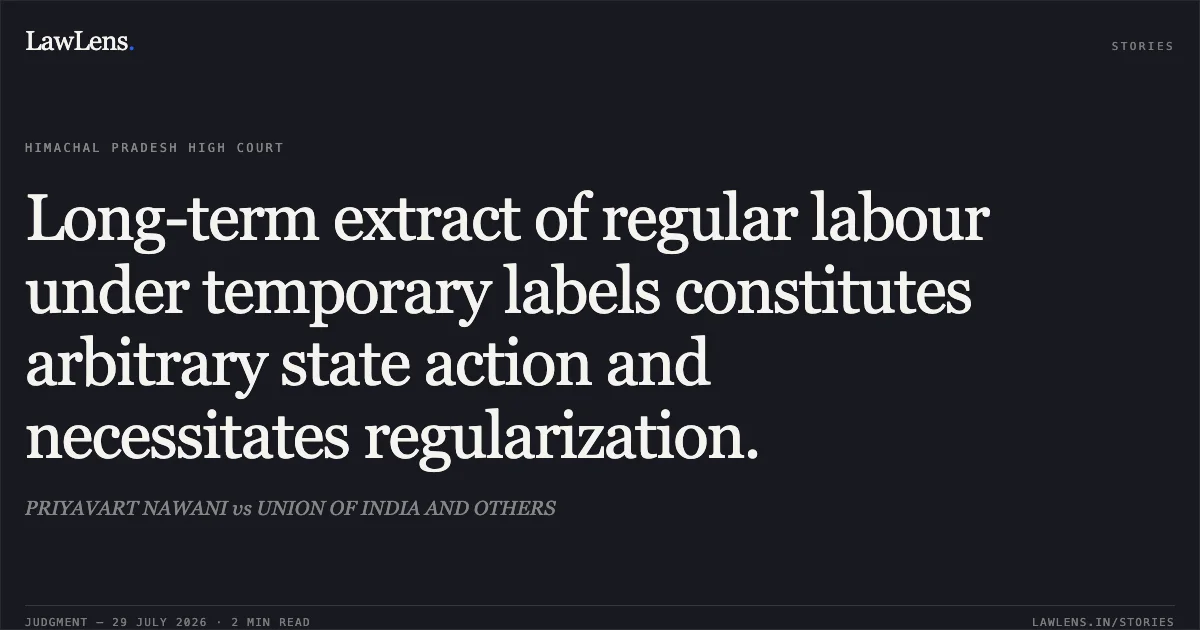
The Court answered the issues in the affirmative, holding that the termination was manifesty arbitrary and violative of Article 14.
The Court quashed the termination order dated September 20, 2022.
Source reference: para. 29It directed the respondents to reinstate the petitioner and ordered the regularization of his services prospectively from the date of the judgment with all consequential benefits.
Source reference: para. 29Original Court PDF
PRIYAVART NAWANIvsUNION OF INDIA AND OTHERS
Click to open original judgment
Original judgment, available to read, download and summarize on LawLens.in


![Subsequent exoneration does not retrospectively invalidate a finalized promotion select list.. UNNIKRISHNAN M vs M/o Environment And Forests. CAT - ['Ernakulam']. LawLens](/stories/thumbnails/subsequent-exoneration-does-not-retrospectively-invalidate-a-finalized-promotion-select-li-ce80a0e84f2f4887857271e8b4341c42.webp)