Facts
The Appellant (a 40-year-old Project Manager and divorcee) filed an acquittal appeal against the judgment of the Additional Sessions Judge, Raipur, which cleared the Respondent/accused of charges under Sections 376(2)(k)(n) and 377 of the IPC
Source reference: p. 1-2The Appellant alleged that the Respondent induced her into a physical relationship starting in July 2019 under a false promise of marriage
Source reference: p. 2Their relationship lasted over two years, including a period of cohabitation
Source reference: para. 9In late 2021, the Respondent refused marriage, citing family opposition and the Appellant’s health reports
Source reference: p. 3The Appellant further alleged a specific instance of unnatural intercourse on 28.11.2021
Source reference: p. 3Prior to the FIR, the parties attempted a monetary settlement before the Women’s Commission, which failed due to a dispute over the final amount
Source reference: para. 9The Trial Court acquitted the accused, finding the relationship to be consensual and the dispute to be financial in nature
Source reference: para. 4, 12Issues
1. Whether a long-drawn physical relationship between two consenting, educated adults can be characterized as rape if it ends in a refusal to marry
Source reference: para. 132. Whether the prosecution provided reliable medical or oral evidence to establish the charge of unnatural sexual intercourse under Section 377 of the IPC
Source reference: para. 4, 11Law Applied
The Court applied Section 376 (Rape) and Section 377 (Unnatural Offences) of the IPC
Source reference: p. 2It heavily relied on the precedent set by the Supreme Court in Ravish Singh Rana v. State of Uttarakhand, which establishes that if two able-minded adults reside together in a live-in relationship for a significant period, a presumption arises that they voluntarily chose the relationship aware of its consequences
Source reference: para. 13, 14The court also reaffirmed the principle that in acquittal appeals, the appellate court should not interfere unless the trial court's findings are perverse, illegal, or unreasonable, as the presumption of innocence is strengthened by acquittal
Source reference: para. 6Reasoning
The Court observed that the Appellant was a highly qualified adult (40 years old) who entered a "long-drawn" relationship lasting over two years
Source reference: para. 9, 12The Court noted that the initial physical encounter occurred in 2019, but the FIR was lodged only in 2022 after the breakdown of marriage talks and a failed monetary settlement
Source reference: para. 9The Appellant’s admission during cross-examination regarding a live-in arrangement and negotiations for a ₹30 Lakh settlement indicated a consensual relationship rather than one based on a "misconception of fact" regarding marriage
Source reference: para. 9, 12Regarding Section 377, the Court highlighted that the medical testimony of Dr. Vidya Shiv Kumar (PW/4) found no injuries or evidence to support allegations of forceful or unnatural sex
Source reference: para. 11Consequently, the Court found that the refusal to marry did not retroactively vitiate the voluntary consent given during the subsistence of the relationship
Source reference: para. 13Holding
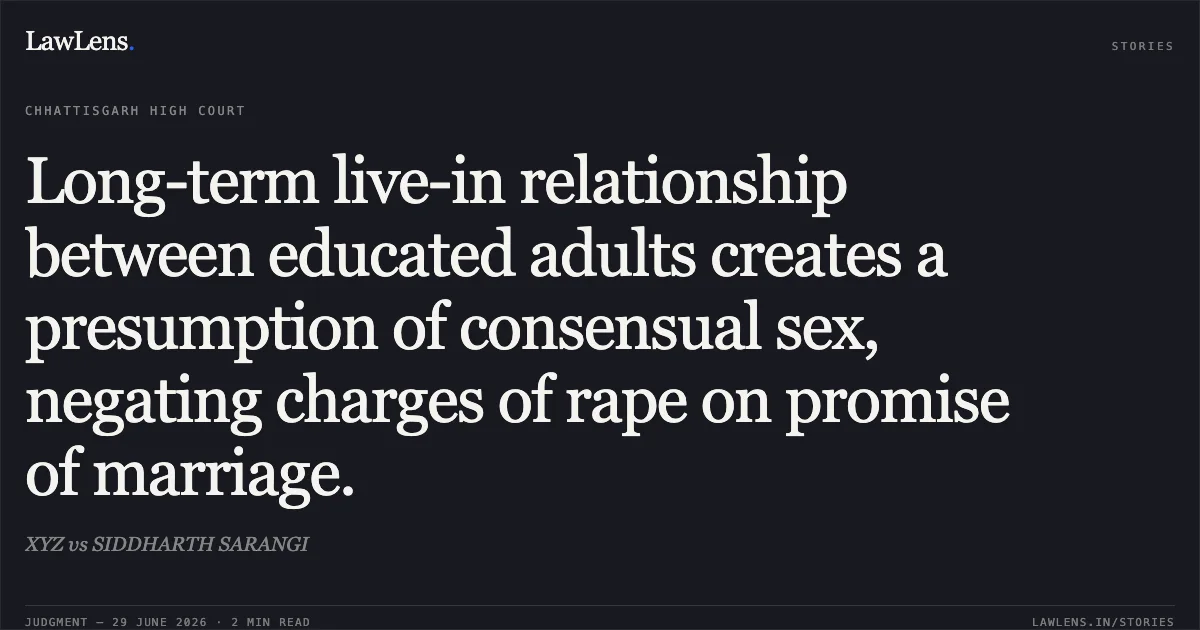
the Court held that when two financially independent and educated adults cohabit for years, the relationship is presumed to be based on valid consent, and a subsequent refusal to marry does not constitute rape
The High Court dismissed the appeal at the admission stage, affirming the Trial Court’s acquittal. The Court found no infirmity or perversity in the Trial Court’s judgment
Source reference: para. 14Acts & Sections Cited
2 provisions across 1 statute referred to in this judgment. Each provision opens on LawLens.
Indian Penal Code, 18602
Original Court PDF
XYZvsSIDDHARTH SARANGI
Click to open original judgment
Original judgment, available to read, download and summarize on LawLens.in


