Facts
The deceased, Meena Sahu, married Respondent No. 7 in 2008.
Source reference: para. 2On June 17, 2013, she committed suicide by hanging at her parental home.
Source reference: para. 2The prosecution alleged that the respondents (husband and in-laws) harassed her for dowry, leading to the registration of an FIR under Sections 306/34 and 304-B of the IPC.
Source reference: para. 2A suicide note and other handwritten notes were recovered but not verified by a handwriting expert.
Source reference: para. 4, 15The Trial Court acquitted the respondents on October 23, 2019, noting that the deceased had been living separately from her in-laws for three years prior to her death.
Source reference: para. 4, 11The appellant, the father of the deceased, challenged the acquittal via this appeal.
Source reference: para. 1Issues
1. Whether the respondents could be held liable for dowry death under Section 304-B of the IPC considering the deceased lived separately for three years.
Source reference: para. 112. Whether the acts of the respondents amounted to abetment of suicide under Section 306 of the IPC.
Source reference: para. 123. Whether unverified suicidal notes can form the basis of a conviction in the absence of expert testimony.
Source reference: para. 15Law Applied
The Court primarily applied Section 304-B of the IPC, which requires proof of harassment "soon before death" in connection with dowry demands.
Source reference: para. 11It further relied on Section 306 (Abetment of suicide) and Section 107 (Abetment) of the IPC, applying the principles from Mahendra Awase v. State of Madhya Pradesh (2025) 4 SCC 801, which establish that a conviction for abetment requires proof of an active role, instigation, or a continued course of conduct that leaves the deceased with no option but suicide.
Source reference: para. 12-13Reasoning
The Court observed that while there were allegations of money being demanded for a medical shop, no police reports were filed regarding dowry harassment during the deceased's lifetime.
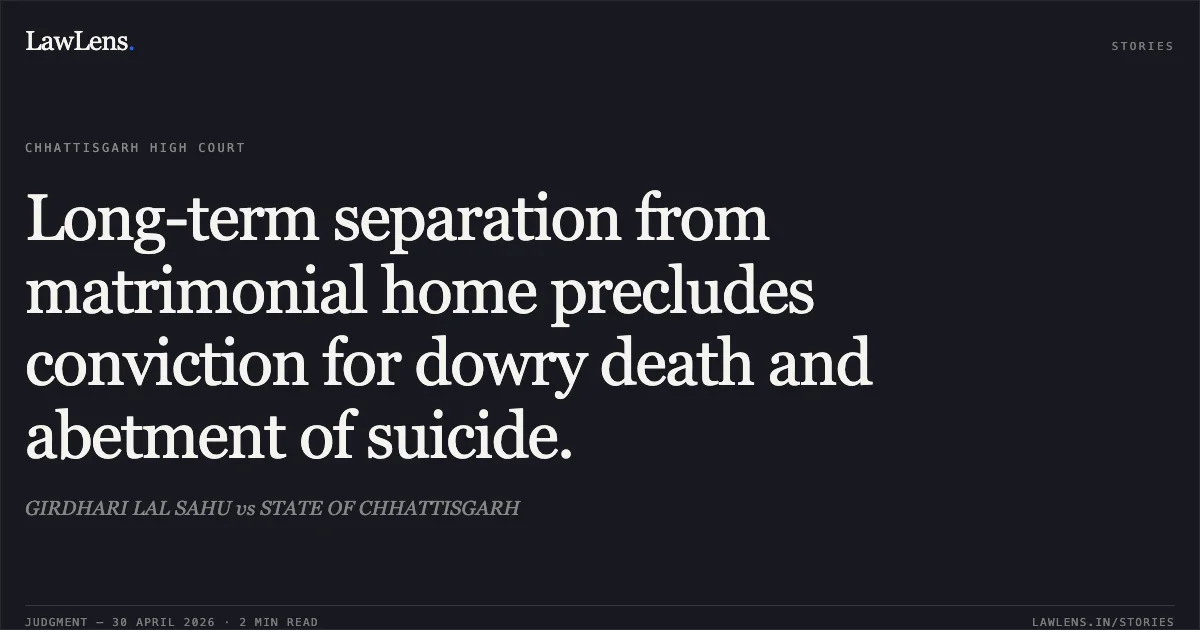
Source reference: para. 10-11Crucially, the deceased had been living at her parental home for approximately three years before the suicide, breaking the "soon before death" nexus required for Section 304-B.
Source reference: para. 11Regarding Section 306, the Court found no evidence of "instigation" or "active role" played by the respondents; separate living arrangements for three years negated the possibility of a continuous course of conduct compelling suicide.
Source reference: para. 11-14The Court further held that the alleged suicidal notes (Articles A and B) were rightly discarded by the Trial Court because the prosecution failed to examine a handwriting expert to prove their authenticity.
Source reference: para. 15Holding
The High Court affirmed the acquittal, holding that the prosecution failed to prove the ingredients of Sections 304-B and 306 IPC beyond a reasonable doubt. The court answered the issues in the negative, finding no evidence of harassment "soon before death" or "instigation".
The appeal was dismissed at the admission stage.
Source reference: para. 16Acts & Sections Cited
4 provisions across 2 statutes referred to in this judgment. Each provision opens on LawLens.
Code of Criminal Procedure, 19731
Indian Penal Code, 18603
Original Court PDF
GIRDHARI LAL SAHUvsSTATE OF CHHATTISGARH
Click to open original judgment
Original judgment, available to read, download and summarize on LawLens.in