Facts
The respondent was appointed as Lecturer in Political Science at Madhya Kamrup College pursuant to an advertisement dated 23 December 1992, and his service was approved by the Higher Education Department on 8 July 1994.
Source reference: p.3, paras. 4–5His appointment order provided that he would receive incremental benefits in the UGC Scale of Pay only upon obtaining an M.Phil. or Ph.D. within eight years, failing which his service would not continue; it also denied Senior Scale/Selection Grade benefits until fulfilment of the UGC scheme conditions.
Source reference: p.3, paras. 4–5The respondent did not challenge these conditions at the time, subsequently obtained an M.Phil. in 2008, and was granted the UGC Scale of Pay with effect from 1 April 2008.
Source reference: p.3, paras. 5–6In 2019, he claimed the UGC Scale retrospectively from his initial appointment date.
Source reference: p.3, para. 6After the authorities declined that relief, he filed WP(C) No. 3820/2023.
Source reference: p.3, para. 6The learned Single Judge allowed the writ petition and directed grant of the UGC Scale from 8 July 1994, holding the M.Phil./Ph.D.-linked conditions illegal and arbitrary.
Source reference: p.3, paras. 6–8The State appealed.
Source reference: no citationIssues
Whether possession of 55% marks in the Master’s degree, by itself, conferred an unconditional right to the UGC Scale of Pay from the date of appointment.
Source reference: pp. 5–6, paras. 15–20; p.8, para. 29Whether the conditions requiring acquisition of an M.Phil./Ph.D. for earning incremental benefits in the UGC Scale and obtaining Senior Scale/Selection Grade benefits were illegal, arbitrary, or inconsistent with the applicable UGC framework.
Source reference: pp. 6–8, paras. 19–26Whether the respondent could challenge those conditions after accepting them in 1994, continuing in service under them, and receiving the UGC Scale from 1 April 2008 after obtaining an M.Phil.
Source reference: p.10, para. 35Whether differential treatment of other lecturers who were allegedly not subjected to similar conditions entitled the respondent to relief under Article 14 of the Constitution.
Source reference: pp. 9–10, paras. 30–32Law Applied
The Court applied the UGC Notification dated 19 September 1991, which prescribed, for appointment as Lecturer, a good academic record with at least 55% marks at the Master’s degree level and clearance of the UGC/CSIR or equivalent UGC-accredited eligibility test.
Source reference: p.5, paras. 15–17It distinguished qualifications for initial appointment from conditions regulating accrual of pay, increments, and promotional financial benefits.
Source reference: pp. 6–7, paras. 19–22The Court relied on the departmental communication dated 2 November 1982, recording that UGC-approved conditions required non-M.Phil. appointees to obtain an M.Phil. or equivalent higher qualification within eight years for earning future increments.
Source reference: p.7, paras. 24–26It further applied the principles that Article 14 does not require the State to extend an otherwise legally unsustainable benefit merely because another employee may have received it, and that accepted appointment conditions may be relevant when their validity is challenged after prolonged acquiescence.
Source reference: pp. 9–11, paras. 31–35The Court considered, but distinguished, Kalyani Mathivanan v. K.V. Jeyaraj, AIR 2015 SC 1875, and P.J. Dharmaraj v. Church of South India, 2024 INSC 938, holding that neither decision invalidated an accepted condition governing financial benefits merely because it was not a minimum qualification for initial appointment.
Source reference: pp. 10–11, paras. 33–34Reasoning
The Court held that the respondent’s reliance on the 55% Master’s-degree requirement was incomplete because the 1991 UGC framework also required clearance of an eligibility test, which he admittedly lacked.
Source reference: pp. 5, 8–9, paras. 15–18, 28–29Although the Court did not invalidate his appointment on that ground, it held that possession of 55% marks did not create an unconditional entitlement to every benefit under the UGC Scale.
Source reference: p.8, para. 29The M.Phil./Ph.D. requirement did not operate as a bar to initial appointment; rather, it regulated the subsequent accrual of increments and higher pay benefits.
Source reference: no citationThe contemporaneous 1982 communication demonstrated that such a condition was recognised within the UGC pay framework and approved by the State Government.
Source reference: pp. 6–8, paras. 20–26The respondent had accepted the condition, remained in service under it, obtained an M.Phil., and accepted the UGC Scale from 1 April 2008.
Source reference: p.10, para. 35His belated challenge in 2019 therefore did not establish arbitrariness.
Source reference: p.10, para. 35The alleged treatment of other lecturers could not independently invalidate the condition, particularly without proof that their benefits were legally valid and that the cases were identical in all material respects.
Source reference: pp. 9–10, paras. 30–32Holding
The Division Bench allowed the intra-court appeal and set aside the learned Single Judge’s judgment dated 23 October 2025.
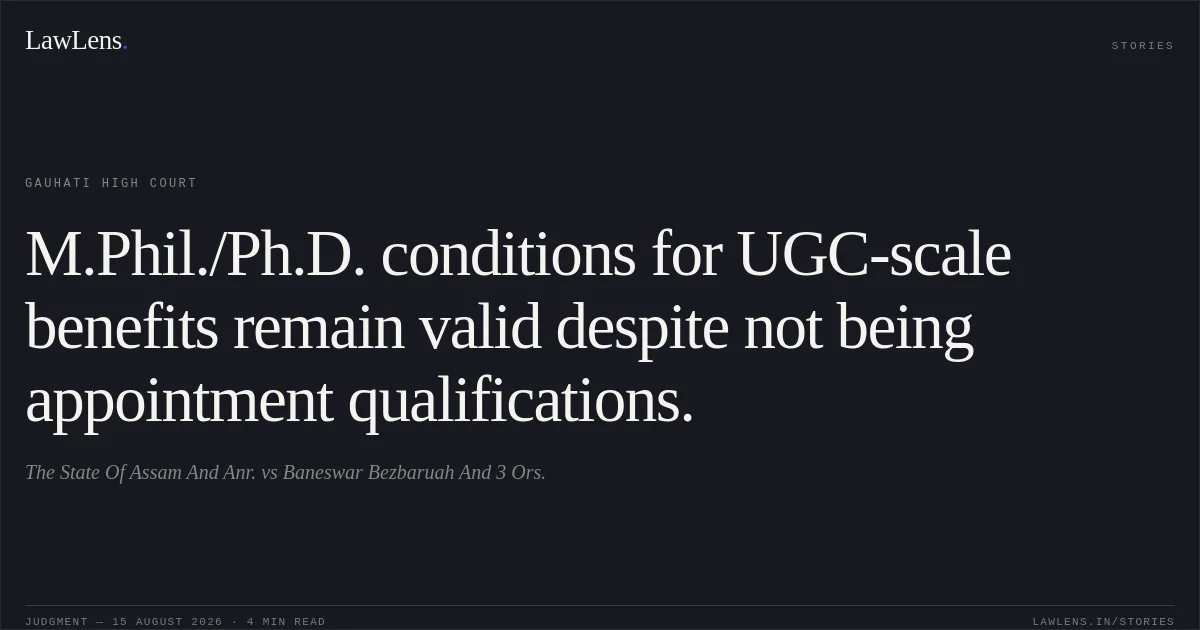
It held that 55% marks in the Master’s degree did not, by itself, confer an unconditional right to the UGC Scale from 8 July 1994, and that the M.Phil./Ph.D.-linked conditions governing increments and higher-scale benefits were not shown to be illegal or arbitrary.
Source reference: pp. 11–12, paras. 37–38Consequently, WP(C) No. 3820/2023 was dismissed.
Source reference: p.12, paras. 38–39There was no order as to costs.
Source reference: p.12, paras. 38–39Original Court PDF
The State Of Assam And Anr.vsBaneswar Bezbaruah And 3 Ors.
Click to open original judgment
Original judgment, available to read, download and summarize on LawLens.in