Facts
The petitioners were distilleries and bottling units manufacturing and supplying country liquor in Madhya Pradesh under licences and tenders issued by the State Excise Department.
Source reference: para. 3A CAG audit report concerning the State’s tender process for 2012–13 to 2016–17 observed that the same distilleries repeatedly emerged as successful L-1 bidders with narrow price variations, allegedly indicating bid-rigging or market allocation.
Source reference: para. 4Relying on an untabled copy of the report, the Competition Commission of India (“CCI”) registered Suo Motu Case No. 05/2020 and, by order dated 4 August 2020 under Section 26(1) of the Competition Act, 2002, directed the Director General (“DG”) to investigate alleged bid-rigging and horizontal market-sharing under Section 3(3) read with Section 3(1).
Source reference: para. 5The DG investigated the petitioners, examined State officials, and conducted search-and-seizure operations at the distilleries.
Source reference: para. 6It submitted a voluminous investigation report on 31 March 2023, which was divided into confidential and non-confidential versions, although the report recorded that the opposite parties had not claimed confidentiality over their submissions.
Source reference: para. 7The CCI circulated only the redacted version and invited objections and suggestions.
Source reference: para. 8By order dated 20 March 2024, the CCI rejected the petitioners’ preliminary objections concerning jurisdiction, the CAG report, the State’s regulatory authority, and the redactions, and decided to proceed under Section 26(8).
Source reference: para. 9The petitioners then invoked Article 226 of the Constitution seeking quashing of the Section 26(1) order, the investigation report, and the consequential CCI orders.
Source reference: para. 2Issues
Whether the CCI had jurisdiction under the Competition Act, 2002 to investigate alleged cartelisation, bid-rigging, and market allocation in the State-regulated country-liquor tender process, notwithstanding the State’s exclusive powers under Entries 8 and 51 of List II and the Madhya Pradesh Excise Act, 1915?
Source reference: paras. 10–15, 34–41Whether the CCI could initiate proceedings under Sections 19 and 26 of the Competition Act on the basis of an untabled CAG report?
Source reference: paras. 14, 22, 40Whether the Section 26(1) order was invalid for failure to record adequate reasons or for being based merely on the CAG report?
Source reference: paras. 17, 25, 42, 45Whether the existence of the State Excise Department and the statutory tender framework excluded or postponed the CCI’s jurisdiction, requiring a reference or consultation under Sections 21 or 21A of the Competition Act?
Source reference: paras. 15, 24, 39–41Whether the DG’s redaction of the investigation report, and the CCI’s reliance on a non-confidential version, violated natural justice and the petitioners’ right to an effective defence?
Source reference: paras. 18, 26, 33Whether the writ petitions were maintainable when the CCI proceedings were at an interlocutory/investigative stage and an efficacious statutory appeal was available under Section 53B of the Competition Act?
Source reference: paras. 25, 46Law Applied
The Court applied Entries 8 and 51 of List II and the Madhya Pradesh Excise Act, 1915, which confer on the State extensive control over intoxicating liquor, including its manufacture, possession, transport, sale, licensing, and regulation.
Source reference: paras. 34–35However, it distinguished such excise regulation from the Competition Act, 2002, whose object is to eliminate anti-competitive practices, promote competition, protect consumers, and ensure freedom of trade.
Source reference: paras. 35–38Sections 3, 19, 26 and 27 of the Competition Act empower the CCI to examine anti-competitive agreements and to act on its own motion or on information received, including information derived from a CAG report.
Source reference: paras. 36, 40Relying on Competition Commission of India v. Bharti Airtel Ltd., (2019) 2 SCC 521, the Court held that a sectoral regulator’s jurisdiction does not exclude the CCI’s specialised jurisdiction over anti-competitive conduct; the statutory “comity” between regulators must be maintained.
Source reference: paras. 39–41Under CCI v. Steel Authority of India Ltd., (2010) 10 SCC 744, a Section 26(1) order is administrative and preliminary, though it must disclose a prima facie opinion supported by minimum reasons; it is not a final adjudication of rights or liability.
Source reference: paras. 42, 45The Court also relied on Arun Kumar Agrawal v. Union of India, (2013) 7 SCC 1, holding that a CAG report need not be treated as conclusive evidence and may serve as information prompting an investigation.
Source reference: para. 40The availability of an efficacious statutory appellate remedy and the rule against interference with ongoing statutory proceedings weighed against exercise of writ jurisdiction.
Source reference: para. 46Reasoning
The Court held that the State’s excise powers and the CCI’s competition jurisdiction operated in distinct fields. The Excise Department regulated licensing, manufacture, sale, pricing, and distribution of liquor, whereas the CCI was examining whether private distilleries had entered into anti-competitive agreements involving bid-rigging and market allocation.
Source reference: paras. 34–39The Court therefore rejected the argument that the State’s exclusive legislative competence over intoxicating liquor ousted the CCI’s jurisdiction.
Source reference: paras. 34–39It further held that the CAG report was not treated as a final finding of guilt but merely as information triggering a lawful investigation under Sections 19 and 26; the DG had subsequently collected independent material, including corporate records, electronic communications, and alleged evidence of cover bidding and district-wise allocation.
Source reference: paras. 22–23, 40The reliance on Bharti Airtel did not assist the petitioners because, unlike the telecom context involving an active specialist dispute-resolution regulator, the Madhya Pradesh excise framework contained no independent authority specifically empowered to determine anti-competitive practices.
Source reference: para. 39The Section 26(1) order was preliminary and administrative, and the Court declined to examine the merits of the alleged cartel at the investigation stage.
Source reference: paras. 42, 45The petitioners had also participated in the CCI proceedings, sought extensions and cross-examination, and approached the High Court only after the investigation report was circulated and the CCI commenced further proceedings.
Source reference: para. 46In these circumstances, the Court considered the writ petitions premature and held that the petitioners should pursue their objections before the CCI and, if adversely affected by a final order, avail themselves of the statutory appeal.
Source reference: paras. 25, 46Holding
The High Court dismissed all the writ petitions.
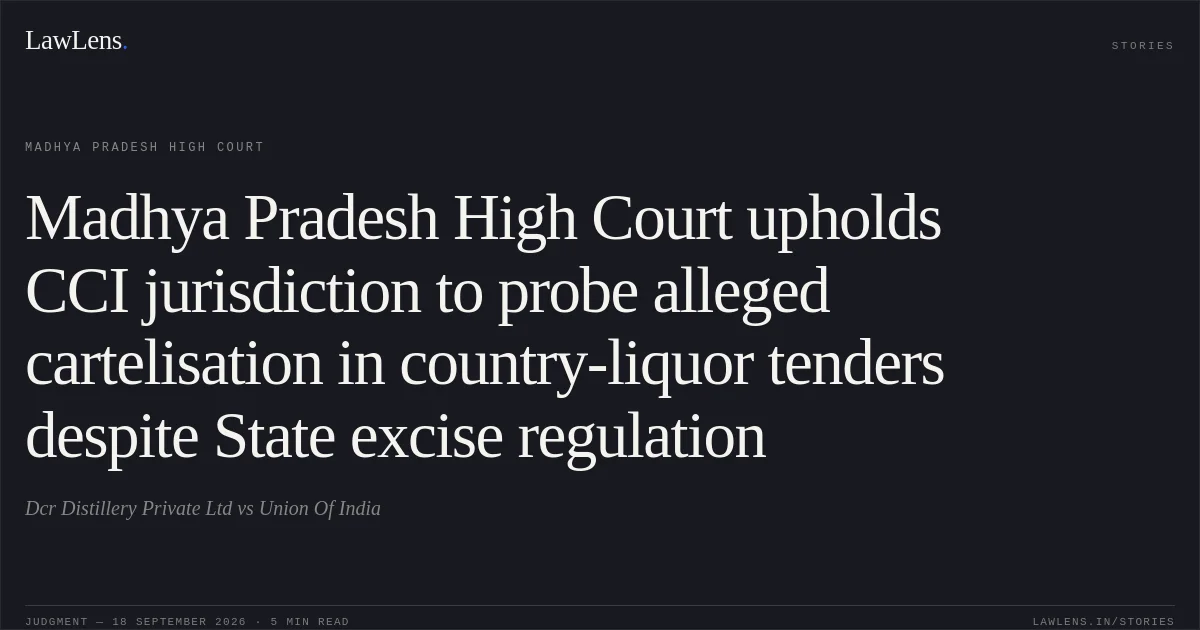
It upheld the CCI’s authority to investigate alleged bid-rigging, cartelisation, and market allocation in the State-regulated liquor tender process, holding that the Competition Act did not encroach upon the State’s excise powers.
Source reference: paras. 37–41The Court also declined to invalidate the proceedings on the basis of the untabled CAG report, the alleged insufficiency of reasons in the Section 26(1) order, or the pending investigation and redaction objections.
Source reference: paras. 40, 42, 46The interim protection earlier granted was vacated, and the CCI was directed to complete the inquiry under Section 26 and pass an appropriate final order under Section 27 of the Competition Act, 2002.
Source reference: para. 47Acts & Sections Cited
23 provisions across 2 statutes referred to in this judgment. Each provision opens on LawLens.
Competition Act, 2002
Companies Act, 20131
Original Court PDF
Dcr Distillery Private LtdvsUnion Of India
Click to open original judgment
Original judgment, available to read, download and summarize on LawLens.in