01Facts
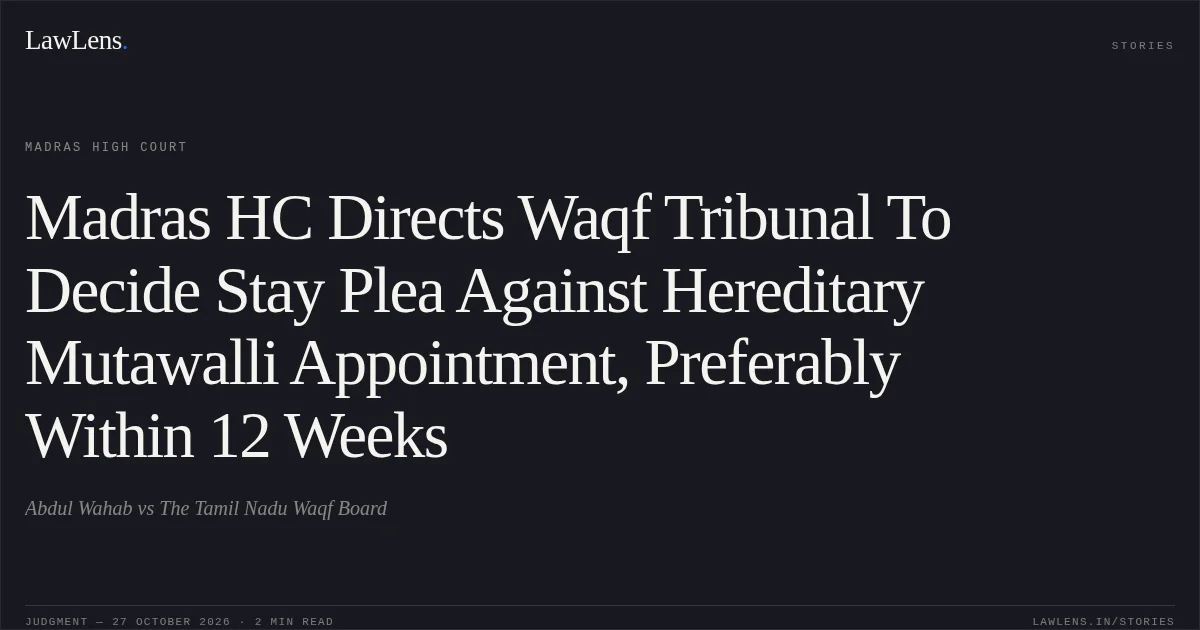
The appellant, claiming to be the elected Mutawalli/Administrator of the Nawab Abdul Nabi Khan Mosque Waqf, challenged a Waqf Board resolution appointing the third respondent as hereditary Mutawalli and constituting a seven-member committee.
pp. 2–5 · ¶ 3–4After his writ petition was dismissed, he filed an original application before the Waqf Tribunal and sought an interim stay of the Board’s resolution and consequential order.
pp. 2–5 · ¶ 3–4The Tribunal issued notice on the interim application; the appellant appealed that docket order under Section 83(9) of the Waqf Act, 1995.
pp. 2–5 · ¶ 3–4At the hearing, he chose to pursue the interim application before the Tribunal and asked the High Court to fix a disposal timeframe.
p. 5 · ¶ 5–602Issues
i.1. Whether the High Court should determine the merits of the appeal against the Tribunal’s order issuing notice on the interim application, when the appellant opted to pursue that application before the Tribunal.
p. 5 · ¶ 5–7ii.2. Whether the Tribunal should be directed to dispose of the interim application within a specified timeframe.
p. 5 · ¶ 6–703Law Applied
The appeal was brought under Section 83(9) of the Waqf Act, 1995, and the underlying original application was filed under Section 83(2) of that Act, read with Order VII Rule 1 of the Code of Civil Procedure.
p. 2 · p. 3 · ¶ 4The judgment cited no precedent and did not determine any substantive rule governing the appellant’s entitlement to interim relief.
p. 5 · ¶ 7–9Provisions in the judgment · 1
Waqf (Amendment) Act, 2025 Section 83
04Reasoning
The appeal concerned the Tribunal’s decision to issue notice on the appellant’s stay application.
p. 5 · ¶ 5–9The High Court cautioned that hearing the appeal on its merits could prejudice the appellant’s rights before the Tribunal.
p. 5 · ¶ 5–9The appellant therefore elected to proceed before the Tribunal and sought an expedited hearing; the respondents also undertook to cooperate.
p. 5 · ¶ 5–9In those circumstances, the Court considered it unnecessary to decide the merits and instead directed the Tribunal to hear the application expeditiously.
p. 5 · ¶ 5–905Holding
The Court did not decide the merits of the challenge to the Board’s resolution or the appellant’s request for an interim stay.
pp. 5–6 · ¶ 9–10It directed the Waqf Tribunal to dispose of IA No. 452 of 2026 in OA No. 122 of 2026 as expeditiously as possible, preferably within twelve weeks of receiving a copy of the judgment.
pp. 5–6 · ¶ 9–10The appeal was disposed of at the admission stage without costs, and the connected miscellaneous petition was closed.
pp. 5–6 · ¶ 9–10Original Court PDF
Abdul WahabvsThe Tamil Nadu Waqf Board
Click to open original judgment
Original judgment, available to read, download and summarize on LawLens.in