01Facts
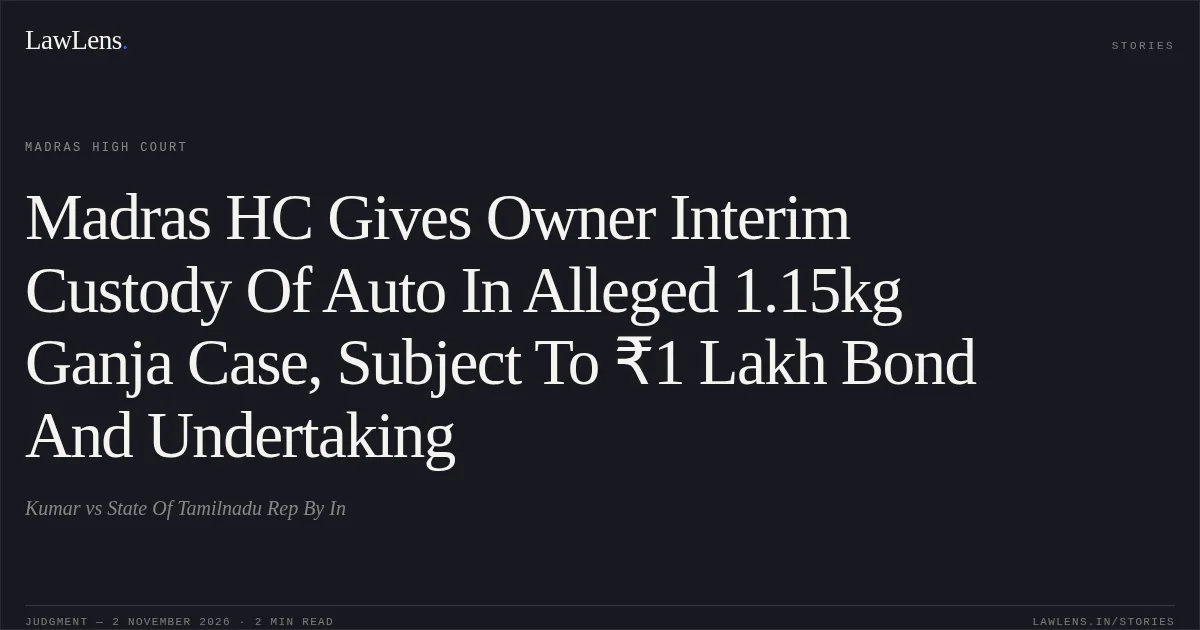
The petitioner claimed ownership of an APE Auto D3S passengers vehicle seized in connection with a case under Sections 8(c) read with 20(b)(ii)(B), 25 and 29(i) of the NDPS Act, involving 1.150 kg of ganja.
pp. 2–4He sought interim custody under Sections 497 and 503 BNSS, asserting that he was not an accused and that the vehicle would deteriorate in police custody.
pp. 2–4The prosecution opposed release, citing the pending investigation and the risk of the vehicle being used again or sold.
pp. 2–4The Special Court dismissed the application because the vehicle had allegedly been used to smuggle ganja and the investigation was pending.
pp. 2–4The owner challenged that order in revision.
pp. 2–402Issues
i.Whether the petitioner was entitled to interim custody of the seized vehicle and reversal of the Special Court’s dismissal order
pp. 5–6, 9–1103Law Applied
Sections 497 and 498 BNSS address custody and disposal of property produced before a criminal court during proceedings and at their conclusion, respectively; Section 503 concerns property seized by police but not produced before a criminal court.
pp. 6–9Under Sunderbhai Ambalal Desai v. State of Gujarat, seized vehicles should not be kept at police stations for long periods, and interim release may be secured by appropriate bonds, guarantees or security.
p. 10The Court also relied on Selvam v. State by Inspector of Police, which supports considering vehicle-return applications on their merits, and R. Manimaran v. State of Tamil Nadu, which recognises that the analogous BNSS provisions may be invoked in NDPS cases to prevent vehicles from deteriorating in custody.
pp. 10–11Provisions in the judgment · 11 · Linked ones open on LawLens
Bharatiya Nagarik Suraksha Sanhita, 2023 Section 438Section 442Section 497Section 503
Narcotic Drugs and Psychotropic Substances Act, 1985 Section 8Section 20Section 25Section 29
Code of Criminal Procedure, 1973 Section 451Section 452Section 457
04Reasoning
The Special Court’s reasons—that the vehicle was allegedly used in the offence and that investigation remained pending—did not, by themselves, justify retaining it in custody.
pp. 9–12Applying the cited authorities, the High Court held that vehicle-release applications should be considered judicially and expeditiously, including in NDPS cases, because prolonged custody risks deterioration.
pp. 9–12It also noted that no confiscation proceedings had been reported against the vehicle.
pp. 9–12Interim release could therefore be granted subject to safeguards ensuring the vehicle’s preservation and production when required.
pp. 9–1205Holding
The High Court allowed the revision, reversed the Special Court’s order dated 24 August 2026, and allowed the interim-custody application.
p. 12Release was conditioned on the petitioner executing a bond of ₹1,00,000 with two sureties for the like sum, filing photographs of all four sides of the vehicle with the original registration certificate, and furnishing an affidavit undertaking to produce the vehicle as and when directed.
pp. 12–13The Special Court was directed to hand over the vehicle only after compliance with these conditions.
pp. 12–13Original Court PDF
KumarvsState Of Tamilnadu Rep By In
Click to open original judgment
Original judgment, available to read, download and summarize on LawLens.in