01Facts
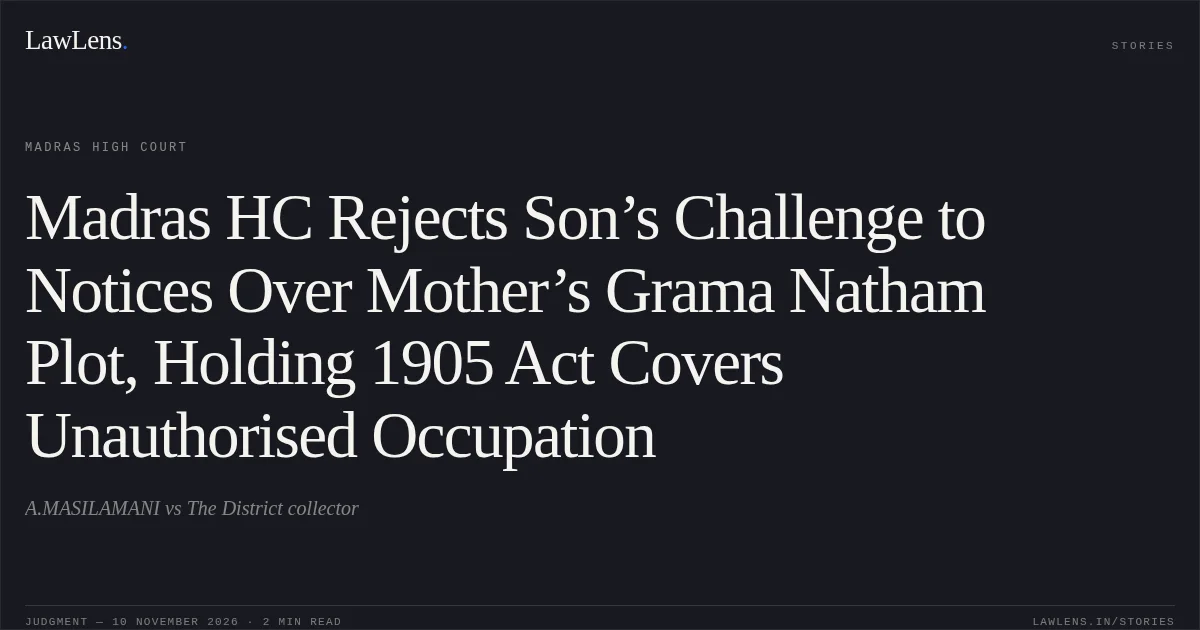
The petitioner challenged a show-cause notice issued under Section 7 and a notice issued under Section 6 of the Tamil Nadu Land Encroachment Act, 1905, concerning Grama Natham land.
p. 2 · p. 4He claimed that his mother had been assigned the land and that, after her death, he had applied for transfer of patta as her legal heir.
pp. 2–3He argued that Grama Natham land did not vest in the Government and that the authorities therefore lacked jurisdiction under the Act.
pp. 2–3The State maintained that the assignment was conditional, that the conditions had been violated, and that the petitioner’s remedy was a statutory appeal under Section 10.
pp. 3–4The petitioner had not filed that appeal.
p. 1202Issues
i.Whether the authorities could invoke the Tamil Nadu Land Encroachment Act, 1905, in respect of the disputed Grama Natham land.
pp. 5–6 · p. 13ii.Whether the writ petition challenging the notices was maintainable when the petitioner had not pursued the statutory appeal under Section 10 of the Act.
p. 1203Law Applied
The Court applied Sections 6, 7 and 10 of the Tamil Nadu Land Encroachment Act, 1905, concerning eviction proceedings and the statutory appeal remedy.
p. 2 · pp. 12–13It relied on Revenue Standing Orders 21(1) and 26(1), treating grants of Grama Natham land as subject to assignment conditions and unauthorised occupation of Government land as actionable under the Act.
pp. 9–12The Court also relied on the Full Bench decisions in Madathapu Ramaya v. Secretary of State for India in Council and Taluk Board, Dindigul v. Venkatarama Ayyar, as well as Selvakumar v. Additional Chief Secretary to Government, for the proposition that the Government could regulate Grama Natham land.
p. 8It further referred to S. Anbananthan v. District Collector, Perambalur and other decisions on occupation of such land.
pp. 5–8Provisions in the judgment · 5 · Linked ones open on LawLens
Tamil Nadu Land Encroachment Act, 1905 Section 2Section 6Section 7Section 10Section 16
04Reasoning
The Court considered the petitioner’s claimed status as the legal heir of the original assignee but held that a conditional Government assignment did not become hereditary property; the authorities could examine the heirs’ eligibility and compliance with the assignment conditions.
pp. 4–5 · p. 13It rejected the jurisdictional challenge, reasoning from the Revenue Standing Orders and the cited precedents that Grama Natham land could be regulated by the Government and unauthorised occupation addressed under the 1905 Act.
pp. 8–12The Court also noted that the petitioner had not used the statutory appeal under Section 10, which it regarded as the appropriate remedy against the authority’s decision.
p. 1205Holding
The Court held that the challenge to the Section 6 and Section 7 notices was not entertainable and dismissed the writ petition.
p. 13It made no order as to costs and closed the connected miscellaneous petition.
p. 13Original Court PDF
A.MASILAMANIvsThe District collector
Click to open original judgment
Original judgment, available to read, download and summarize on LawLens.in