01Facts
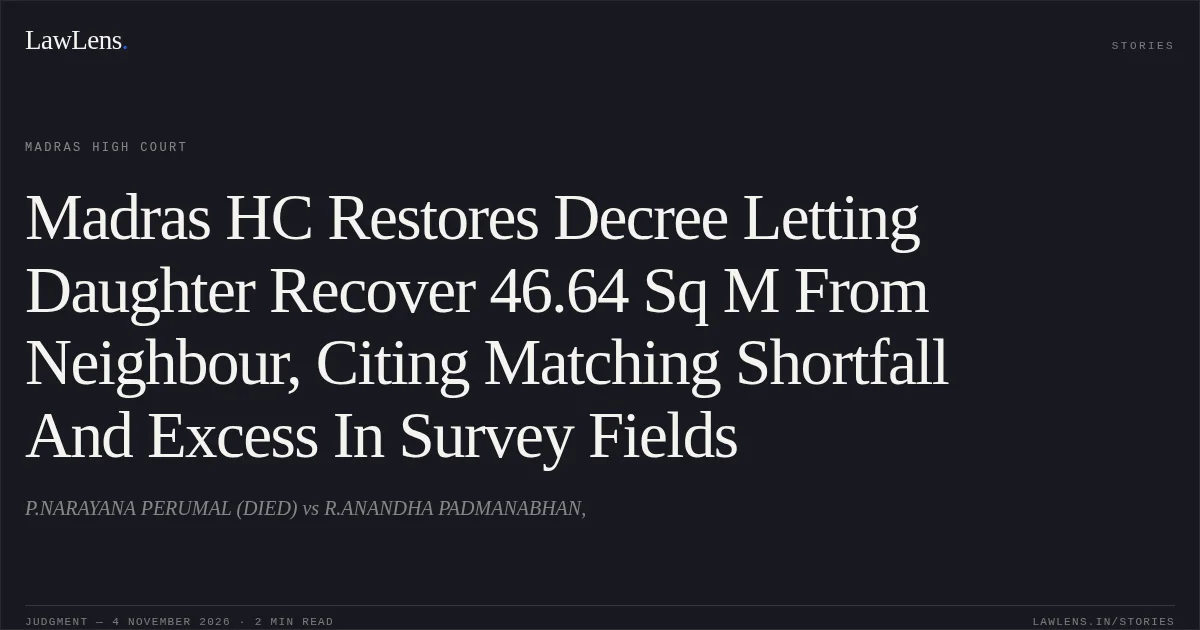
The plaintiffs claimed title to 2½ cents in Survey Nos. 788/1 and 788/2 under registered sale deeds, with the first plaintiff later settling the property on the second plaintiff.
pp. 2–3, 6They alleged that the defendant, whose adjoining property lay to the east, encroached on 46.64 square metres and sought declaration, recovery of possession, mandatory injunction and permanent injunction.
pp. 2–3, 6The trial court decreed the suit, but the first appellate court reversed that decree.
p. 4In the second appeal, the High Court considered the Commissioner’s measurements, which showed a deficiency in the plaintiffs’ survey fields and a corresponding excess in the defendant’s Survey No. 788/3.
pp. 7–802Issues
i.1. Whether the defendant could claim entitlement to the disputed land on the basis of the Field Measurement Book or resurvey measurements.
p. 4 · pp. 8–9ii.2. Whether the defendant’s failure to produce the correlation report or examine revenue officials undermined his case.
p. 4 · p. 8iii.3. Whether Exs. A1 and A2 could be presumed genuine under Section 90 of the Evidence Act, and whether the first appellate court failed to consider the plaintiffs’ patta and kist receipts.
p. 4 · pp. 8–9iv.4. Whether the evidence, including the Commissioner’s report and plan, established the plaintiffs’ title and entitlement to recover the disputed portion.
p. 4 · pp. 7–10v.5. Whether the defendant proved possession or lawful entitlement to the disputed portion.
p. 4 · pp. 9–1003Law Applied
Under Section 100 of the Code of Civil Procedure, a second appeal concerns substantial questions of law.
p. 4Section 90 of the Indian Evidence Act, 1872 permits a court, where the statutory conditions are satisfied—including that a document is at least 30 years old and comes from proper custody—to presume its execution and attestation.
p. 9A Field Measurement Book or resurvey record may assist in identifying boundaries and measurements, but does not itself confer title or enlarge the ownership conveyed by registered documents.
p. 8Revenue records do not independently establish title, though they may corroborate possession and enjoyment.
p. 9Provisions in the judgment · 1 · Linked ones open on LawLens
Code of Civil Procedure, 1908 Section 100
04Reasoning
The Commissioner’s plan and measurements showed that the plaintiffs’ survey fields contained 1.265 cents against 2.453 cents identified under their title deeds, while Survey No. 788/3 contained 3.696 cents against the defendant’s deed-based extent of 2.500 cents; the corresponding shortfall and excess supported the plaintiffs’ encroachment claim.
pp. 7–8The defendant’s reliance on resurvey measurements could not establish title to the excess, and he produced neither the correlation report nor evidence from a competent revenue official explaining the resurvey.
p. 8The court also treated the patta and kist receipts as corroborative evidence and found no convincing proof that the plaintiffs’ missing extent had been lost to road formation.
pp. 9–10Considered together with the registered deeds and the Commissioner’s identification of the disputed area, the evidence established the plaintiffs’ claim; the first appellate court had failed to assess that material properly.
pp. 9–1005Holding
The High Court answered the substantial questions in favour of the plaintiffs, holding that they established title and entitlement to the reliefs claimed.
pp. 9–10It allowed the second appeal, set aside the first appellate court’s judgment and decree, and restored the trial court’s decree; there was no order as to costs, and the connected miscellaneous petition was closed.
p. 11Original Court PDF
P.NARAYANA PERUMAL (DIED)vsR.ANANDHA PADMANABHAN,
Click to open original judgment
Original judgment, available to read, download and summarize on LawLens.in