01Facts
The petitioner was arrayed as A1 in Crime No. 284 of 2025 for offences under Sections 8(c) r/w 22(c) and 29(1) of the NDPS Act, 1985.
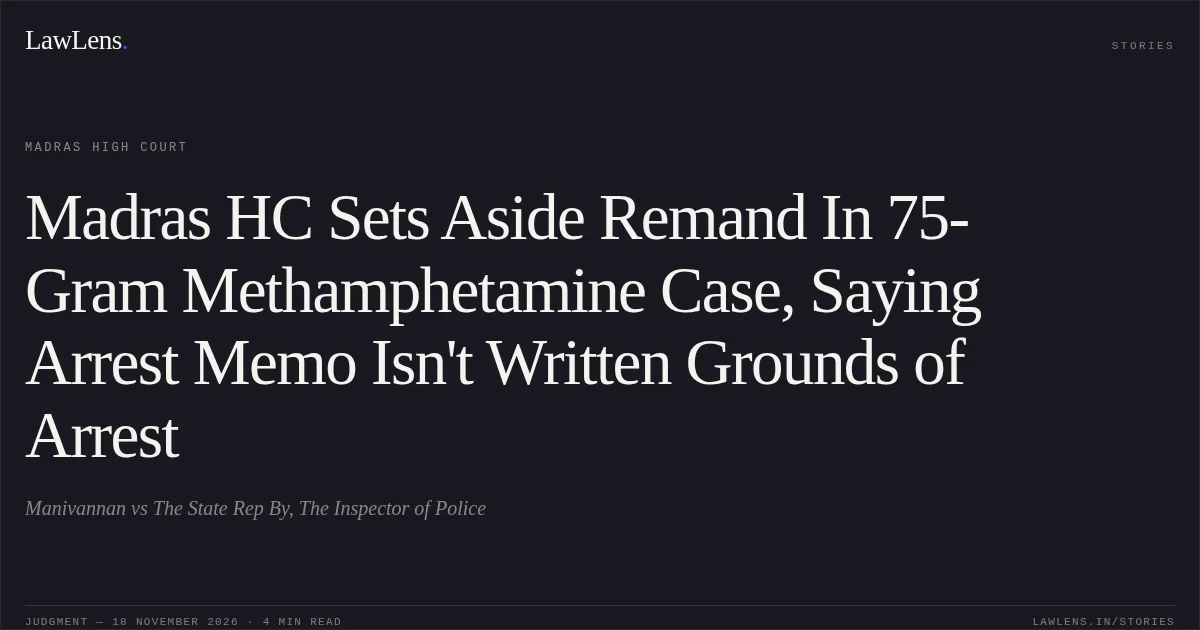
p. 2The prosecution alleges possession of 56 g of methamphetamine, LSD stamps and 4 g of MDMA tablets, a commercial quantity.
p. 2All accused were arrested and remanded to judicial custody by the Munsif-cum-Judicial Magistrate, Gummidipoondi, by order dated 14.12.2025.
p. 2The petitioner's bail applications were dismissed, after which he filed this petition under Section 528 BNSS to set aside the remand order.
p. 1 · p. 4The sole ground was that the specific grounds of arrest were not furnished to him in writing, in violation of Article 22(1) of the Constitution and Section 47(1) BNSS.
p. 2 · p. 6The petitioner was served an arrest memo stating he was arrested for illegal possession of contraband, and the arrest was communicated to his relatives.
p. 6The arrest memo was a template containing a statement that the grounds of arrest were explained orally before arrest.
p. 10, para 11The State contended that the petitioner was apprehended in conscious possession, was orally informed of the reasons for arrest, and had suffered no prejudice; it also argued the challenge was raised belatedly.
pp. 4–602Issues
i.1. Whether the failure to furnish the grounds of arrest in writing, as distinct from the reasons for arrest and the arrest memo, violates Article 22(1) of the Constitution and Section 47(1) BNSS, thereby vitiating the arrest and the consequent remand order.
p. 2, para 2 · p. 6, para 6 · pp. 8–9, paras 9–10ii.2. Whether an oral explanation of the grounds of arrest, recorded as a template statement in the arrest memo, satisfies the constitutional mandate.
p. 9, para 11iii.3. Whether the petitioner must demonstrate prejudice before the arrest and remand can be impugned for non-compliance. (Raised by the State; not expressly decided by the Court.)
pp. 5–6, paras 4.3–4.403Law Applied
The Court relied on Article 22(1) of the Constitution and Section 47(1) BNSS, which require that grounds of arrest be communicated to the arrestee.
p. 3, para 3.1 · p. 8, para 10The Court applied Prabir Purkayastha v. State (NCT of Delhi), 2024 INSC 414, holding that failure to furnish written grounds vitiates the arrest and consequent remand.
p. 3 · p. 8, para 10The Court followed Vihaan Kumar v. State of Haryana, 2025 INSC 162, that serving the arrest memo or communicating the fact of arrest does not satisfy Article 22(1).
pp. 8–9, para 10The Court followed Mihir Rajesh Shah v. State of Maharashtra, 2025 INSC 1288, that grounds must be communicated in writing in a language the arrestee understands, failing which the arrest and remand are illegal.
p. 9, para 10The Court drew the distinction that "reasons for arrest" are generic and "grounds of arrest" are specific facts personal to the accused.
pp. 6–7, paras 7–8The State's authorities, Karan Singh v. State (NCT of Delhi) (Del. HC, 2026) and State of Karnataka v. Sri Darshan, 2025 SCC OnLine SC 1702 (prejudice-oriented test), were noted but not applied.
pp. 4–5, para 4.2 · p. 5, para 4.3The Court relied on P.K. Shaji v. State of Kerala for bail-condition enforcement.
p. 10Provisions in the judgment · 6 · Linked ones open on LawLens
Bharatiya Nagarik Suraksha Sanhita, 2023 Section 528Section 47
Narcotic Drugs and Psychotropic Substances Act, 1985 Section 8Section 22Section 29
Code of Criminal Procedure, 1973 Section 50
04Reasoning
The Court held that the arrest memo's stated reason, illegal possession of contraband, is a generic reason, not the factual grounds necessitating arrest.
pp. 6–7, paras 6–7Serving the arrest memo and conveying the fact of arrest are procedural steps and cannot be equated with furnishing grounds.
pp. 7–8, para 9The petitioner received only the arrest memos, so the constitutional requirement was not met.
p. 8, para 10The template recital that grounds were explained orally did not cure the defect, because oral explanation cannot establish compliance with the written-communication requirement laid down by the Supreme Court and the High Court.
p. 9, para 11Because the arrest was defective, the consequential remand could not stand.
p. 9, para 11The Court did not address the State's prejudice and delay arguments, and rested its decision on the non-furnishing of written grounds alone.
pp. 9–10, paras 11–1205Holding
The Court answered Issues 1 and 2 in the affirmative. Non-furnishing of written grounds of arrest violates Article 22(1) and vitiates the arrest and remand, and an oral recital in a template arrest memo is insufficient.
pp. 9, paras 11–12The remand order dated 14.12.2025 in Crime No. 284 of 2025 is set aside.
pp. 9–10, para 12The petitioner is to be released on bail on depositing Rs.25,000 as a non-refundable deposit with the Tamil Nadu Mediation and Conciliation Centre, and executing a bond of Rs.25,000 with two sureties (one a blood relative) to the satisfaction of the Additional District Judge, Special Court under the EC and NDPS Act, Chennai. Conditions include daily reporting to the police at 10:30 a.m., non-absconding, and non-tampering with evidence or witnesses.
p. 10, para 12 · pp. 10–11, para 12The petition is allowed.
p. 11, para 13Original Court PDF
SanthoshvsThe State Rep By, The Inspector of Police
Click to open original judgment
Original judgment, available to read, download and summarize on LawLens.in