Facts
The applicant, the returned candidate in the 23 April 2026 Ambasamudram Assembly election, was elected with 65,589 votes.
Source reference: no citationThe election petitioner challenged his election on grounds of alleged corrupt practices under Sections 123(1) and 123(2) of the Representation of the People Act, 1951 (“R.P. Act”), seeking to have the election declared void and the second respondent declared elected.
Source reference: no citationThe returned candidate had resigned from the Assembly on 26 May 2026, and a separate writ proceeding had restrained notification of a by-election while the election petition was pending.
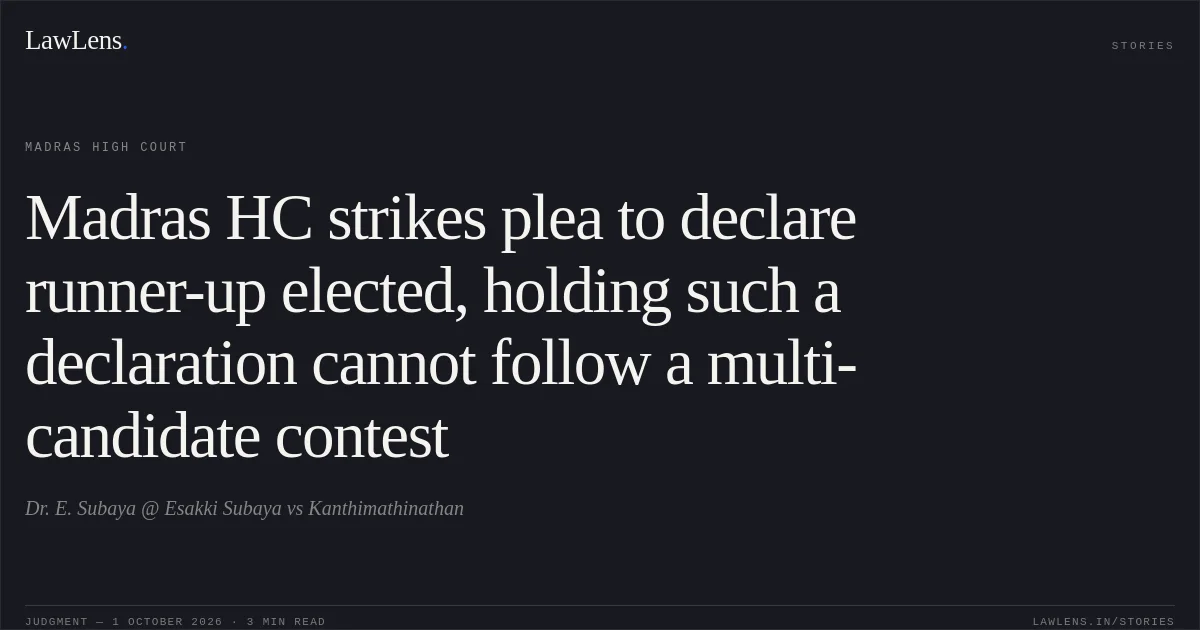
Source reference: para. 4–6, 18He applied under Order VI Rule 16 CPC to strike out the prayer for a declaration that the second respondent was duly elected, arguing that a voter could not seek that relief under Section 84 and that the second-highest vote-getter could not be declared elected in a multi-candidate contest.
Source reference: para. 5–12Issues
Whether an elector who files an election petition may seek a further declaration under Section 84 of the R.P. Act that another candidate was duly elected.
Source reference: para. 19–20, 26–27Whether, in a contest involving more than two candidates, the prayer to declare the second-highest vote-getter elected could be struck out under Order VI Rule 16 CPC.
Source reference: para. 28–34Law Applied
Section 81(1) of the R.P. Act permits an election petition to be presented by a candidate or an elector; its Explanation defines an elector as a person entitled to vote at the election.
Source reference: para. 20Section 84 permits a petitioner, in addition to seeking a declaration that an election is void, to seek a further declaration that the petitioner or another candidate was duly elected; the Court construed “petitioner” to include an elector who presents a petition under Section 81.
Source reference: para. 19–20, 26–27Sections 100 and 101 govern the grounds for declaring an election void and the circumstances in which a candidate may be declared elected.
Source reference: para. 21, 23–29Relying on Vatal Nagaraj v. R. Dayanand Sagar, (1975) 4 SCC 127, the Court noted that tainted votes must be quantified and the required majority established for relief under Section 101(a).
Source reference: para. 23Relying on Prakash Khandre v. Dr. Y.S. Rajasekhar Reddy, (2001) 8 SCC 721, and Muniraju Gowda P.M. v. Munirathna, (2020) 10 SCC 192, it held that, in a contest with more than two candidates, the second-highest vote-getter cannot be presumed to have obtained the required majority; ordinarily, a fresh election is the appropriate course.
Source reference: para. 24–25, 28–29Order VI Rule 16 CPC empowers the Court to strike out matter in a pleading that is unnecessary, frivolous or vexatious, prejudices or delays a fair trial, or is an abuse of process.
Source reference: para. 30, 33Reasoning
The Court rejected the contention that only a contesting candidate could invoke Section 84: read with Section 81, the provision’s use of “petitioner” includes an elector who files an election petition.
Source reference: para. 20, 26–27It nevertheless concluded that the challenged relief could not succeed because more than two candidates had contested the election.
Source reference: para. 28–29Under the cited Supreme Court decisions, the Court could not infer that the second respondent would have obtained the necessary majority absent the returned candidate’s votes; the proper course, if the election were set aside, would be a fresh election.
Source reference: para. 28–29Given that conclusion and the continuing vacancy, it treated the prayer to declare the second respondent elected as unnecessary, frivolous and vexatious, and held that the prayer formed part of the pleading and could be struck out under Order VI Rule 16 CPC.
Source reference: para. 31–34Holding
The Court held that an elector may seek relief under Section 84 of the R.P. Act, but the second respondent could not be declared elected on the facts of this multi-candidate contest.
It allowed O.A. No. 839 of 2026 and struck out the relief seeking a declaration that the second respondent was duly elected.
Source reference: para. 34, 38Acts & Sections Cited
8 provisions across 2 statutes referred to in this judgment. Each provision opens on LawLens.
Representation of the People Act, 19517
Code of Civil Procedure, 19081
Original Court PDF
Dr. E. Subaya @ Esakki SubayavsKanthimathinathan
Click to open original judgment
Original judgment, available to read, download and summarize on LawLens.in