01Facts
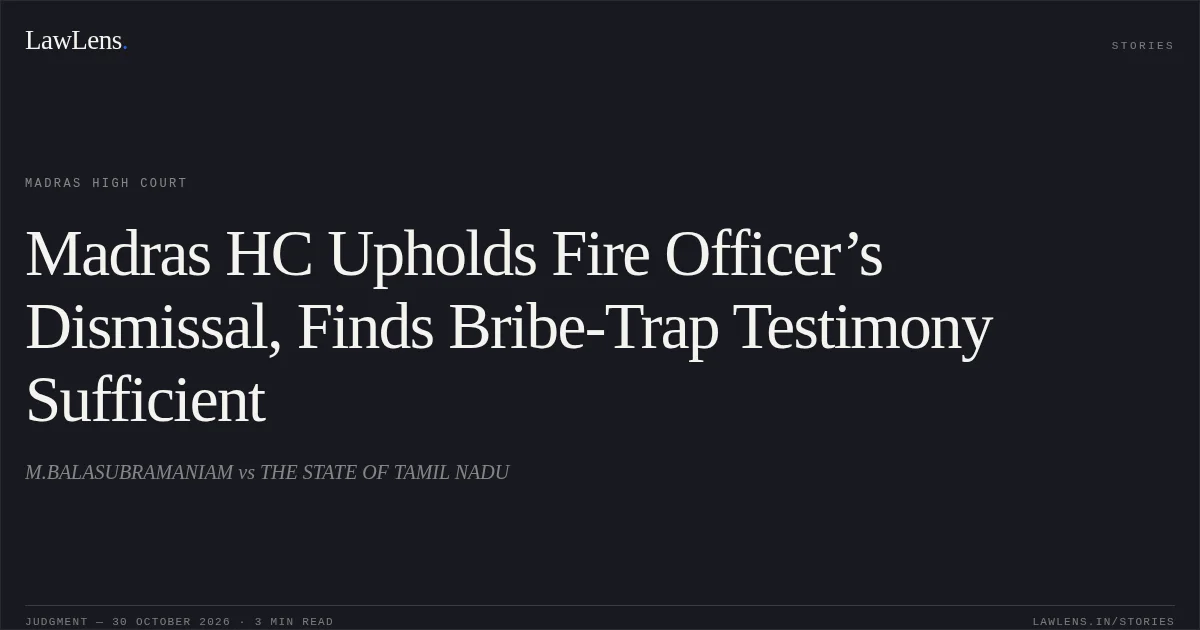
The petitioner, a District Officer in the Tamil Nadu Fire and Rescue Services Department, was remanded to judicial custody on 8 November 2019 in a corruption case arising from a trap proceeding and was subsequently suspended.
pp. 2–4After the Supreme Court directed the respondents to complete disciplinary proceedings within four months, a charge memorandum was issued on 7 March 2022.
pp. 2–4Following an enquiry, the State dismissed him from service by G.O.Ms.No.404 dated 31 July 2023.
pp. 2–4He challenged that order under Article 226, alleging, among other things, denial of procedural fairness, lack of evidence, and an improper enquiry
pp. 2–402Issues
i.Whether non-supply of the TNPSC opinion, which the petitioner claimed was relied upon in imposing dismissal, vitiated the order
pp. 6–11ii.Whether the enquiry was unfair because the Enquiry Officer questioned the management witnesses, the Investigating Officer was present, and some witnesses were initially examined in the petitioner’s absence
pp. 9–20iii.Whether the disciplinary findings were unsupported by evidence or otherwise perverse, including in light of the allegation that a witness was unavailable for cross-examination and video footage was not furnished
pp. 18–22iv.Whether the punishment of dismissal warranted interference in judicial review
pp. 22–2303Law Applied
Where an authority relies on UPSC advice as material against a delinquent employee, the advice should be supplied before the final order; the requirement does not invalidate an order where the advice was not mandatory, was obtained only after the disciplinary authority had reached its decision, and its non-supply caused no prejudice (*Union of India v. R.P. Singh*, applying *Managing Director, ECIL v. B. Karunakar*)
pp. 7–11An Enquiry Officer must remain an impartial adjudicator and must not act as prosecutor, but non-appointment of a Presenting Officer does not by itself vitiate an enquiry; the question turns on how the evidence was elicited and recorded (*State of U.P. v. Saroj Kumar Sinha*; *Union of India v. Ram Lakhan Sharma*)
pp. 10–16Disciplinary findings are assessed on the preponderance of probabilities, subject to the requirement of a proper evidentiary basis; *Union of India v. Gyan Chand Chattar*, concerning vague charges and hearsay evidence, was distinguished on its facts
pp. 18–20In judicial review, a merely possible alternative view does not establish perversity or justify interference
p. 2204Reasoning
The Court found that the applicable rules did not require the disciplinary authority to obtain TNPSC advice and that the authority had already decided to dismiss the petitioner before seeking the Commission’s advisory opinion; its non-supply therefore caused no demonstrated prejudice
pp. 8–11Although no Presenting Officer was appointed, the Enquiry Officer’s questions were found to elicit information rather than lead witnesses through the prosecution case, and the petitioner had not raised a timely objection
pp. 12–17The Investigating Officer’s presence and the initial examination of some witnesses in the petitioner’s absence likewise did not establish prejudice: the petitioner was represented by counsel, the witnesses were re-examined in his presence, and he cross-examined them
pp. 16–20The Court considered the complainant and trap witnesses’ evidence sufficient to support the findings, distinguishing *Gyan Chand Chattar* because that case involved vague charges and hearsay evidence.
pp. 18–21It also rejected the complaint about video footage because it was held by the police, not relied upon by the management, and was not within the management’s custody or control
pp. 18–21Finding no perversity, the Court declined to reassess the evidence or interfere with the penalty
pp. 21–2305Holding
The Court answered the issues against the petitioner, holding that the non-supply of the TNPSC opinion and the alleged procedural defects had not been shown to cause prejudice, and that the disciplinary findings were supported by evidence and were not perverse
pp. 8–22It further held that dismissal was an appropriate punishment for the proved corruption charge.
pp. 22–23The writ petition was dismissed, the connected miscellaneous petition was closed, and no costs were awarded
pp. 22–23Original Court PDF
M.BALASUBRAMANIAMvsTHE STATE OF TAMIL NADU
Click to open original judgment
Original judgment, available to read, download and summarize on LawLens.in