Facts
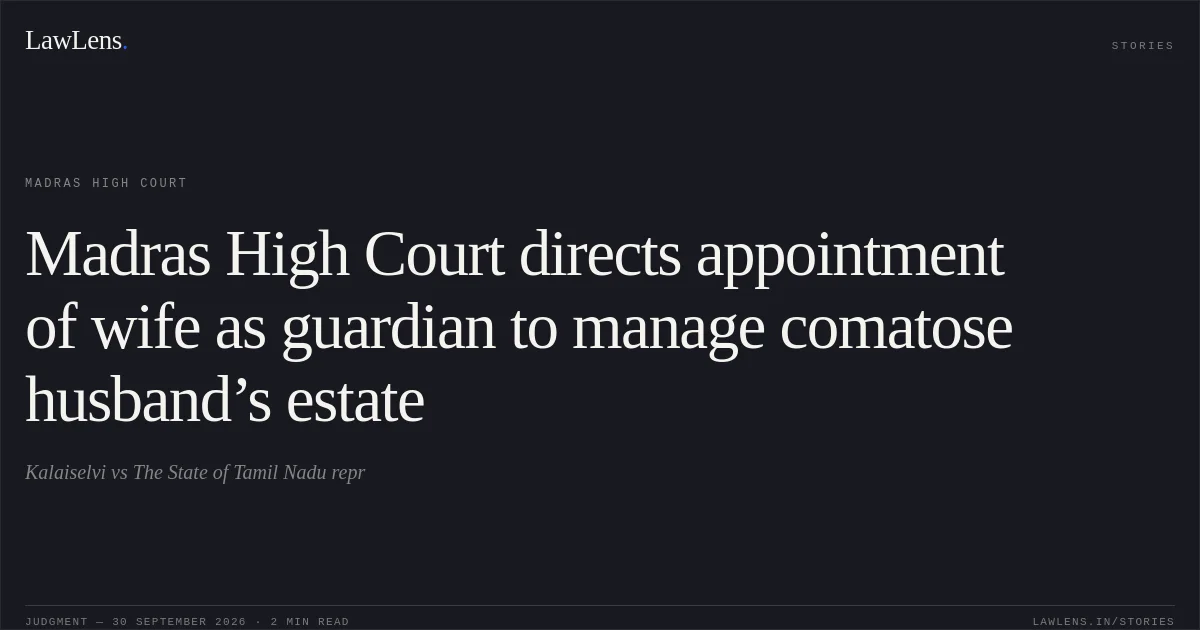
The first petitioner sought permission to act for her husband, Bovas, who was unconscious and non-responsive following a hemorrhagic stroke and was undergoing continuous treatment for quadriparesis.
Source reference: pp. 2–3She wished to deal with a 4.600-cent property standing in his name, reportedly for medical and family needs. The Sub-Registrar rejected her request, reasoning that Section 34 of the Registration Act, 1908 required the executant to appear and acknowledge the document.
Source reference: pp. 2–3The petitioners challenged that communication and sought appointment of the first petitioner as guardian of her husband and authority to deal with the property.
Source reference: p. 1Issues
Whether the Sub-Registrar could decline the request on the ground that the husband could not personally appear and acknowledge the document under Section 34 of the Registration Act, 1908.
Source reference: pp. 2–3Whether the first petitioner could be appointed guardian to manage her husband’s estate, including for the proposed alienation of the property, under the National Trust Act, 1999.
Source reference: pp. 6–8Law Applied
Section 34 of the Registration Act, 1908 was cited by the Sub-Registrar as requiring the executant’s appearance and acknowledgment for registration.
Source reference: pp. 2–3The Court relied on the National Trust for Welfare of Persons with Autism, Cerebral Palsy, Mental Retardation and Multiple Disabilities Act, 1999, including the Local Authority’s role in guardianship matters under Section 13.
Source reference: p. 8It also relied on G. Babu v. District Collector, Madurai (as quoted in M. Venkatraman v. State of Tamil Nadu), which adopted a purposive approach to the 1999 Act and recognised the Local Level Committee’s role in considering guardianship for persons with disabilities.
Source reference: pp. 4–6The Court noted Shoba Gopalkrishnan v. State of Kerala, concerning the limits of guardianship under the 1999 Act for a person in a comatose state.
Source reference: p. 7Reasoning
The Court found that Bovas was unconscious, non-responsive and under continuous treatment for quadriparesis, as recorded in the medical certificate dated 20 May 2026.
Source reference: p. 7It treated his condition as falling within the cerebral-palsy limb of the 1999 Act and concluded that the petitioners should pursue guardianship through the statutory Local Authority rather than have the Sub-Registrar’s registration objection determine the matter.
Source reference: pp. 7–8Accordingly, it directed the Local Authority to consider the documents and act on the guardianship request, with the Revenue Authorities facilitating the proposed alienation.
Source reference: p. 8Holding
The writ petition was disposed of with a direction to the concerned Local Authority constituted under Section 13 of the 1999 Act to appoint the first petitioner as guardian to manage her husband’s estate, and to examine the documents and pass orders as the exigencies warranted within 30 days of receiving the order.
The District Collector, Sub-Registrar and Revenue Authorities were directed to facilitate alienation of assets standing in Bovas’s name. Connected miscellaneous petitions were closed; no costs were ordered.
Source reference: p. 8Acts & Sections Cited
5 provisions across 3 statutes referred to in this judgment. Each provision opens on LawLens.
Registration Act, 19081
National Trust for Welfare of Persons with Autism, Cerebral Palsy, Mental Retardation and Multiple Disabilities Act, 19993
Rights of Persons with Disabilities Act, 2016.1
Original Court PDF
KalaiselvivsThe State of Tamil Nadu repr
Click to open original judgment
Original judgment, available to read, download and summarize on LawLens.in