Facts
On 19 June 2025, police found 25 persons, including the appellant, staying at a house in Tiruppur. The prosecution case was that they were Bangladeshi nationals who had entered India without valid travel documents; Bangladesh National Identity Cards were seized.
Source reference: p. 2–3The appellant was charged under Sections 3(2)(c) read with 14 of the Foreigners Act. The Sessions Court convicted him under Section 14(A) of the Act and imposed two years’ simple imprisonment and a fine of ₹10,000, with one month’s simple imprisonment in default.
Source reference: p. 1, 3On appeal, the appellant challenged the fairness of the Tamil-language proceedings and the translator’s competence, and sought relief concerning the fine’s default sentence. The State relied on the prosecution evidence and submitted that deportation procedures required verification of identity and issuance of travel permits.
Source reference: p. 4–8Issues
Whether the evidence justified the appellant’s conviction under Section 14(A) of the Foreigners Act, including in light of the appellant’s contention that he lacked an effective opportunity to understand and defend the proceedings.
Source reference: p. 4–5, 8–9Whether the sentence, particularly the one-month default imprisonment for non-payment of the fine, required modification in view of the appellant’s financial circumstances.
Source reference: p. 8–10Whether the authorities should be directed to complete deportation within a specified period after the appellant serves his sentence.
Source reference: p. 5, 8, 10Law Applied
The Court considered Section 14(A) of the Foreigners Act, under which the appellant was convicted, and the prosecution’s case under Section 3(2)(c) read with Section 14 of that Act.
Source reference: p. 1, 3It relied on Shahejad Khan Mahebukhan Pathan v. State of Gujarat, 2013 (1) SCC 570, in addressing the default sentence in light of the appellant’s asserted poverty.
Source reference: p. 10It also relied on Maja Daruwala v. State of West Bengal, 2025 Law Finder SC 4783, and the Ministry of Home Affairs circular dated 23 November 2009, including clause 2(v), for the direction that the deportation process be completed within 30 days.
Source reference: p. 4–5, 10The appellant invoked Central Bureau of Investigation v. Narottam Dhakad, 2023 SCC OnLine SC 1069, on the asserted denial of an effective opportunity to defend himself.
Source reference: p. 4Reasoning
The Court found that the police witnesses’ evidence and the seized Bangladeshi identity cards established that the appellant was a Bangladeshi citizen who had entered India without valid documents; it therefore upheld the conviction.
Source reference: p. 8–9Although the appellant had raised concerns about language and the translator, the Court did not separately analyse those contentions in its reasons for affirming the conviction.
Source reference: p. 8–9As to sentence, the Court noted the appellant’s poverty and inability to pay the fine, but left the fine and two-year term of imprisonment intact, reducing only the default imprisonment by applying Shahejad Khan.
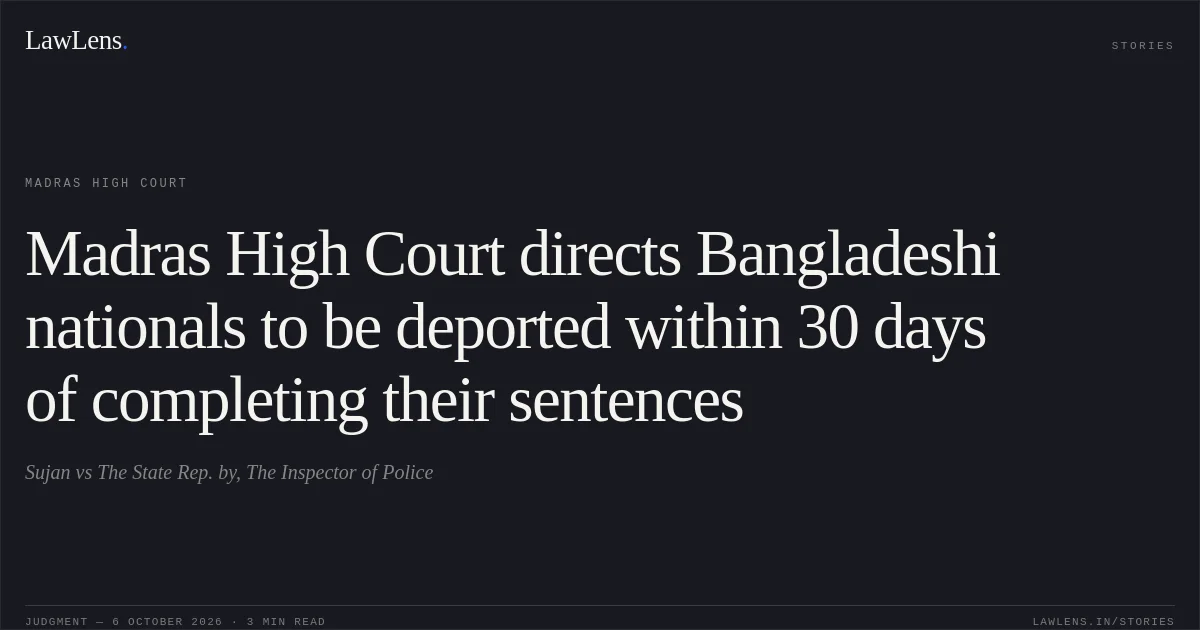
Source reference: p. 9–10Applying Maja Daruwala and the MHA circular, it directed the authorities to complete deportation within 30 days after the sentence and default sentence had been served.
Source reference: p. 10Holding
The appeal was partly allowed. The conviction under Section 14(A) of the Foreigners Act and the sentence of two years’ simple imprisonment and a ₹10,000 fine were confirmed; the default sentence was reduced from one month to one week.
The authorities were directed to deport the appellant, along with the children referred to in the judgment, to Bangladesh within 30 days after completion of the sentence and default sentence.
Source reference: p. 9–10Acts & Sections Cited
1 provisions across 1 statute referred to in this judgment. Each provision opens on LawLens.
Bharatiya Nagarik Suraksha Sanhita, 20231
Original Court PDF
SujanvsThe State Rep. by, The Inspector of Police
Click to open original judgment
Original judgment, available to read, download and summarize on LawLens.in
![HRA parity claims must be assessed against similarly situated employees, with reasoned orders where parity is denied.. Shaphaba Thokchom vs DY. COMPTROLLER AND AUDITOR GENERAL OF INDIA. CAT - ['Guwahati']. LawLens](/stories/thumbnails/hra-parity-claims-must-be-assessed-against-similarly-situated-employees-with-reasoned-orde-a9c45995b0704be18e4bcf7b91c8e507.webp)
![Article 311(2)(c) dismissal is valid where relevant material shows an inquiry would endanger security sources.. Mohd Rafi vs GENERAL ADMINITRATIVE DEPARTMENT. CAT - ['Jammu']. LawLens](/stories/thumbnails/article-311-2-c-dismissal-is-valid-where-relevant-material-shows-an-inquiry-would-endanger-58dabaa9372a4b41bd304e91e9ebe890.webp)