Facts
The petitioner, a financial institution, obtained an order under Section 14 of the SARFAESI Act from the Additional District Magistrate, Vidisha, to take possession of a mortgaged property following a loan default.
Source reference: para 2Physical possession was successfully handed over to the petitioner; however, on 18.06.2026, the borrower and his family illegally re-entered and regained possession of the premises under the guise of removing household articles.
Source reference: para 2Despite the petitioner filing an application for restoration of possession on 19.06.2026, the authorities failed to act, claiming the original Section 14 order had already been executed and could not be re-enforced.
Source reference: paras 2, 4Issues
1. Whether the competent authority can direct the restoration of possession on the strength of the same order passed under Section 14 of the SARFAESI Act if a borrower illegally re-enters a secured asset after lawful dispossession.
Source reference: para 32. Whether the respondent authorities are under a legal obligation to provide police assistance to a secured creditor for the removal of a tresspassing borrower.
Source reference: para 6 / para 11 of cited precedentLaw Applied
Section 14 of the Securitisation and Reconstruction of Financial Assets and Enforcement of Security Interest Act, 2002 (SARFAESI Act), which mandates District Magistrates to assist secured creditors in taking possession of secured assets.
Source reference: para 6The Division Bench precedent in Cholamandalam Investment and Finance Company Ltd. vs. The District Magistrate, Gwalior & Ors. (W.P. No. 1681/2025), which established that the power under Section 14 is ministerial, not adjudicatory, and does not become functus officio upon a single execution if the process is undermined by illegal re-entry.
Source reference: para 6, sub-paras 10, 14, 16The principle that illegality (criminal trespass) cannot be permitted to be perpetuated.
Source reference: para 6, sub-para 11Reasoning
The court rejected the State's contention that the Section 14 order became unenforceable once initial possession was delivered.
Source reference: para 6Referring to the Cholamandalam decision, the court observed that where a borrower adopts a "novel and unsustainable modus operandi" to defeat the law by re-entering premises, the authorities cannot remain mute spectators.
Source reference: para 6, sub-para 14The court reasoned that since Section 14 is intended to facilitate the recovery of public money by secured creditors, there is no legal bar to providing "re-assistance" to dispossess a borrower who has illegally trespassed into a secured asset.
Source reference: para 6, sub-paras 8, 10The court emphasized that such re-entry constitutes an "assault on the law itself," and the authorities have a duty to ensure the rule of law is not mocked by the borrower’s deceitful actions.
Source reference: para 6, sub-para 14Holding
The court answered the issues in the affirmative, holding that the petitioner is entitled to the restoration of possession.
The writ petition was allowed, and the court directed the respondent authorities to provide necessary assistance and police aid to the petitioner to dispossess the borrower and restore the secured asset to the petitioner in accordance with law.
Source reference: para 7-8No order was made as to costs.
Source reference: para 9Acts & Sections Cited
3 provisions across 2 statutes referred to in this judgment. Each provision opens on LawLens.
Securitisation and Reconstruction of Financial Assets and Enforcement of Security Interest Act, 20022
MP Land Revenue Code 19591
Original Court PDF
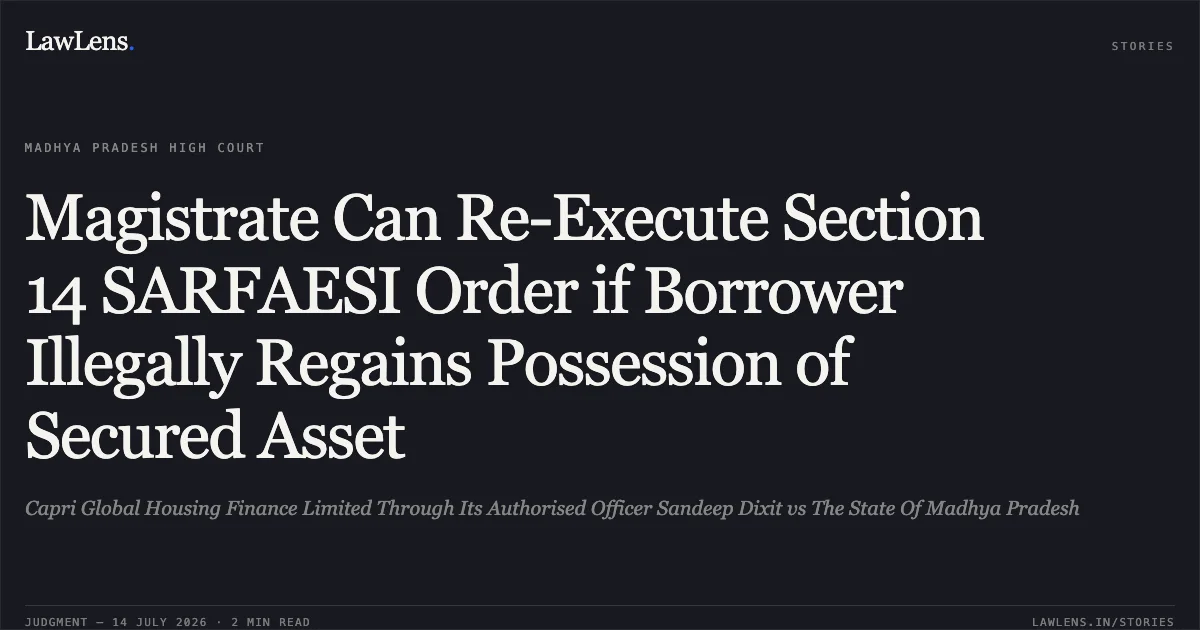
Capri Global Housing Finance Limited Through Its Authorised Officer Sandeep DixitvsThe State Of Madhya Pradesh
Click to open original judgment
Original judgment, available to read, download and summarize on LawLens.in