Facts
Following an FIR dated 22.03.2025 alleging cheating regarding land transactions, the Investigating Officer (IO) filed a closure report on the grounds that the dispute was civil in nature
Source reference: para. 2, 4The respondent-complainant filed a protest petition, asserting that although the land was only regularized in 2024, the owner had executed an agreement to sell and accepted Rs. 15,00,000/- years prior while the land was still recorded as government property
Source reference: para. 5On 02.05.2026, the Judicial Magistrate, Kichha, accepted the protest petition and directed the SHO to conduct a "reinvestigation"
Source reference: para. 2, 3The revisionist, a subsequent purchaser of the land via registered sale deeds, challenged this order, arguing it was mechanical and legally unsustainable as the dispute was purely civil
Source reference: para. 4Issues
1. Whether a dispute involving a breach of an agreement to sell, where an element of deception exists from the inception, can be categorized as a criminal offense of cheating despite having civil overtones
Source reference: para. 5, 72. Whether a Magistrate has the legal competence to order a "reinvestigation" as opposed to a "further investigation"
Source reference: para. 6, 8Law Applied
The Court considered the distinction between civil disputes and criminal proceedings, noting that both can co-exist if the ingredients of a criminal offense are prima facie present
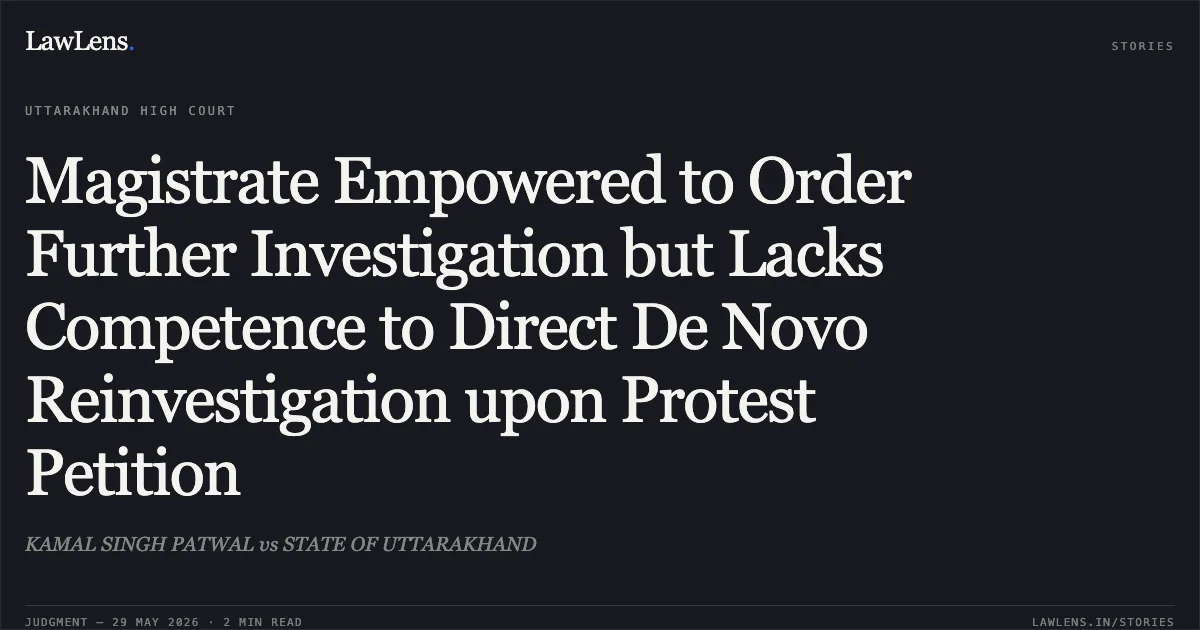
Source reference: para. 4The Court focused on the Magistrate's powers under the Code of Criminal Procedure (CrPC/BNSS), distinguishing between "further investigation" and "reinvestigation." It observed that while High Courts and the Apex Court possess the power to order "reinvestigation" under Article 226 or Article 32 of the Constitution, a Magistrate’s power is limited to ordering "further investigation"
Source reference: para. 6Reasoning
The Court rejected the revisionist's argument that the matter was purely civil. It noted that the element of cheating was prima facie evident because the original owner entered into an agreement to sell and accepted substantial consideration for land that was, at that time, non-regularized government land
Source reference: para. 5The fact that the owner sold the land to third parties at a higher price immediately after regularization, despite the complainant’s long-standing possession and payment, indicated a deceptive intent from the inception
Source reference: para. 5The Court reasoned that since the power to order a fresh or "reinvestigation" remains exclusively with the constitutional courts, the Magistrate's order for "reinvestigation" was technically incompetent and required modification to "further investigation"
Source reference: para. 6, 7Holding
The Court held that there was no patent illegality in the Magistrate's decision to reject the closure report and continue the investigation, as the facts revealed a potential criminal element of cheating
The criminal revision was dismissed for lack of merit... the High Court modified the impugned order to the extent that the Investigating Officer shall proceed with "further investigation" instead of "reinvestigation," as the latter exceeded the Magistrate's jurisdictional competence
Source reference: para. 8Acts & Sections Cited
4 provisions across 2 statutes referred to in this judgment. Each provision opens on LawLens.
Code of Criminal Procedure, 19733
Indian Penal Code, 18601
Original Court PDF
KAMAL SINGH PATWALvsSTATE OF UTTARAKHAND
Click to open original judgment
Original judgment, available to read, download and summarize on LawLens.in


![Subsequent exoneration does not retrospectively invalidate a finalized promotion select list.. UNNIKRISHNAN M vs M/o Environment And Forests. CAT - ['Ernakulam']. LawLens](/stories/thumbnails/subsequent-exoneration-does-not-retrospectively-invalidate-a-finalized-promotion-select-li-ce80a0e84f2f4887857271e8b4341c42.webp)