Facts
An FIR was registered on May 23, 2006, against the petitioner and others for misappropriation of funds (approx. Rs. 5.14 crore) from the Sarba Shiksha Abhiyan (SSA) account in Darjeeling
Source reference: p. 2-3On September 18, 2006, the investigation agency added Sections 13(1)(d)/13(2) of the Prevention of Corruption Act (PC Act)
Source reference: p. 8Despite the addition of these special sections, the Learned Chief Judicial Magistrate (CJM) continued to pass orders, including extending the time for investigation on May 28, 2009, and taking cognizance on August 12, 2009
Source reference: p. 7The petitioner sought discharge on the ground that investigation was not completed within the statutory period under Section 167(5) CrPC (WB Amendment), which was rejected by both the CJM and subsequently the Revisional Court
Source reference: p. 7Issues
1. Whether the Learned Magistrate had the jurisdiction to pass orders extending investigation and taking cognizance after the addition of offences under the Prevention of Corruption Act
Source reference: p. 8-92. Whether the proceedings should be quashed for failure to complete investigation within the statutory period of two/three years as per Section 167(5) of the CrPC (WB Amendment)
Source reference: p. 7-8Law Applied
The court primarily applied Section 167(5)(ii) and (iii) of the CrPC as amended in West Bengal, which stipulates specific time frames (two to three years) for stopping investigations if not concluded within the period from the date of arrest
Source reference: p. 11-12It relied on Durgesh Chandra Saha v. Bimal Chandra Saha, which held that Section 167(5) cannot be invoked after a chargesheet is filed
Source reference: p. 15Crucially, the court applied Sections 3, 4, and 5 of the Prevention of Corruption Act, 1988, which mandate that offences under the Act must be tried exclusively by a Special Judge
Source reference: p. 16-17Reasoning
The court observed that the petitioner surrendered on June 11, 2006; therefore, the statutory period for investigation lapsed in June 2008 or 2009
Source reference: p. 18However, the court held that since the petitioner did not apply for discharge until after the chargesheet was filed and cognizance was taken, he lost the right to seek termination of investigation under Section 167(5)
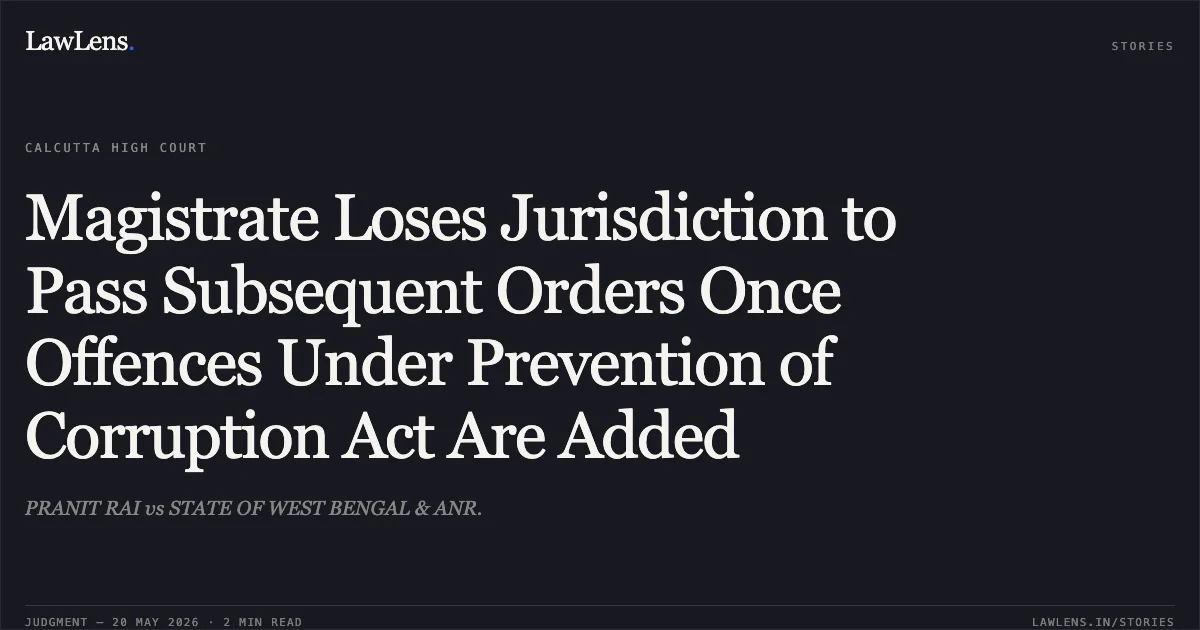
Source reference: p. 15-16Regarding jurisdiction, the court reasoned that once Sections 13(1)(d)/13(2) of the PC Act were added on September 18, 2006, the CJM was legally divested of jurisdiction
Source reference: p. 17-18Under the PC Act, only a Special Judge can try such cases or take cognizance. Consequently, the CJM’s orders extending time for investigation and taking cognizance were coram non judice—without any legal authority
Source reference: p. 18Holding
The court refused to quash the FIR/proceedings but set aside and quashed all orders passed by the Learned Magistrate after September 18, 2006, for lack of jurisdiction
The CJM, Darjeeling, was directed to immediately transfer the case records to the concerned Special Judge under the PC Act. The Special Judge is directed to take appropriate steps, including proceedings against the prime accused and considering the petitioner's discharge on merits if an application is filed. The interim order was vacated
Source reference: p. 18-19Acts & Sections Cited
17 provisions across 3 statutes referred to in this judgment. Each provision opens on LawLens.
Code of Criminal Procedure, 19738
Indian Penal Code, 18605
Prevention of Corruption Act, 19884
Original Court PDF
PRANIT RAIvsSTATE OF WEST BENGAL & ANR.
Click to open original judgment
Original judgment, available to read, download and summarize on LawLens.in