Facts
Thirteen writ petitions were filed under Article 32 of the Constitution seeking directions for the Union of India to legislate against ‘hate speech’ and ‘rumour-mongering,’ citing the Law Commission’s 267th Report.
Source reference: para. 1-2Petitioners alleged institutional inertia in registering FIRs against inflammatory public speeches, particularly those delivered during the COVID-19 pandemic and at various religious assemblies.
Source reference: para. 6-8The Delhi High Court had previously dismissed a related plea (governed by Part II of this judgment), holding that prior sanction under Sections 196 and 197 of the CrPC was a prerequisite for a Magistrate to order an investigation under Section 156(3).
Source reference: para. 100-102The Supreme Court consolidated these petitions to address the legislative vacuum and the procedural hurdles in hate speech enforcement.
Source reference: para. 4Issues
1. Whether the Court can create or expand criminal offences in the absence of legislative action?
Source reference: para. 4 / 182. Whether the existing substantive criminal law adequately deals with hate speech or if the field is legislatively unoccupied?
Source reference: para. 4 / 373. Whether the existing criminal procedural law provides efficacious remedies for the non-registration of FIRs?
Source reference: para. 4 / 454. Whether prior sanction is a precondition for a Magistrate to direct registration of an FIR and investigation under Section 156(3) of the CrPC?
Source reference: para. 101Law Applied
The Court applied the Doctrine of Separation of Powers, affirming that only the Legislature can create offences and punishments.
Source reference: para. 25, 30It relied on Articles 19(2), 21, and 51A(e) regarding the balance between free speech and fraternity.
Source reference: para. 81, 88Lalita Kumari v. Govt. of U.P., which mandates FIR registration upon disclosure of a cognizable offence.
Source reference: para. 108Sakiri Vasu v. State of U.P., establishing the Magistrate’s supervisory role under Section 156(3) CrPC.
Source reference: para. 55State of Karnataka v. Pastor P. Raju, which clarifies that the bar of prior sanction under Section 196 CrPC applies only at the stage of "taking cognizance," not during investigation.
Source reference: para. 121-124Reasoning
The Court reasoned that under the Indian constitutional scheme, the judiciary lacks the mandate to legislate or "create" crimes, as this involves complex social and political value-balancing reserved for the Legislature.
Source reference: para. 33-34It found that the field is not "unoccupied" because Sections 153A, 153B, 295A, and 505 of the IPC (now BNS) already criminalize incitement to hatred and communal disharmony.
Source reference: para. 41-42Regarding procedure, the Court emphasized that Sections 154(3), 156(3), and 200 of the CrPC (now BNSS) provide a "multi-tiered mechanism" for victims when police refuse to register an FIR.
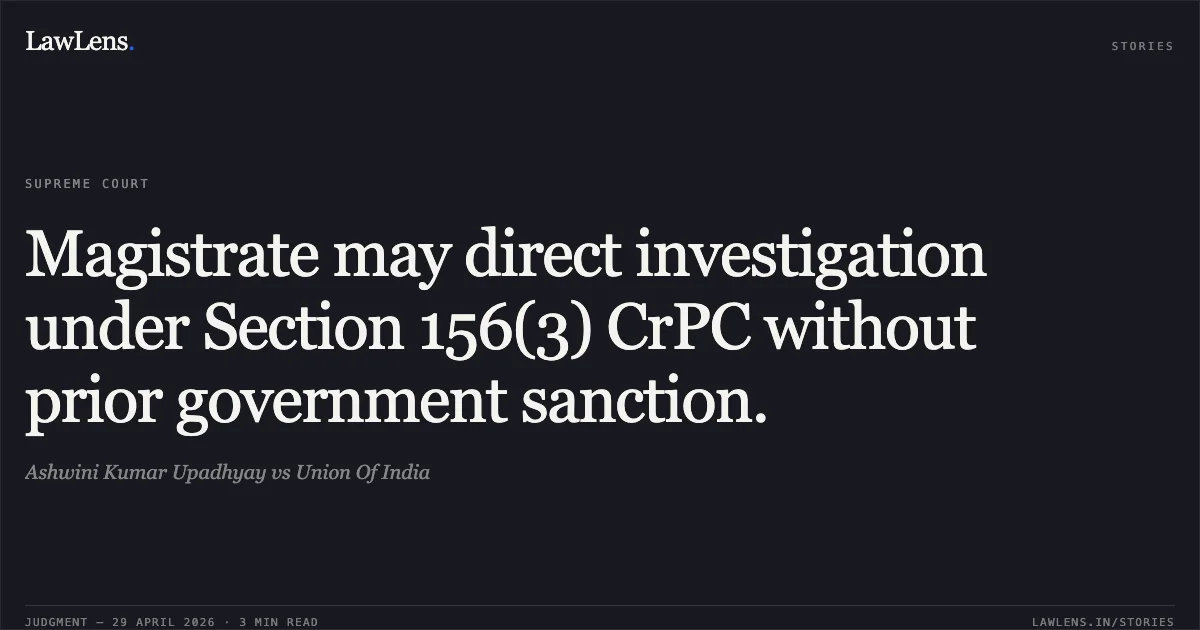
Source reference: para. 98.3The Court corrected the Delhi High Court's stance on sanction, explaining that "taking cognizance" is a specific judicial act (proceeding with a trial) distinct from the "pre-cognizance" stage of ordering an investigation; thus, a lack of government sanction cannot block the registration of an FIR or a police probe.
Source reference: para. 126-127, 134Holding
The Court dismissed the request to create new hate speech laws or issue a continuing mandamus, holding that the existing law is sufficient and the remedy lies in enforcement, not new legislation.
It partly allowed the Criminal Appeal (SLP Crl. No. 5107/2023), setting aside the Delhi High Court’s ruling to the limited extent that it required prior sanction for a Section 156(3) order.
Source reference: para. 166It directed all High Courts to consider issuing practice directions to ensure the effective implementation of these procedural rules.
Source reference: para. 169Four specific contempt petitions alleging inaction despite complaints were kept pending for further response from authorities.
Source reference: para. 168Acts & Sections Cited
41 provisions across 8 statutes referred to in this judgment. Each provision opens on LawLens.
Indian Penal Code, 18607
Code of Criminal Procedure, 1973
Bharatiya Nagarik Suraksha Sanhita, 20238
Representation of the People Act, 19513
Protection of Civil Rights Act, 19551
Religious Institutions (Prevention of Misuse) Act, 19881
Prevention of Corruption Act, 19881
Original Court PDF
Ashwini Kumar UpadhyayvsUnion Of India
Click to open original judgment
Original judgment, available to read, download and summarize on LawLens.in