Facts
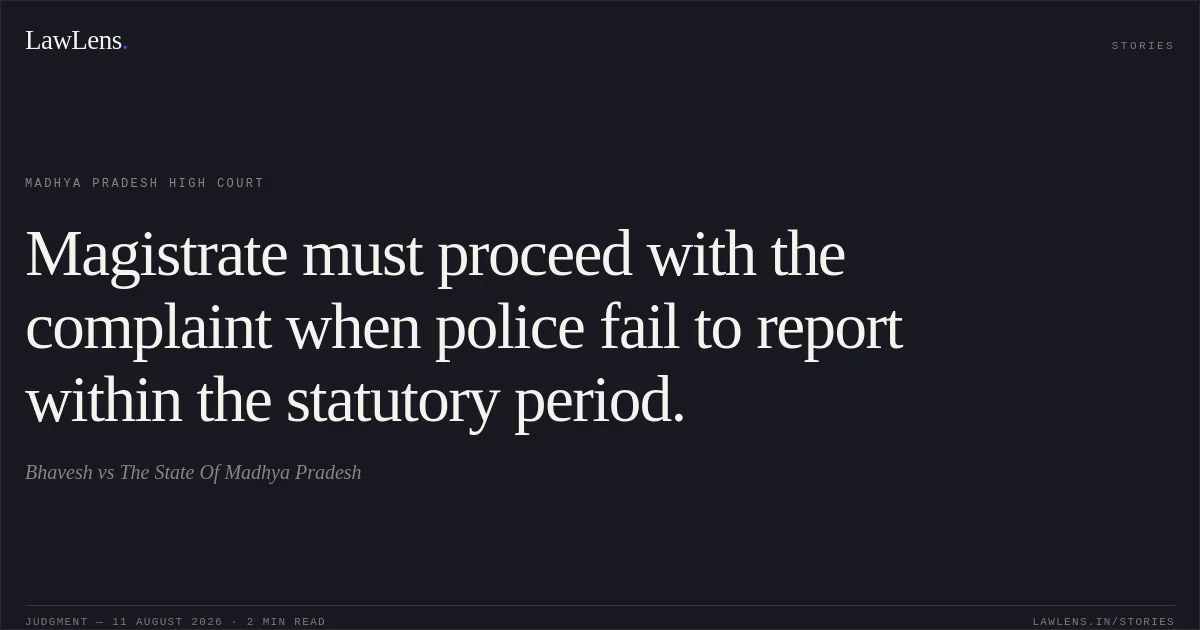
The petitioner instituted a complaint case before the Judicial Magistrate First Class, Kesli, District Sagar, registered as Complaint Case/UNCR No. 04/2023.
Source reference: para. 2; p. 2The Magistrate repeatedly sought an enquiry report from the police, but the report was not submitted, resulting in repeated adjournments and continued pendency of the complaint proceedings.
Source reference: para. 2; p. 2The petitioner therefore invoked Article 226 of the Constitution seeking a direction to the State to submit the enquiry report before the Magistrate within a prescribed time.
Source reference: p. 1Issues
1. Whether the police can indefinitely delay submission of its enquiry/investigation report, thereby keeping complaint proceedings pending before the Magistrate.
Source reference: para. 2; p. 22. Whether the Magistrate should proceed with the complaint under Sections 200 onwards of the Code of Criminal Procedure, 1973 (“CrPC”), where the police fails to submit its report within the prescribed period.
Source reference: para. 4, quoting Om Prakash Sharma; pp. 2–5Law Applied
The Court relied on Section 210 CrPC, which requires the Magistrate to stay complaint proceedings when a police investigation concerning the same offence and accused is pending, and to call for a police report; however, the provision presupposes that the investigation will be completed expeditiously.
Source reference: para. 4, quoted paras 19.1–19.6; pp. 2–4Sections 167 and 173 CrPC support the requirement of timely investigation and submission of the police report.
Source reference: no citationRelying on the Division Bench decision in Om Prakash Sharma v. State of M.P. and another, 2021 SCC OnLine MP 630 : ILR 2021 MP 984, the Court applied the rule that police should not be granted more than 60/90 days, or any longer statutorily prescribed period, to submit its report; failing such submission, the Magistrate must proceed with the complaint under Chapters XV and XVI CrPC notwithstanding Section 210, while later clubbing the complaint with the police case if a police report is filed and cognizance is taken.
Source reference: para. 4, quoted para. 20(i)–(v); pp. 4–6Reasoning
The Court found that the petitioner’s complaint had remained pending because the police had not submitted the report despite repeated directions from the Magistrate.
Source reference: para. 2; p. 2Applying Om Prakash Sharma, the Court held that Section 210 CrPC cannot be interpreted as permitting complaint proceedings to remain in a state of “suspended animation” for months or years owing to police inaction.
Source reference: para. 4, quoted paras 19.5–19.8; pp. 3–4The statutory scheme requires expeditious investigation so that the complainant’s right to pursue proceedings under Section 200 CrPC is not defeated by delay.
Source reference: no citationAccordingly, the Magistrate was required to follow the safeguards and procedural directions laid down by the Division Bench, including proceeding with the complaint if the police report was not filed within the permissible period.
Source reference: para. 4; pp. 4–6Holding
The petition was disposed of in terms of the directions in Om Prakash Sharma.
The Magistrate was directed to immediately adhere to those directions.
Source reference: para. 6; p. 6Thus, the Court did not independently grant a mandamus directing immediate submission of the police report; instead, it ensured that the complaint could not remain indefinitely pending because of the delayed enquiry and required the Magistrate to proceed in accordance with Sections 200–210 CrPC and the applicable time-bound principles.
Source reference: no citationActs & Sections Cited
5 provisions across 1 statute referred to in this judgment. Each provision opens on LawLens.
Code of Criminal Procedure, 19735
Original Court PDF
BhaveshvsThe State Of Madhya Pradesh
Click to open original judgment
Original judgment, available to read, download and summarize on LawLens.in