Facts
The petitioners (accused) and respondent (complainant) entered into an agreement on 01.04.2019 for construction projects.
Source reference: para 4Following disputes, a Security Bond was signed on 09.04.2021, and the petitioners issued a cheque for Rs. 2,24,71,917/- as 'security'.
Source reference: para 5The respondent presented the cheque for payment, which was returned for "Funds Insufficient" on 01.07.2020 (sic).
Source reference: para 5After a legal notice went unheeded, a complaint was filed under Section 138 of the Negotiable Instruments (NI) Act.
Source reference: no citationThe Metropolitan Magistrate issued a summoning order on 29.04.2023, which the petitioners challenged under Section 482 of the Cr.P.C., alleging it was a mechanical "template order" lacking application of mind.
Source reference: paras 1-2, 7-10Issues
Whether the summoning order dated 29.04.2023 was passed without application of judicial mind to the facts and essential ingredients of the offence.
Source reference: para 2, 9Whether a cheque issued as 'security' falls under the ambit of an 'enforceable debt or liability' under Section 138 of the NI Act.
Source reference: para 8Law Applied
The court relied on Section 138 of the NI Act regarding dishonour of cheques.
Source reference: para 1The court relied on Section 204 of the Cr.P.C. concerning the issuance of process.
Source reference: para 22It applied the principle from *Pepsi Foods Ltd. v. Special Judicial Magistrate*, which establishes that summoning an accused is a serious matter and the order must reflect an application of mind to the facts and law.
Source reference: para 11, 23It further cited *Mehmood Ul Rehman v. Khazir Mohammad Tunda*, emphasizing that while a detailed speaking order is not required at the summoning stage, there must be "sufficient indication" of judicial satisfaction that the allegations constitute an offence.
Source reference: para 22Additionally, the court noted *Sripati Singh v. State of Jharkhand*, holding that a cheque given as security attracts Section 138 if the underlying obligation remains unpaid.
Source reference: para 15Reasoning
The High Court scrutinized the impugned summoning order, observing that while the Magistrate detailed the logistical and procedural aspects of service (labels, meta-data, and digital uploads), the order failed to mention essential legal ingredients such as the specific reason for dishonour, receipt of statutory notice, or adherence to limitation timelines.
Source reference: paras 10, 24The court noted the petitioners' argument that the cheque was a security instrument requiring a 45-day cure period before presentation.
Source reference: para 7However, the court balanced this against the respondent's argument that signatures were admitted, triggering the statutory presumption under Section 139 of the NI Act.
Source reference: para 13While criticizing the "template" nature of the order, the court found that since it had independently perused the complaint, the cheque, the return memo, and the notice—all of which prima facie satisfied the legal requirements—the omission in the Magistrate’s written reasoning did not warrant quashing the entire proceeding at this advanced stage.
Source reference: paras 25-27Holding
The Court declined to interfere with the summoning order.
It held that although the Magistrate's order omitted explicit mention of the ingredients of the offence, the underlying record (cheque, memo, and notice) supported the initiation of the trial.
Source reference: paras 27-28The petition was dismissed, the stay on proceedings was vacated, and the Magistrate was directed to proceed with the matter in accordance with law.
Source reference: para 29Acts & Sections Cited
9 provisions across 2 statutes referred to in this judgment. Each provision opens on LawLens.
Code of Criminal Procedure, 19737
Negotiable Instruments Act, 18812
Original Court PDF
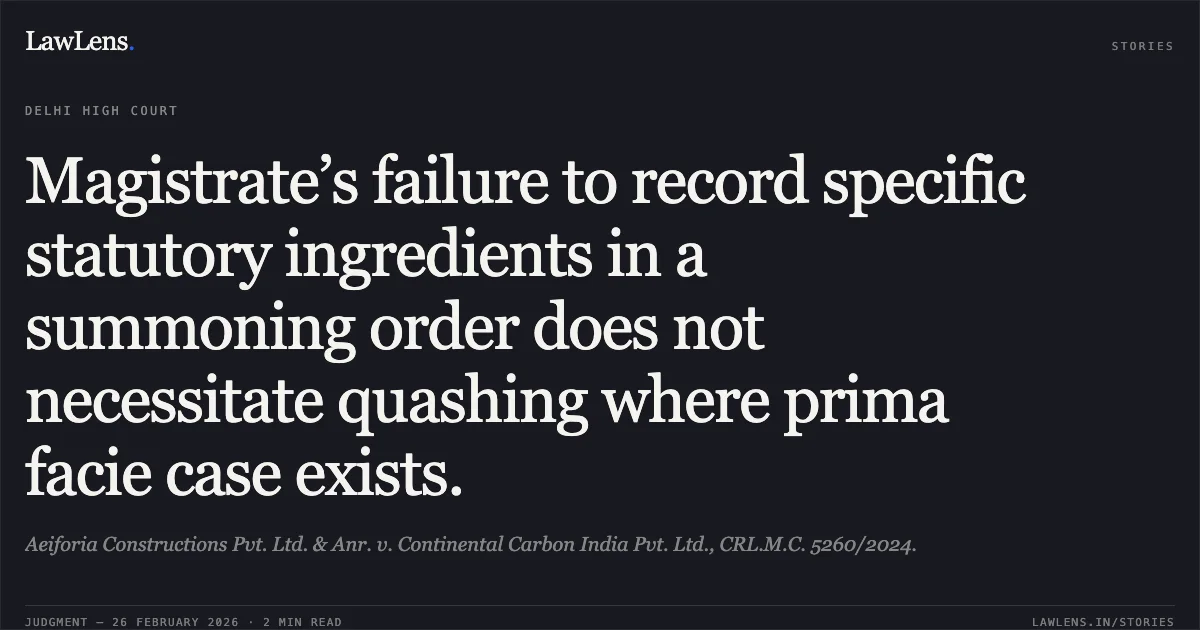
Aeiforia Constructions Pvt. Ltd. & Anr. v. Continental Carbon India Pvt. Ltd., CRL.M.C. 5260/2024.
Click to open original judgment
Original judgment, available to read, download and summarize on LawLens.in


