Facts
Respondents 1 and 2—respectively the mother-in-law and sister-in-law of petitioner 6—filed an application under Section 12 of the Protection of Women from Domestic Violence Act, 2005 (“DV Act”), alleging that petitioner 6 had lived with respondent 1 in a joint family/shared household at Raipur and Mumbai and that the petitioners had subjected them to physical, verbal, emotional and mental abuse.
Source reference: para. 3They sought compensation of ₹15,00,000 each and other reliefs.
Source reference: para. 3The Magistrate took cognizance and rejected the petitioners’ objection that the complaint was not maintainable because the parties had not lived in a shared household and the complainants did not qualify as “aggrieved persons.”
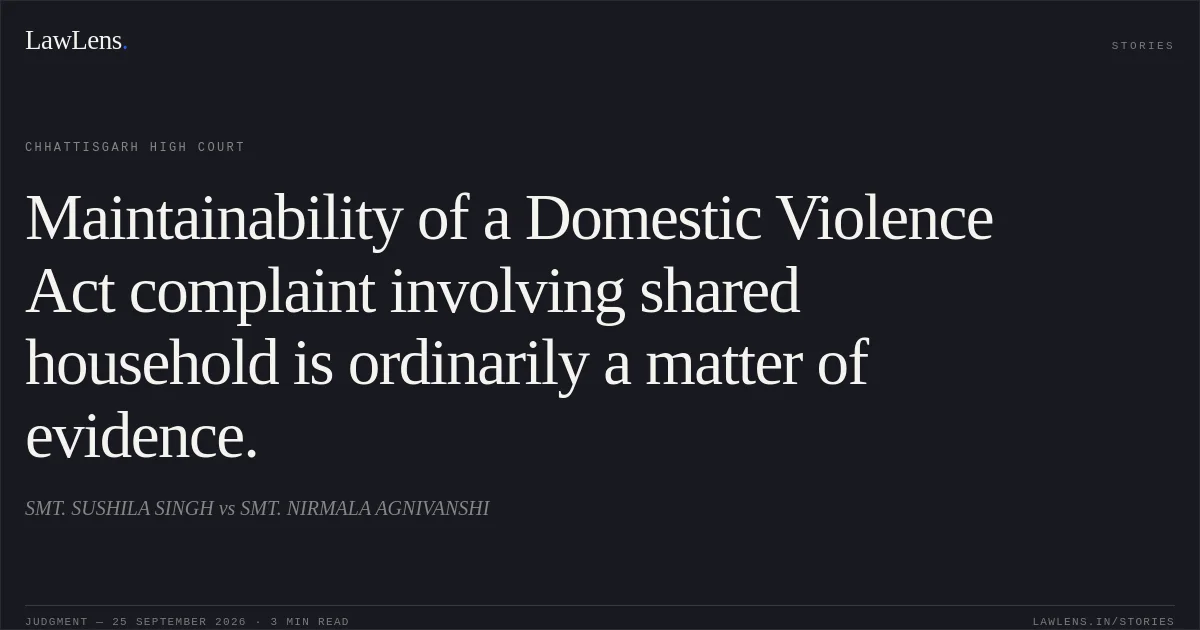
Source reference: paras. 2, 4The Magistrate held that the questions concerning domestic relationship and shared household were matters of evidence.
Source reference: paras. 2, 4The petitioners’ criminal appeal against that order was dismissed by the Additional Sessions Judge, leading to the present petition under Section 528 of the Bharatiya Nagarik Suraksha Sanhita, 2023 (“BNSS”).
Source reference: paras. 2, 4Issues
Whether the Magistrate was justified in taking cognizance of the complaint under Section 12 of the DV Act filed by the mother-in-law and sister-in-law of petitioner 6, despite the petitioners’ objection that the complainants were not aggrieved persons and that no domestic relationship or shared household was established?
Source reference: para. 10Whether the High Court should exercise its inherent jurisdiction under Section 528 BNSS to quash the DV Act proceedings for alleged abuse of process or lack of jurisdiction?
Source reference: paras. 6, 17–19Law Applied
The Court applied Sections 2(a), 2(f), 2(s), 3 and 12 of the DV Act.
Source reference: para. 11Section 2(a) defines an “aggrieved person” as a woman who is or has been in a domestic relationship with the respondent and alleges domestic violence; Section 2(f) defines “domestic relationship” to include persons related by consanguinity, marriage or as members of a joint family who live or have lived together in a shared household; Section 2(s) gives an inclusive definition of “shared household”; and Section 3 includes physical, verbal, emotional and economic abuse, including mental harm, threats, humiliation and insults.
Source reference: para. 11Relying on Hiral P. Harsora v. Kusum Narottamdas Harsora, (2016) 10 SCC 165, and Prabha Tyagi v. Kamlesh Devi, (2022) 8 SCC 90, the Court held that the expressions “domestic relationship” and “shared household” must receive an expansive interpretation and may include mothers, sisters, daughters-in-law and other female members of a joint family.
Source reference: paras. 12, 16Under Shaurabh Kumar Tripathi v. Vidhi Rawal, 2025 SCC OnLine SC 1158, the High Court may exercise inherent jurisdiction under Section 482 CrPC, corresponding to Section 528 BNSS, to quash proceedings arising from a Section 12 DV Act application; however, such power must be exercised cautiously and ordinarily only in cases of gross illegality or injustice.
Source reference: para. 17Reasoning
The complaint specifically alleged that petitioner 6 had lived with respondent 1 in a joint family and shared household at Raipur and Mumbai, and that the petitioners had subjected the respondents to abuse, threats and mental torture.
Source reference: paras. 3, 14On these allegations, the respondents prima facie satisfied the statutory description of aggrieved persons, and the alleged conduct could fall within the broad definition of domestic violence under Section 3 of the DV Act.
Source reference: paras. 13–14The Court held that the petitioners’ objections regarding whether the parties actually lived together, whether a shared household existed, and whether the alleged conduct amounted to domestic violence required appreciation of evidence and could not be conclusively determined at the cognizance stage.
Source reference: paras. 15, 19Although the High Court possessed jurisdiction under Section 528 BNSS to quash the proceedings, the petitioners failed to demonstrate gross illegality, absence of jurisdiction or an exceptional case warranting interference.
Source reference: paras. 17–19Holding
The Court held that the Magistrate was justified in taking cognizance of the complaint under Section 12 of the DV Act and in rejecting the petitioners’ preliminary objection.
The appellate court’s dismissal of the petitioners’ challenge was also upheld.
Source reference: paras. 15, 19–20The petition under Section 528 BNSS was dismissed, but the petitioners were granted liberty to raise all their factual and legal defences before the Magistrate, who was directed to decide them on the basis of the evidence and material produced at trial, uninfluenced by the High Court’s dismissal of the petition.
Source reference: paras. 15, 19–20Acts & Sections Cited
12 provisions across 3 statutes referred to in this judgment. Each provision opens on LawLens.
Bharatiya Nagarik Suraksha Sanhita, 20231
Protection of Women from Domestic Violence Act, 2005
Code of Criminal Procedure, 19731
Original Court PDF
SMT. SUSHILA SINGHvsSMT. NIRMALA AGNIVANSHI
Click to open original judgment
Original judgment, available to read, download and summarize on LawLens.in