01Facts
The complainant (respondent) invested ₹4,00,000 with the accused (petitioner), who was the Managing Director of Sree Shanmuga Modern Rice Mills Pvt. Ltd., in 2016
¶ 3Following the cessation of interest payments, the accused issued a cheque dated 19.03.2018 for the principal amount
¶ 3The cheque was returned for "funds insufficient"
¶ 3The complainant issued a legal notice to the petitioner in his individual capacity as Managing Director, but did not address or implead the company itself
¶ 13, 16The Trial Court convicted the petitioner under Section 138 of the N.I. Act
¶ 4The petitioner challenged these findings on the grounds that the prosecution was not maintainable without arraigning the company as an accused
¶ 802Issues
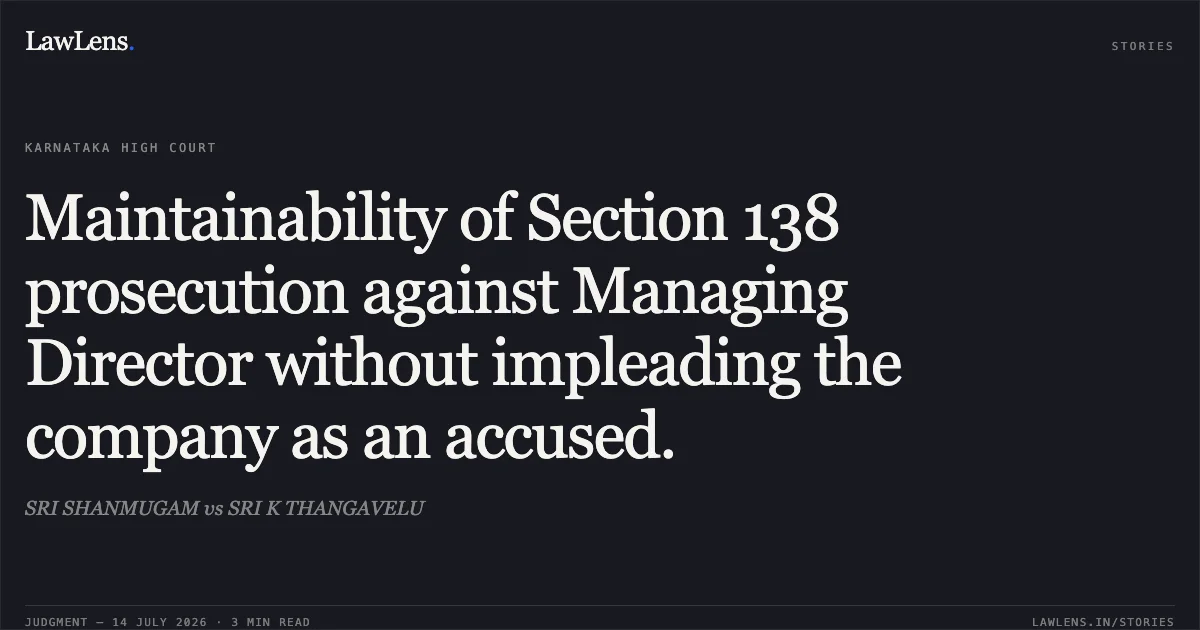
i.1. Whether a Managing Director of a company can be liable for prosecution under Section 138 of the N.I. Act without the company being arraigned as an accused
¶ 17ii.2. Whether the absence of specific averments in the complaint regarding the Managing Director's responsibility for the business conduct of the company, coupled with the non-inclusion of the company as an accused, vitiates the proceedings
¶ 17iii.3. Whether the Trial and Appellate Courts erred in convicting the petitioner by overlooked the mandate of Section 141 of the N.I. Act
¶ 1703Law Applied
The Court primarily applied Section 138 (dishonour of cheque) and Section 141 (offences by companies) of the Negotiable Instruments Act, 1881
¶ 18, 19It relied heavily on the landmark Supreme Court precedent Aneeta Hada v. Godfather Travels and Tours Private Limited (2012), which established that arraigning the company as an accused is a condition precedent to invoking vicarious liability against its directors
¶ 9, 27Further reliance was placed on Himanshu v. B. Shivamurthy (2019) and Pawan Kumar Goel v. State of U.P. (2022), which reaffirmed that prosecution against a director is not maintainable without the company as a principal accused
¶ 10, 23, 26Provisions in the judgment · 6 · Linked ones open on LawLens
Negotiable Instruments Act, 1881 Section 138Section 141
Code of Criminal Procedure, 1973 Section 313Section 397Section 401Section 482
04Reasoning
The Court observed that the subject cheque (Ex.P1) was issued on the account of "Sree Shanmuga Modern Rice Mills Private Limited" and signed by the petitioner as its Managing Director
¶ 19Under Section 141 of the N.I. Act, when a company commits an offence, the company itself must be prosecuted to fasten vicarious liability on its officers
¶ 25The Court noted that the complainant failed to implead the company in the cause title or the legal notice
¶ 20, 26It rejected the Appellate Court’s reasoning that the petitioner could be prosecuted alone simply because he was at the helm of affairs, noting that such a finding contradicts the doctrine of strict construction applied to criminal statutes
¶ 23, 27The Court highlighted that the commission of the offence by the company is an "express condition precedent" to attract the liability of others
¶ 27Thus, the failure to array the juristic person (the company) was deemed a fatal legal defect that could not be overlooked as a mere technicality
¶ 26, 2705Holding
The Court answered the issues in the affirmative, holding that for maintaining a prosecution under Section 141, arraigning the company is imperative
¶ 27The revision petition was allowed, and the judgments of conviction passed by the Trial Court and confirmed by the Appellate Court were set aside. The petitioner was acquitted of the offence punishable under Section 138 of the N.I. Act, and his bail bonds were cancelled
¶ 28Original Court PDF
SRI SHANMUGAMvsSRI K THANGAVELU
Click to open original judgment
Original judgment, available to read, download and summarize on LawLens.in