Facts
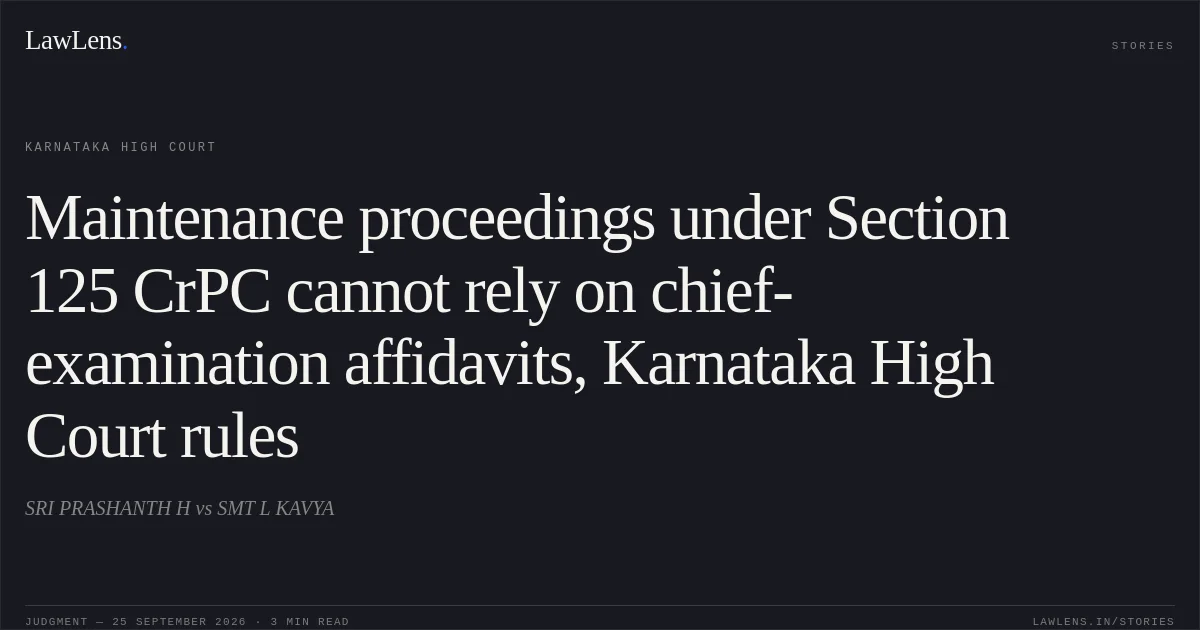
The petitioner-husband challenged the order dated 1 March 2024 passed by the Family Court, Davanagere, in Crl. Misc. No. 287/2021 under Section 125 Cr.P.C.
Source reference: no citationThe respondent-wife and minor daughter had claimed maintenance of ₹30,000 and ₹20,000 per month, respectively. The Family Court, after considering the evidence of PW-1 and RW-1 and Exhibits P-1 to P-4, awarded ₹6,000 per month to the wife and ₹4,000 per month to the daughter
Source reference: p. 3–4The petitioner disputed his liability and contended, among other things, that the wife was earning and that the proceedings were procedurally invalid because the parties’ chief-examination evidence had been filed by affidavit rather than recorded orally before the Court
Source reference: p. 5–7Both sides had filed affidavits in lieu of chief examination.
Source reference: p. 7–8Issues
Whether witnesses in proceedings under Section 125 Cr.P.C. may lead their evidence-in-chief by filing affidavits instead of having their evidence recorded in the manner prescribed for summons cases
Source reference: para. 10Whether the Family Court’s order granting maintenance could be sustained when it was based on evidence received through such affidavits.
Source reference: paras. 24–30Law Applied
Section 126(2) Cr.P.C. mandates that evidence in proceedings under Section 125 Cr.P.C. shall be recorded in the presence of the person against whom maintenance is sought, or his pleader, and in the manner prescribed for summons cases.
Source reference: pp. 9–10The procedure for summons cases under Chapter XX Cr.P.C. does not contemplate the filing of affidavits in lieu of chief examination.
Source reference: para. 14Section 10(2) of the Family Courts Act, 1984 requires the procedure under the Cr.P.C. to be followed in Chapter IX maintenance proceedings before a Family Court, while Section 10(3) permits the Family Court to devise its own procedure for facilitating settlement, not for disregarding the statutory manner of recording evidence.
Source reference: pp. 16–19; paras. 24–26The Court followed the Division Bench decision in Gayathri v. Ramesh, which held that affidavit evidence is unknown to summons-case proceedings under Section 125 Cr.P.C.
Source reference: para. 15The contrary view in Zaheeda v. Rajmohammed was not followed to the extent it permitted such affidavits, as it was a decision of a learned Single Judge and was inconsistent with the statutory procedure and the binding Division Bench ruling.
Source reference: paras. 21–23Reasoning
The High Court held that the nature of Section 125 proceedings as a speedy social-justice remedy did not authorise departure from the express procedural requirement in Section 126(2) Cr.P.C.
Source reference: paras. 11–14Since the proceedings were instituted under Chapter IX Cr.P.C., Section 10(2) of the Family Courts Act required the Family Court to follow the Cr.P.C. procedure, including the procedure applicable to summons cases.
Source reference: paras. 24–26Section 10(3) could not be invoked because the Family Court had not devised a procedure to facilitate settlement; it had adjudicated the parties’ claims on merits after relying on the affidavits as substantive chief-examination evidence.
Source reference: paras. 26–27Consequently, the affidavits filed by PW-1 and RW-1 were received contrary to law, and the maintenance order founded on that evidence could not be legally sustained, irrespective of the fact that the petitioner himself had adopted the same procedure.
Source reference: paras. 9, 28–30Holding
The Court answered the issues against the validity of affidavit-based chief examination in Section 125 Cr.P.C. proceedings.
It allowed the revision petition, set aside the Family Court’s order dated 1 March 2024, and directed the Family Court, Davanagere, to restore the case, record the evidence of both parties in accordance with Section 126 Cr.P.C., and decide the matter afresh.
Source reference: para. 30Pending disposal, the petitioner was directed to pay interim maintenance of ₹3,000 per month each to the wife and minor daughter from the date of filing of the maintenance case. The Family Court was granted liberty to modify the interim amount upon proof of changed circumstances.
Source reference: para. 30Acts & Sections Cited
16 provisions across 2 statutes referred to in this judgment. Each provision opens on LawLens.
Family Courts Act, 19842
Original Court PDF
SRI PRASHANTH HvsSMT L KAVYA
Click to open original judgment
Original judgment, available to read, download and summarize on LawLens.in