Facts
The petitioners, both stated to be majors, were in a consensual live-in relationship and were residing together voluntarily.
Source reference: paras. 3, 5They expressed their intention to solemnize and register their marriage under the applicable provisions of the Uniform Civil Code, Uttarakhand.
Source reference: paras. 3, 5Respondent Nos. 4 to 6, relatives of petitioner no. 1, allegedly opposed the relationship and proposed marriage and were alleged to have threatened the petitioners.
Source reference: para. 4The petitioners therefore approached the High Court seeking protection of their life, personal liberty, and peaceful existence.
Source reference: para. 4Petitioner no. 1 personally stated before the Court that she was a major, was residing with petitioner no. 2 of her own free will, and had not been subjected to force, coercion, threat, undue influence, or inducement.
Source reference: para. 5Issues
Whether major individuals residing together consensually and intending to marry are entitled to protection of their life and personal liberty against unlawful interference, threats, or coercion.
Source reference: paras. 5–8Whether the police authorities should be directed to assess the alleged threat perception and take protective measures if a real and imminent threat exists.
Source reference: para. 8Law Applied
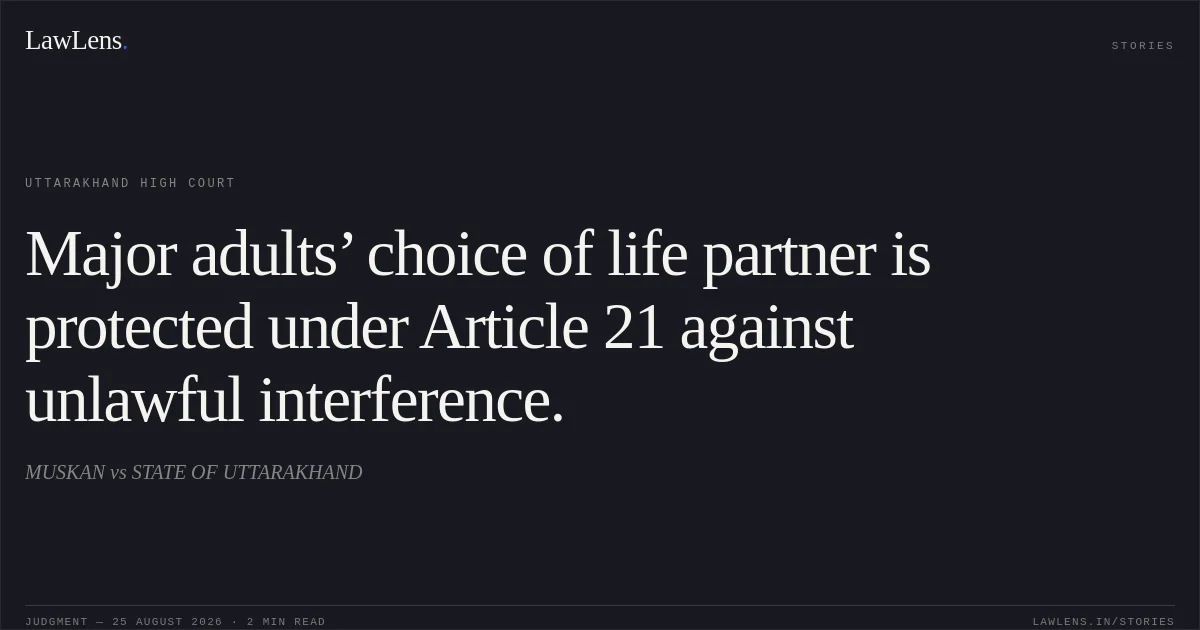
The Court applied Article 21 of the Constitution of India, which protects an adult’s autonomy to make personal-life choices, including the choice of a life partner.
Source reference: para. 6It relied on Lata Singh v. State of U.P., (2006) 5 SCC 475, recognising that major individuals are entitled to choose their partners and that the State must protect their life and personal liberty against unlawful interference.
Source reference: para. 7The Court further proceeded on the principle that no person may take the law into their own hands or subject individuals to unlawful interference, intimidation, harassment, or coercion.
Source reference: para. 8Reasoning
The Court found it undisputed that both petitioners were majors and competent to make decisions concerning their personal lives.
Source reference: para. 6Petitioner no. 1’s voluntary statement established that her cohabitation with petitioner no. 2 was free from coercion or undue influence and that she intended to marry him.
Source reference: para. 5Applying Article 21 and the principle in Lata Singh, the Court held that the petitioners’ relationship and personal choices attracted constitutional protection.
Source reference: para. 8However, without adjudicating the inter se rights of the parties or the validity of the proposed marriage, the Court limited the relief to a direction for an assessment of the alleged threat and appropriate police protection if the threat was found to be real and imminent.
Source reference: para. 8Holding
The petition was disposed of with a direction to the Station House Officer, Police Station Kiccha, District Udham Singh Nagar, to examine the petitioners’ representation and assess the threat perception to their life and liberty.
If a real and imminent threat was found, the police were directed to provide adequate protection in accordance with law and to prevent any person from unlawfully interfering with, intimidating, harassing, or coercing the petitioners on account of their relationship.
Source reference: para. 8The Court expressly declined to express any opinion on the parties’ inter se rights or the validity of the proposed marriage.
Source reference: para. 8Pending applications, if any, were also disposed of.
Source reference: para. 10Original Court PDF
MUSKANvsSTATE OF UTTARAKHAND
Click to open original judgment
Original judgment, available to read, download and summarize on LawLens.in
![Courts will not interfere with transfers absent mala fides or violation of statutory rules.. M Ramya vs EMPLOYEES STATE INSURANCE CORPORATION (ESIC). CAT - ['Chennai']. LawLens](/stories/thumbnails/courts-will-not-interfere-with-transfers-absent-mala-fides-or-violation-of-statutory-rules-a6845e9ca6f548fca284c51c8351957f.webp)
![Courts cannot direct one-time recruitment age relaxation absent authority in the governing rules or advertisement.. UT OF PUDUCHERRY vs M ANDAL. CAT - ['Chennai']. LawLens](/stories/thumbnails/courts-cannot-direct-one-time-recruitment-age-relaxation-absent-authority-in-the-governing-895d78fde47143e2a8ed0207c4b6a44f.webp)
![A review cannot correct an allegedly erroneous decision absent an error apparent on the record.. Ajit Kumar Jha vs RAILWAY BOARD. CAT - ['Delhi']. LawLens](/stories/thumbnails/a-review-cannot-correct-an-allegedly-erroneous-decision-absent-an-error-apparent-on-the-re-8ac952fd4eba470c92f7da20af72a220.webp)