Facts
The petitioner and respondent were married in January 1997 and have three children
Source reference: p.2Following a history of matrimonial litigation, including a withdrawn divorce case (F.C. Civil Case No. 741/2013) and a withdrawn domestic violence case (C.R. (D.V.) Case No. 16/2014) based on a breached promise of maintenance, the petitioner filed for maintenance under Section 125 of the CrPC
Source reference: p.2On 26.05.2025, the Family Court granted maintenance to the petitioner and her children but terminated the son’s maintenance upon his attainment of majority, despite his ongoing graduation studies
Source reference: p.2-3The petitioner moved the High Court in revision to extend the son’s maintenance until he completes his studies or begins earning, and to enhance the maintenance amount to Rs. 15,000
Source reference: p.3Issues
1. Whether a child who has attained majority but is still pursuing education is entitled to maintenance under Section 125 of the CrPC
Source reference: p.3, para 42. Whether the High Court, in its revisional jurisdiction, can grant maintenance beyond the age of majority by exercising powers similar to Article 142 of the Constitution
Source reference: p.6, para 10Law Applied
The court primarily applied Section 125(1) of the Code of Criminal Procedure, 1973.
Source reference: p.4Section 125(1)(b) stipulates that maintenance is payable to a legitimate or illegitimate minor child
Source reference: p.4Section 125(1)(c) provides an exception for children who have attained majority only if they are unable to maintain themselves due to "physical or mental abnormality or injury"
Source reference: p.4-5The court further clarified that while the Supreme Court may grant maintenance to adult children pursuing education under the extraordinary powers of Article 142 of the Constitution (as seen in Chandrashekar v. Swapnil, 2021 12 SCC 624), such powers do not vest in the High Court
Source reference: p.6, para 10Reasoning
The Court analyzed the statutory language of Section 125(1) and determined that the legislature intentionally restricted the eligibility for maintenance to minor children, except in specific cases of disability
Source reference: p.5-6The Court rejected the petitioner's reliance on Chandrashekar v. Swapnil and Urvashi Agarwal v. Indarpal Agarwal, noting that the High Court’s revisional jurisdiction does not permit issuing directions that are "plainly contrary to law," even if intended to prevent vagrancy
Source reference: p.6, para 10It was observed that the son had attained majority in 2021 and did not suffer from any physical or mental abnormality that would trigger the exception under Section 125(1)(c)
Source reference: p.6, para 11Consequently, the father’s legal obligation to maintain the son ceased upon the son reaching the age of 18
Source reference: p.6Holding
The Court dismissed the revision petition, affirming the trial court's order
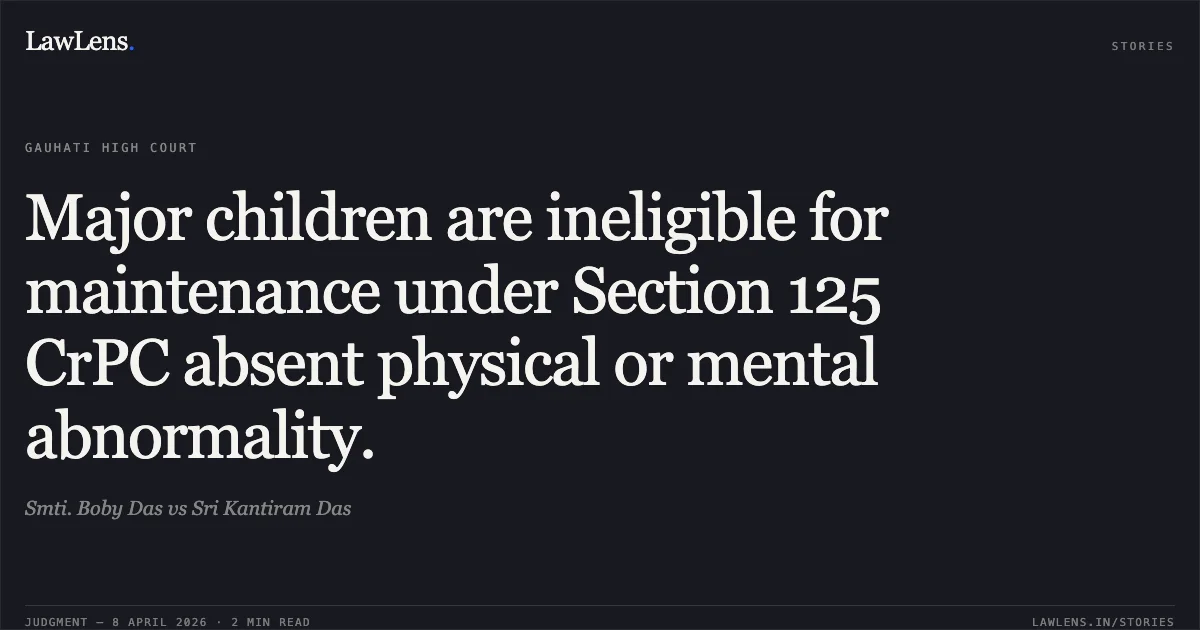
It held that under Section 125 CrPC, a son is not entitled to maintenance beyond the age of majority solely on the ground of pursuing higher education
Source reference: p.6, para 10-11The Court concluded that it lacks the jurisdiction to extend statutory benefits beyond the express limits set by the legislature
Source reference: p.6, para 10Acts & Sections Cited
1 provisions across 1 statute referred to in this judgment. Each provision opens on LawLens.
Code of Criminal Procedure, 19731
Original Court PDF
Smti. Boby DasvsSri Kantiram Das
Click to open original judgment
Original judgment, available to read, download and summarize on LawLens.in


