01Facts
The petitioners, who claimed to be majors, stated that they were in a relationship and had solemnized their marriage (Nikah) on 27 July 2026 according to Muslim rites and rituals.
¶ 5They had applied for registration of the marriage under the Uniform Civil Code, Uttarakhand.
¶ 5The petitioners alleged that petitioner no. 2’s father, uncles and paternal aunt opposed the marriage, extended threats to them, and had allegedly manhandled petitioner no. 1’s paralysed father.
¶ 5–6Both petitioners appeared before the Court, were identified by counsel, and stated that they had married voluntarily, without force, coercion or undue influence, and were residing together as husband and wife.
¶ 7–9The Registry had objected to the petitioners’ failure to disclose their earlier marital status; the objection was overlooked after counsel stated that neither petitioner had been married previously.
¶ 2–402Issues
i.Whether the petitioners, being consenting adults who claimed to have voluntarily solemnized their marriage, were entitled to protection of their life and personal liberty against alleged threats from private respondents.
¶ 5–9ii.Whether the Court should direct the police to assess the alleged threat perception and provide protection without deciding the validity of the marriage or the inter se rights of the parties.
¶ 1003Law Applied
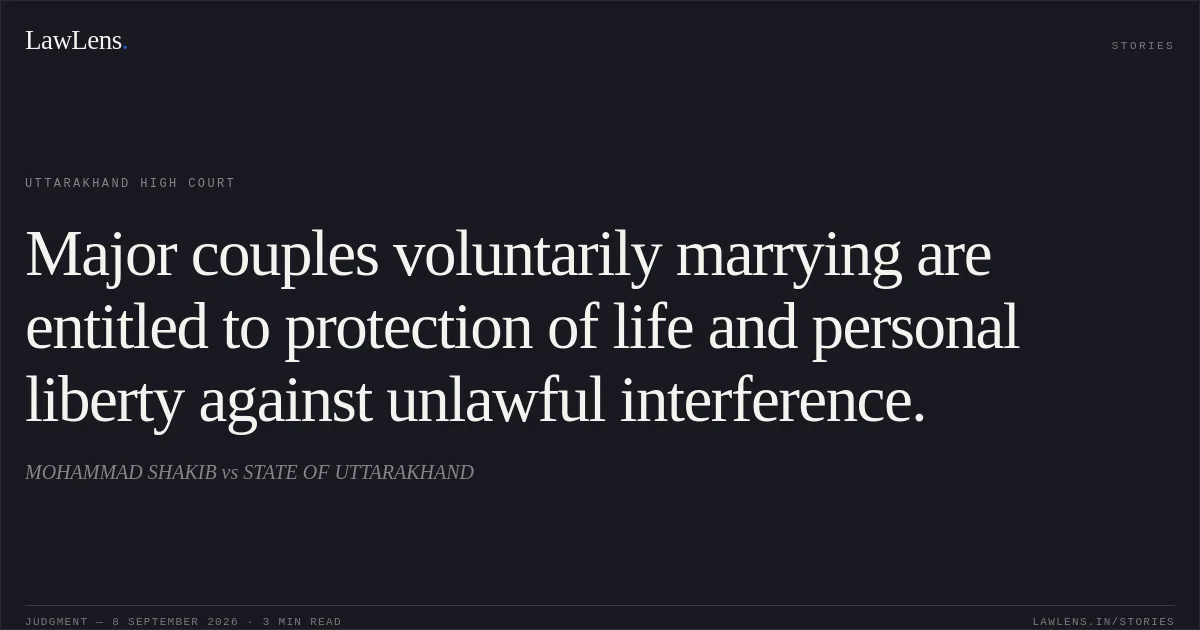
The Court applied the constitutional protection of life and personal liberty and the principle that consenting major adults are entitled to choose their partner and live together without unlawful interference.
¶ 9Relying on Lata Singh v. State of U.P. and Another, (2006) 5 SCC 475, the Court held that persons who have attained majority and voluntarily enter into a relationship or marriage are entitled to protection of their life and personal liberty in accordance with law.
¶ 9The Court also proceeded on the limited principle that police authorities must assess a genuine and imminent threat and prevent private individuals from taking the law into their own hands, while leaving the validity of the marriage and related inter se rights open.
¶ 1004Reasoning
The Court noted that both petitioners had produced documents showing that they were majors and had personally affirmed that their marriage was voluntary and free from coercion or undue influence.
¶ 7–9In light of their assertion that they were residing together as husband and wife and their allegations of threats from the private respondents, the Court applied the principle in Lata Singh that consenting adults are entitled to protection of their life and personal liberty.
¶ 9However, the Court did not adjudicate the validity of the Nikah, the pending registration under the Uniform Civil Code, or the parties’ inter se rights.
¶ 10Instead, it directed the jurisdictional police officer to independently examine the petitioners’ representation and assess whether a real and imminent threat existed.
¶ 1005Holding
The Court held that the petitioners were entitled to seek protection of their life and personal liberty.
¶ 10Without expressing any opinion on the validity of their marriage or the inter se rights of the parties, it directed the Station House Officer, Police Station Vikas Nagar, District Dehradun, to examine their representation and assess the threat perception.
¶ 10If a real and imminent threat was found, the police were directed to provide appropriate protection in accordance with law and to prevent the private respondents or any other person from unlawfully interfering with, intimidating, harassing or coercing the petitioners on account of their marriage.
¶ 10The writ petition and pending applications, if any, were disposed of.
¶ 11–12Original Court PDF
MOHAMMAD SHAKIBvsSTATE OF UTTARAKHAND
Click to open original judgment
Original judgment, available to read, download and summarize on LawLens.in