Facts
The applicant, while serving as a Postal Assistant on deputation as Sub-Postmaster at Eriyodu Sub Office in 2013, was charged with failing to credit a sum of ₹210 collected from a depositor into the Post Office account.
Source reference: p. 3, 7Following a departmental inquiry, a penalty was imposed on 07.12.2015 reducing his pay by three stages for six months with cumulative effect.
Source reference: p. 3-4, 8The applicant was under suspension from 10.10.2014 to 08.12.2015.
Source reference: p. 5The disciplinary authority later issued a modification order on 02.06.2016 to correct the pay scale figures due to the applicant's impending retirement.
Source reference: p. 4, 9The applicant challenged these orders and the subsequent decision dated 07.02.2017, which treated his suspension period as "non-duty" for all purposes.
Source reference: p. 5Issues
1. Whether the modification of the punishment order dated 02.06.2016 constituted an illegal enhancement or delayed implementation of the penalty to prejudice the applicant's retirement benefits.
Source reference: p. 4, 62. Whether the administration's decision to treat the suspension period (11.10.2014 to 08.12.2015) as "non-duty" was legally sustainable.
Source reference: p. 5, 9Law Applied
The Tribunal primarily applied Fundamental Rule (FR) 54B, which governs the treatment of pay, allowances, and service status of a government servant upon reinstatement following suspension.
Source reference: p. 9-11Specifically, FR 54B(4) and (5) stipulate that when a government servant is reinstated but not fully exonerated (e.g., imposed with a penalty), the period of suspension shall not be treated as duty unless the competent authority specifically directs otherwise after providing a show-cause notice to the employee.
Source reference: p. 11Reasoning
The Tribunal examined the timeline of the penalty and found that the modification order dated 02.06.2016 did not enhance the punishment but merely corrected the pay band figures to ensure the penalty remained effective until the original conclusion date of 09.06.2016.
Source reference: p. 6, 9Evidence showed the applicant received his annual increment on 01.07.2016, negating the claim of deliberate delay.
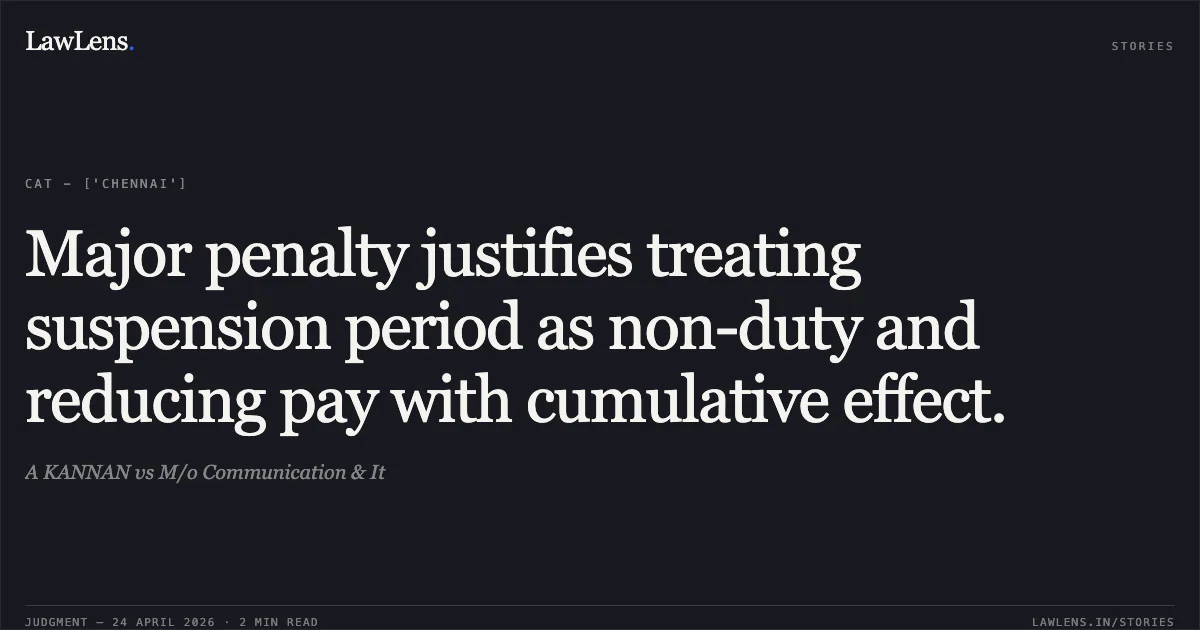
Source reference: p. 6Regarding the suspension period, the Tribunal noted that because the applicant was found guilty and awarded a major penalty, he was not entitled to have the suspension treated as "duty" under FR 54B(2).
Source reference: p. 10-12The respondents followed the due process required by FR 54B(4) by issuing a show-cause notice on 19.01.2017 and considering the applicant’s representation before passing the final order treating the period as "non-duty".
Source reference: p. 11-12Holding
The Tribunal held that the disciplinary proceedings and the subsequent treatment of the suspension period were conducted in strict accordance with the law; the court answered both issues in the negative, finding no infirmity in the respondents' orders.
The Original Application was dismissed as devoid of merit, and no costs were awarded.
Source reference: p. 12Original Court PDF
A KANNANvsM/o Communication & It
Click to open original judgment
Original judgment, available to read, download and summarize on LawLens.in