Facts
Respondent No. 2, the authorised signatory of a salon partnership, occupied commercial premises owned by the petitioner under a registered lease.
Source reference: paras. 2–5, pp. 2–4The parties had ongoing disputes concerning electricity, maintenance, parking, and rent, alongside civil proceedings and earlier police complaints.
Source reference: paras. 2–5, pp. 2–4Respondent No. 2 alleged that on 28 May 2024, the petitioner and about 60 others forcibly entered the premises and removed salon property and staff mobile phones.
Source reference: para. 6, p. 5Police registered Crime No. 194/2024 for offences under Sections 143, 147, 392, 441, 120B and 149 IPC.
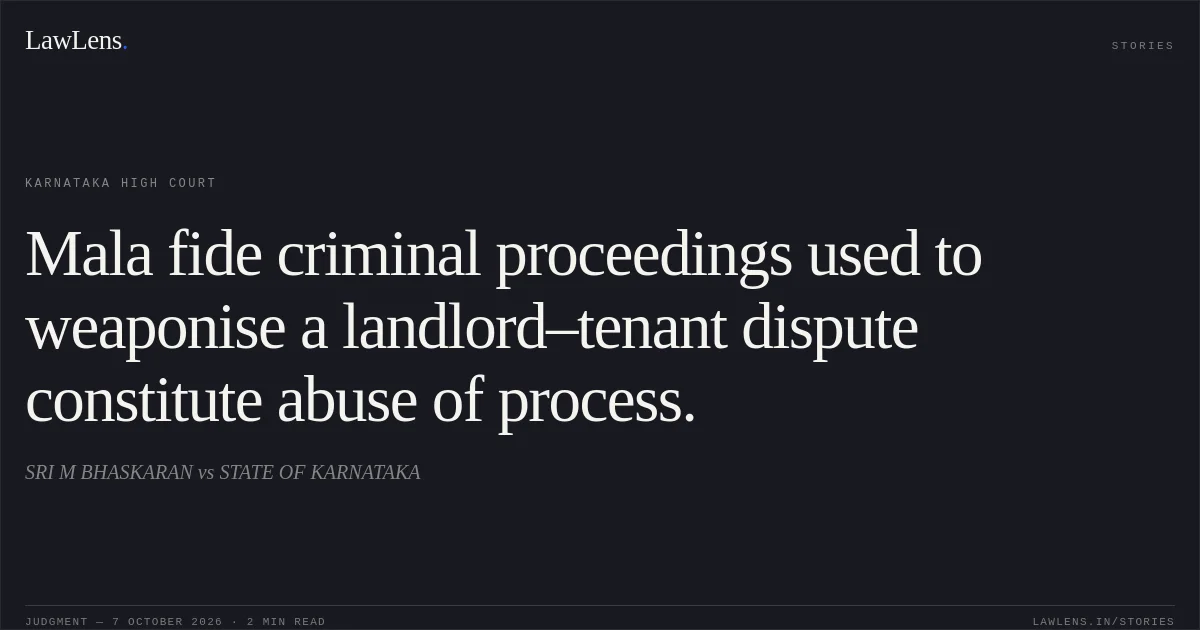
Source reference: para. 6, p. 5The petitioner sought to quash the FIR under Section 482 CrPC, contending that the complaint was a counterblast to a landlord–tenant dispute and contained vague allegations against him.
Source reference: paras. 8–9, pp. 5–6Issues
1. Whether the complaint and accompanying material disclosed a prima facie case against the petitioner for the alleged IPC offences
Source reference: paras. 8–10, pp. 5–72. Whether the FIR was an abuse of process, having allegedly been lodged to give a criminal colour to a civil landlord–tenant dispute and warranting quashing under Section 482 CrPC
Source reference: paras. 8–12, pp. 5–8Law Applied
Section 482 CrPC empowers the High Court to prevent abuse of the process of any court and secure the ends of justice.
Source reference: no citationUnder State of Haryana v. Bhajan Lal, an FIR may be quashed, among other circumstances, where its allegations do not disclose an offence, are inherently improbable, or the proceedings are manifestly mala fide and instituted for an ulterior purpose.
Source reference: para. 18, pp. 11–14The Court also relied on Bikku Bhai Govinda Bhai v. State of Gujarat, which recognises that criminal proceedings may be quashed where a predominantly civil property dispute is given a criminal colour and continuation would amount to abuse of process.
Source reference: para. 17, pp. 10–11Mohammed Ali v. State of U.P. was cited for the principle that, when mala fides or vexatious proceedings are alleged, the Court may consider relevant attending circumstances and material on record, while distinguishing that exercise from assessing the reliability of evidence at trial.
Source reference: para. 18, pp. 11–18Reasoning
The Court noted the undisputed landlord–tenant relationship and the pending civil dispute.
Source reference: para. 13, p. 8It considered that the property allegedly removed was brought to the police station in three lorries, and that the petitioner’s demand notice for alleged rent and maintenance arrears was served on 25 May 2024—three days before the complaint was lodged.
Source reference: paras. 14–15, pp. 8–9In light of these circumstances, the Court found that the complaint prima facie appeared to be a counterblast arising from the civil dispute and intended to give it a criminal colour.
Source reference: para. 16, p. 9Applying the principles in Bhajan Lal and the cited authorities, it concluded that continuing the proceedings against the petitioner would amount to abuse of process.
Source reference: paras. 17–19, pp. 10–19Holding
The High Court allowed the petition and quashed the proceedings against the petitioner in Crime No. 194/2024, registered for offences under Sections 143, 147, 392, 441, 120B read with Section 149 IPC, then pending before the 39th Additional CMM, Bengaluru.
Acts & Sections Cited
8 provisions across 2 statutes referred to in this judgment. Each provision opens on LawLens.
Code of Criminal Procedure, 19733
Indian Penal Code, 18605
Original Court PDF
SRI M BHASKARANvsSTATE OF KARNATAKA
Click to open original judgment
Original judgment, available to read, download and summarize on LawLens.in