Facts
Respondent No. 5 was appointed as a teacher in 1994 and confirmed in 1999
Source reference: para 3(a)-(b)On September 4, 2015, the Petitioner/Management suspended her without waiting for permission from the Education Department
Source reference: para 3(d)Following an inquiry which the School Tribunal later termed "farcical," she was terminated on October 31, 2017
Source reference: para 3(h), 9The School Tribunal, Mumbai, allowed her appeal on December 20, 2019, quashing the termination and granting reinstatement with continuity of service and full back wages
Source reference: para 3(j)This judgment attained finality as it was not challenged
Source reference: para 3(k)While she was reinstated in January 2020, a dispute arose regarding the liability for back wages
Source reference: para 3(l), 5The Management filed this writ petition seeking a direction to the State to pay the back wages, arguing that since the post was grant-in-aid and no substitute teacher was appointed during her termination period, the State suffered no "double payment"
Source reference: para 4, 13Issues
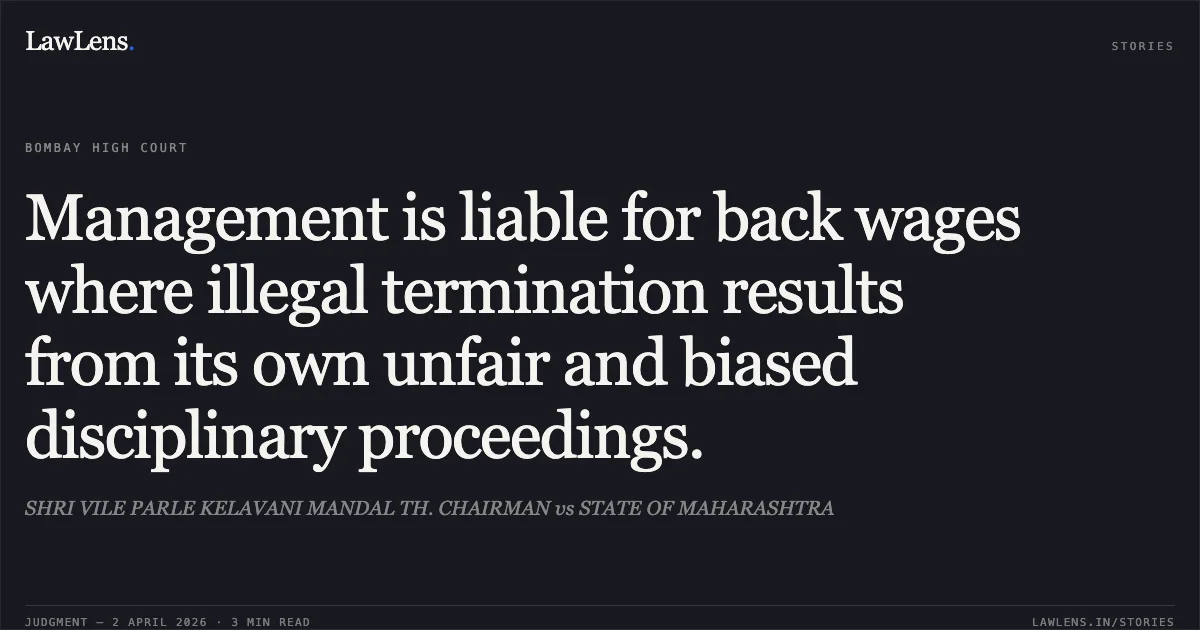
Whether the Management or the State Government is liable to pay the back wages to the teacher upon the quashing of an illegal termination initiated solely by the Management
Source reference: para 7Law Applied
The court primarily applied the Maharashtra Employees of Private Schools (Conditions of Service) Rules, 1981 (“MEPS Rules”), specifically Rules 33 and 35 regarding suspension and subsistence allowance
Source reference: para 21It relied on the Supreme Court’s decision in Educational Society, Tumsar v. State of Maharashtra, which established that the State is only liable for back wages if the termination was at the State's behest or if the State played a role in the inquiry
Source reference: para 18-19Furthermore, it applied the principle from Deepali Gundu Surwase v. Kranti Junior Adhyapak Mahavidyalaya, which holds that where an employer acts in gross violation of statutory provisions or natural justice, the "wrongdoer" employer must bear the burden of full back wages rather than being relieved of the financial consequence of its misconduct
Source reference: para 23The Full Bench decision in Awdesh Narayan K. Singh v. Adarsh Vidya Mandir Trust was cited to establish that management is liable for subsistence allowance when suspension is effected without prior permission
Source reference: para 21Reasoning
The Court observed that the School Tribunal had completely exonerated the teacher, finding the inquiry biased, defective, and farcical
Source reference: para 9, 25The Management had acted unilaterally in suspending the teacher before receiving departmental permission and conducting a flawed disciplinary proceeding
Source reference: para 3(d), 25The Court rejected the Management's argument that the State should pay because no substitute teacher was hired; it reasoned that the State had no role in the victimisation of the employee
Source reference: para 26To shift the financial burden to the State would effectively grant a "premium" to the Management for its own wrongdoings
Source reference: para 23, 26Since the entire disciplinary action was the "handiwork" of the Management, the employer-employee relationship and the findings of unfair labor practice necessitated that the Management, and not the public exchequer, fulfill the Tribunal’s order for back wages
Source reference: para 26-27Holding
The High Court dismissed the Writ Petition, holding that the Petitioner/Management is solely liable to pay both the suspension allowance and the full back wages to Respondent No. 5
The Court clarified that while the Management had already paid approximately Rs. 35 lakhs ad-hoc, any remaining disputes regarding the exact calculation of dues (claimed at Rs. 61 lakhs by the teacher) should be resolved in the pending Darkhast (execution) proceedings
Source reference: para 28-29Rule was discharged with no order as to costs
Source reference: para 30-31Original Court PDF
SHRI VILE PARLE KELAVANI MANDAL TH. CHAIRMANvsSTATE OF MAHARASHTRA
Click to open original judgment
Original judgment, available to read, download and summarize on LawLens.in