Facts
The eleven petitioners claimed to have been continuously working with the Bihar State Housing Board for more than thirteen years against sanctioned posts after selection through public advertisement, written examination, and interview. They sought regularisation of their services and parity with similarly situated employees who had allegedly been regularised pursuant to the Board’s decision in its 245th meeting.
Source reference: p. 2–3The petitioners had submitted representations, including those dated 10 March 2005, 28 May 2025, and 22 May 2026, to the Managing Director of the Bihar State Housing Board, but no decision had been taken on them.
Source reference: p. 3During the hearing, the Housing Board relied on the order in Anil Kumar Sah & Ors. v. The State of Bihar & Ors., CWJC No. 6170 of 2026, dated 23 April 2026, where the Court had directed the Managing Director to decide a similar representation by a reasoned and speaking order.
Source reference: p. 4Issues
Whether the High Court should directly grant the petitioners’ claim for regularisation and parity with similarly situated employees.
Source reference: p. 2–3Whether the Managing Director of the Bihar State Housing Board should be directed to decide the petitioners’ pending representations by a reasoned and speaking order.
Source reference: p. 3–5Law Applied
The Court applied the administrative-law principle that where a statutory or administrative authority has not yet considered a pending representation, the Court ordinarily should not decide the substantive claim at the first instance but may direct the competent authority to take a reasoned and speaking decision.
Source reference: no citationThe Court also followed the approach adopted in Anil Kumar Sah & Ors. v. The State of Bihar & Ors., CWJC No. 6170 of 2026, which held that a mandamus granting substantive relief would be premature while the representation remained pending and directed the Managing Director of the Bihar State Housing Board to decide it within a prescribed period.
Source reference: p. 4–5Reasoning
The Court noted that the petitioners’ principal grievance had not yet been considered by the competent authority because their representations were pending.
Source reference: p. 3Since the claim for regularisation involved consideration of the petitioners’ service records, sanctioned posts, selection process, applicable policy, prior Board decisions, and relevant judicial precedents, the Managing Director was the appropriate authority to examine those matters in the first instance.
Source reference: p. 4–5Following the reasoning in Anil Kumar Sah, the Court declined to enter into the merits of the regularisation claim and instead considered it appropriate to require an administrative determination supported by reasons.
Source reference: p. 4–5Holding
The Court did not directly order regularisation or grant the claimed parity benefits.
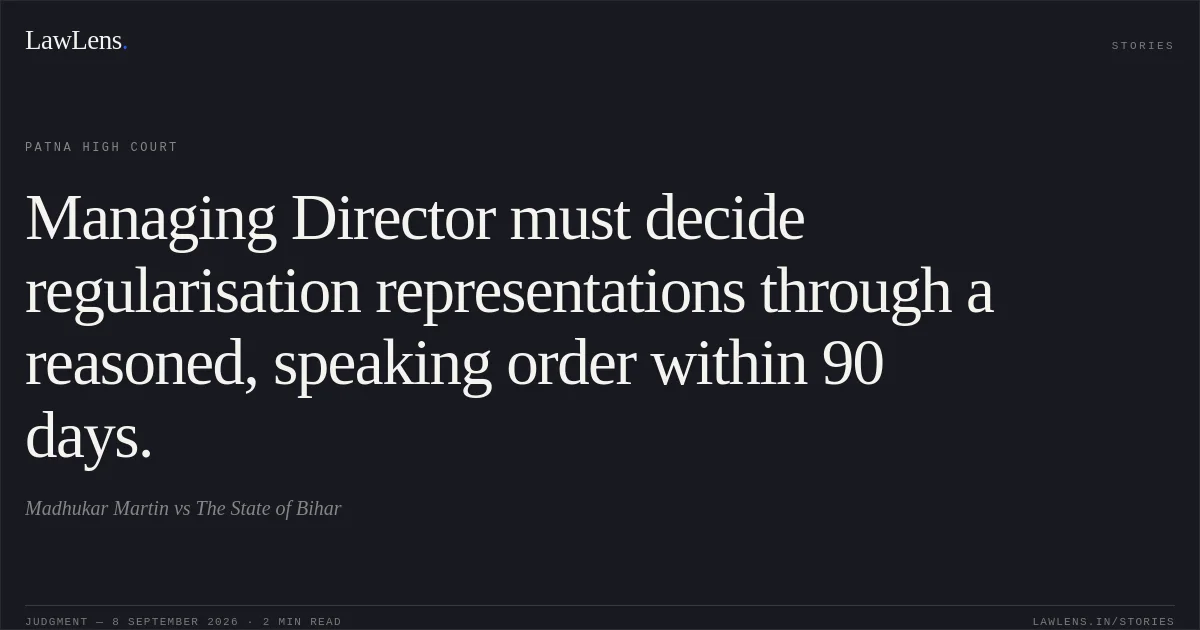
It directed the Managing Director, Bihar State Housing Board, to consider and dispose of the petitioners’ representations by passing a reasoned and speaking order within 90 days from the date of production of the judgment.
Source reference: p. 5With that direction, the writ petition was disposed of.
Source reference: p. 5Original Court PDF
Madhukar MartinvsThe State of Bihar
Click to open original judgment
Original judgment, available to read, download and summarize on LawLens.in