Facts
The Petitioner, an association of property owners, entrepreneurs and residents in commercial and mixed-use areas within the jurisdiction of the New Delhi Municipal Council (“NDMC”), challenged the manner in which rateable values and property tax were assessed.
Source reference: para. 1; p. 2It alleged that NDMC applied different approaches—including the Unit Area Method (“UAM”), actual rent, comparable rent and historical rateable values—to similarly situated properties, resulting in substantial disparities and discriminatory tax liabilities.
Source reference: paras. 2, 7; pp. 2, 4The 2009 NDMC Bye-laws, which incorporated a “Dual Method” and UAM principles, had earlier been declared ultra vires by the Supreme Court in New Delhi Municipal Council v. Association of Concerned Citizens of New Delhi, though past assessments were protected under Article 142.
Source reference: para. 5; p. 3NDMC maintained that it was applying Section 63(1) of the NDMC Act, under which rateable value is based on the annual rent at which the property might reasonably be expected to let, and that actual rent, comparable rent and prior assessments were evidentiary tools rather than separate statutory methods.
Source reference: paras. 3, 10, 15; pp. 2–3, 5, 7–9The Petition sought, inter alia, formulation of a uniform assessment methodology, constitution of an expert committee, and directions for compliance with Sections 63, 65, 70, 71, 72 and 73 of the NDMC Act.
Source reference: para. 18; pp. 10–11The challenge to the words “at any time” in Section 72 was not pressed.
Source reference: paras. 14, 19; pp. 7, 11Issues
1. Whether the High Court could issue a writ of mandamus directing NDMC to formulate and implement a uniform methodology for determining rateable values and property tax.
Source reference: paras. 20–25; pp. 11–132. Whether the Court could direct constitution of an expert committee to investigate alleged irregularities and discrepancies in NDMC’s assessment practices.
Source reference: paras. 26–27; pp. 13–143. Whether a general direction to NDMC to ensure strict compliance with Sections 63, 65, 70, 71, 72 and 73 of the NDMC Act was grantable under Article 226.
Source reference: para. 28; p. 144. Whether the Petitioner-association had an independent, legally enforceable right to maintain the writ petition in respect of alleged individual assessment grievances of its members.
Source reference: paras. 35–36; pp. 17–185. Whether the Court was required to examine the merits of the alleged arbitrariness and disparities in rateable-value assessments after finding the prayers, as framed, unsuitable for mandamus.
Source reference: paras. 37–39; pp. 18–19Law Applied
Section 63(1) of the NDMC Act prescribes the statutory standard for rateable value as the annual rent at which the property might reasonably be expected to let; it does not mandate a single mathematical formula.
Source reference: paras. 3, 15; pp. 2–3, 7–8Dewan Daulat Rai Kapoor v. New Delhi Municipal Committee, (1980) 1 SCC 685, recognises that reasonable rent is a question of fact and that actual rent ordinarily provides guidance unless affected by extraneous circumstances.
Source reference: para. 15; pp. 7–8Section 73 permits adoption of the rateable value in an earlier assessment list, subject to necessary alterations.
Source reference: para. 15; p. 8The Court relied on Union of India v. S.B. Vohra, (2004) 2 SCC 150; Govind Sugar Mills Ltd. v. Hind Mazdoor Sabha, AIR 1975 SC 1735; and State of Mysore v. K.N. Chandrasekhara, AIR 1965 SC 532, for the rule that mandamus may require a statutory authority to exercise discretion according to law but cannot compel the authority to adopt a particular method or substitute the Court’s judgment for that of the statutory authority.
Source reference: para. 21; p. 12Tamil Nadu Education Department Ministerial on General Subordinate Services Association v. State of Tamil Nadu, (1980) 3 SCC 97, supports judicial restraint in interfering with administrative policy merely because another approach may appear preferable or because hardship is alleged.
Source reference: para. 24; p. 13The Court further relied on Indian Sugar Mills Association v. Secretary to Government, Uttar Pradesh, 1950 All LJ 767, for the principle that an association cannot ordinarily seek enforcement of personal rights belonging exclusively to its individual members.
Source reference: para. 36; p. 18Mandamus remains available in taxation matters where the levy is unconstitutional, ultra vires, without jurisdiction or contrary to a statutory or constitutional limitation; however, it is not ordinarily available merely to require adoption of an alternative assessment methodology.
Source reference: paras. 29–30; pp. 15–16Reasoning
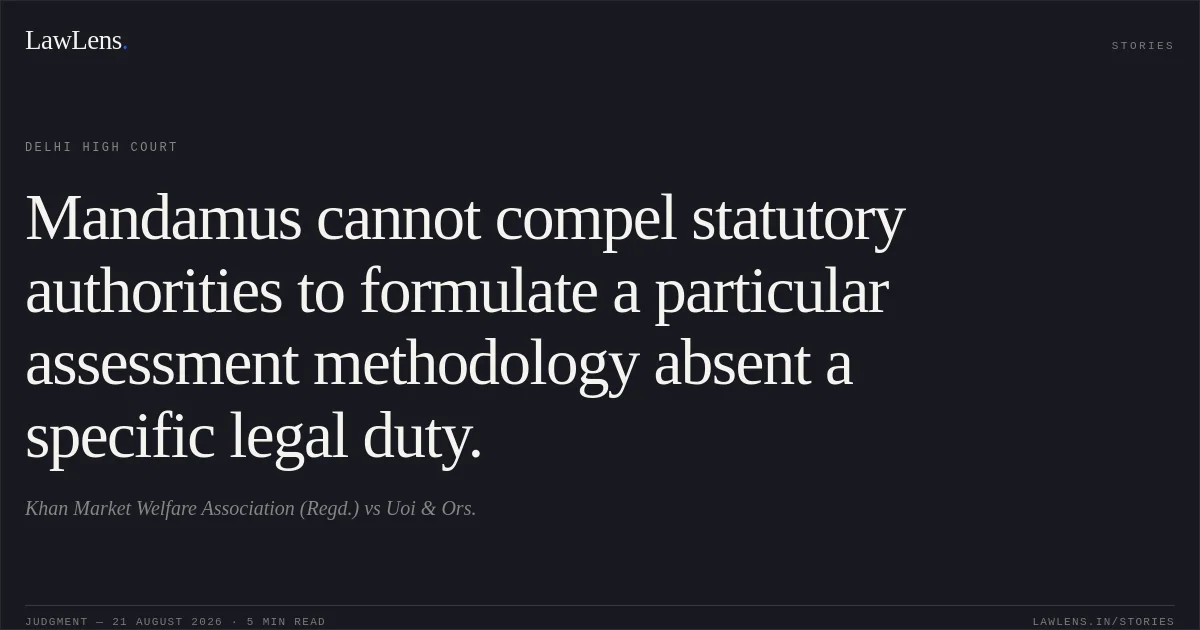
The Court held that prayers (a), (c) and (d) did not seek enforcement of any identified statutory duty but instead invited the Court to design and supervise NDMC’s assessment mechanism.
Source reference: paras. 20–23; pp. 11–13A direction to formulate a uniform method would effectively require the Court to undertake a function entrusted to NDMC, whereas judicial review examines the legality of administrative action and does not permit the Court to administer the statute.
Source reference: paras. 23, 32; pp. 12–16The allegations of arbitrariness, discrimination and hardship did not, without a specific finding of mala fides, irrationality, extraneous considerations, lack of jurisdiction or statutory breach, justify such a structural mandamus.
Source reference: paras. 24–25, 30, 33; pp. 13, 16–17The proposed expert committee lacked any identified statutory foundation and would require the Court to create an administrative institution, prescribe its composition and confer functions upon it.
Source reference: paras. 26–27; pp. 13–14The general direction to comply with statutory provisions was also impermissibly vague because NDMC was already bound by the Act, and any specific breach could be challenged in appropriate proceedings.
Source reference: para. 28; p. 14Additionally, the Petitioner had not demonstrated an independent right of the association; the alleged prejudice principally concerned individual assessees, and the petition was neither a properly framed public-interest action nor a proceeding involving persons unable to approach the Court themselves.
Source reference: paras. 35–36; pp. 17–18Having disposed of the petition on maintainability and the nature of the reliefs, the Court declined to adjudicate the underlying merits of the alleged disparities.
Source reference: paras. 37–38; pp. 18–19Holding
The Court dismissed the writ petition because prayers (a), (c) and (d), as framed, were not amenable to a writ of mandamus under Article 226.
Prayer (b), challenging the expression “at any time” in Section 72, was not pressed and therefore was not adjudicated.
Source reference: paras. 14, 19, 40; pp. 7, 11, 19The Court expressly left open the merits of the allegations concerning NDMC’s assessment practices and clarified that individual assessees remained free to pursue remedies under the NDMC Act against particular assessments, procedural non-compliance, determination of rateable value or unreasonable delay in finalisation of proceedings.
Source reference: paras. 38–39; pp. 18–19Acts & Sections Cited
6 provisions across 1 statute referred to in this judgment. Each provision opens on LawLens.
New Delhi Municipal Council Act, 19946
Original Court PDF
Khan Market Welfare Association (Regd.)vsUoi & Ors.
Click to open original judgment
Original judgment, available to read, download and summarize on LawLens.in