Facts
The sixteen petitioners, who were serving, officiating, or superannuated employees, sought a writ of mandamus directing the State authorities to extend to them the benefits of seniority, annual increments, Assured Career Progression (ACP), and related service benefits allegedly granted to similarly situated employees appointed earlier under the same advertisement and panel.
Source reference: para. 2; p. 2The petitioners relied upon orders passed in CWJC No. 15663 of 2022 and CWJC No. 5830 of 2026, by which comparable employees had reportedly received such benefits.
Source reference: para. 2; p. 2However, the petitioners had not previously submitted representations before the competent authority seeking adjudication of their individual claims.
Source reference: para. 3; p. 2Issues
Whether a writ of mandamus could be issued when the petitioners had not first submitted representations before the competent authority regarding their claims for service benefits
Source reference: para. 3; p. 2Whether the petitioners should be granted liberty to submit individual representations, along with supporting documents and relied-upon judgments, for consideration by the Director, Primary Education
Source reference: paras. 4–5; pp. 3–4Law Applied
A writ of mandamus may be issued only where a legal or statutory duty is imposed upon the public authority and there has been a failure to discharge that duty.
Source reference: para. 3; p. 2The Court relied on Lekhraj Sathramdas Lalvani v. N. M. Shah, Deputy Custodian-cum-Managing Officer, Bombay, AIR 1966 SC 334 and Saraswati Industrial Syndicate Ltd. v. Union of India, (1974) 2 SCC 630, particularly paragraphs 24 and 25, for this principle.
Source reference: para. 3; p. 2The Court further proceeded on the procedural principle that, where the competent authority has not first been approached with the claimant’s individual service details and supporting materials, mandamus should not ordinarily be issued directly by the Court.
Source reference: para. 3; p. 2Reasoning
The Court found that the petitioners had approached it without first presenting their claims to the Director, Primary Education or another competent authority.
Source reference: para. 3; p. 2In the absence of such representations, there was no demonstrated failure by the authority to perform a statutory duty after considering the petitioners’ individual service records and documents.
Source reference: para. 3; p. 2Consequently, the precondition for issuing mandamus was not established.
Source reference: para. 3; p. 2Nevertheless, since the State indicated that the petitioners could submit individual representations containing their service profiles and supporting documents, the Court considered it appropriate to provide that procedural opportunity rather than adjudicate the substantive entitlement to seniority, increments, ACP, or other benefits at that stage.
Source reference: paras. 4–5; pp. 3–4Holding
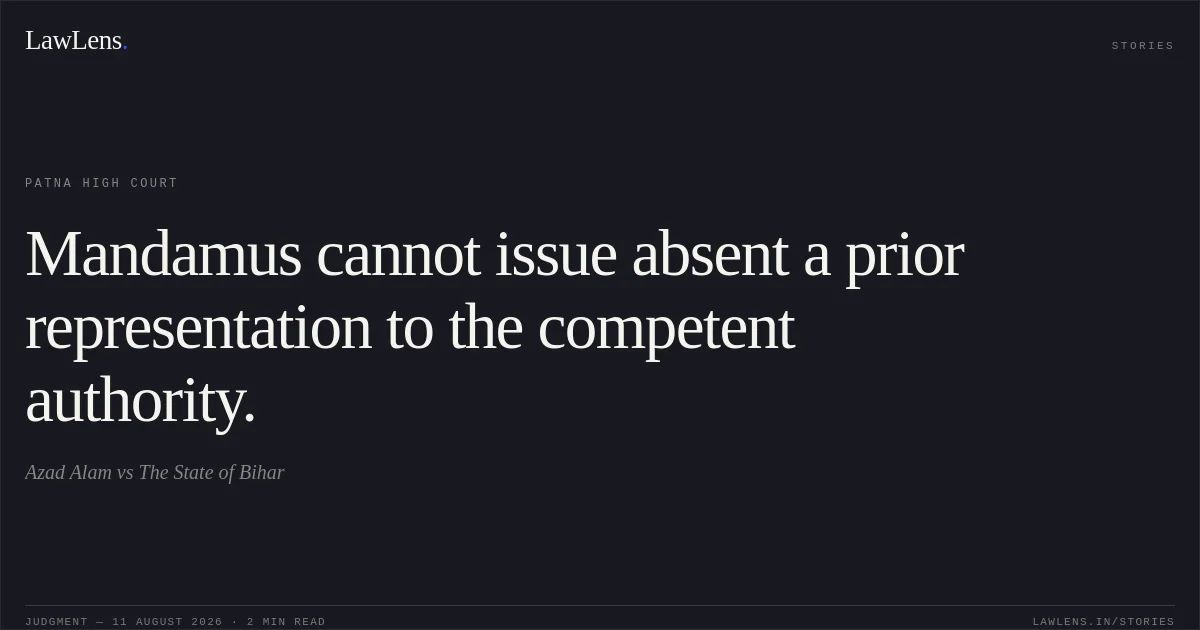
The Court declined to issue the requested writ of mandamus because the petitioners had not previously made representations before the competent authority.
The writ petition was disposed of with liberty to each petitioner to submit an individual representation to the Director, Primary Education, Department of Education, Government of Bihar, together with all supporting documents and the judgments relied upon.
Source reference: para. 5; p. 3The Director was directed to dispose of the representations expeditiously and in accordance with law.
Source reference: para. 5; p. 3The petition was accordingly disposed of, along with any pending interlocutory applications.
Source reference: paras. 6–7; p. 4Original Court PDF
Azad AlamvsThe State of Bihar
Click to open original judgment
Original judgment, available to read, download and summarize on LawLens.in