Facts
The petitioner claimed to be in "hostile possession" of a property used as a Gau-shala since 2002.
Source reference: para. 7A civil suit for permanent injunction (No. 128/2019) and land grabbing proceedings were already pending between the parties.
Source reference: para. 7The petitioner alleged that on January 19, 2026, the private respondents (Nos. 12 & 13) forcibly dispossessed her and partially demolished the construction with the active assistance of police personnel.
Source reference: para. 3The petitioner sought a High Court direction to register an FIR and initiate disciplinary action against the officers.
Source reference: para. 1A report from the Deputy Commissioner of Police revealed that the police arrived at the scene only after receiving emergency calls from both the petitioner’s husband and the private respondent regarding a quarrel.
Source reference: para. 9Issues
1. Whether the facts available on record indicate the commission of a cognizable offence necessitated by the High Court's intervention?
Source reference: para. 6(i)2. Whether the petitioner had exhausted the alternative remedy of approaching the police authorities for registration of an FIR before filing the writ petition?
Source reference: para. 6(ii)3. Whether a writ of mandamus can be issued to register an FIR without evidence of the police refusing a prior request?
Source reference: para. 12Law Applied
The Court considered the principles of mandatory registration of FIR for cognizable offences as laid down in Lalita Kumari v. Govt. of U.P.
Source reference: p. 4The Court evaluated the maintainability of writ petitions under Article 226 of the Constitution of India in matters of FIR registration, referencing Rameshwar Vitthalbhai Navadiya v. State of Gujarat regarding directions to register offences.
Source reference: p. 4-5Section 170 of the Bharatiya Nagarik Suraksha Sanhita, 2023 (BNSS) regarding preventive measures.
Source reference: para. 9Section 528 of the Bharatiya Nyaya Sanhita (BNS), 2023.
Source reference: para. 1Reasoning
The Court found that the dispute was essentially civil in nature, involving a contested claim of "hostile possession" already pending before a Civil Court.
Source reference: para. 7-8Upon examining video footage and the DCP’s report, the Court determined that the allegations of police collusion were unfounded; the police were present because both parties called the control room to report a ruckus.
Source reference: para. 9-10The Court observed that the petitioner suppressed the fact that her husband invited the police presence.
Source reference: para. 9Crucially, the Court noted that the petitioner failed to provide any evidence of ever approaching the concerned police station or higher authorities to file a formal complaint before approaching the High Court.
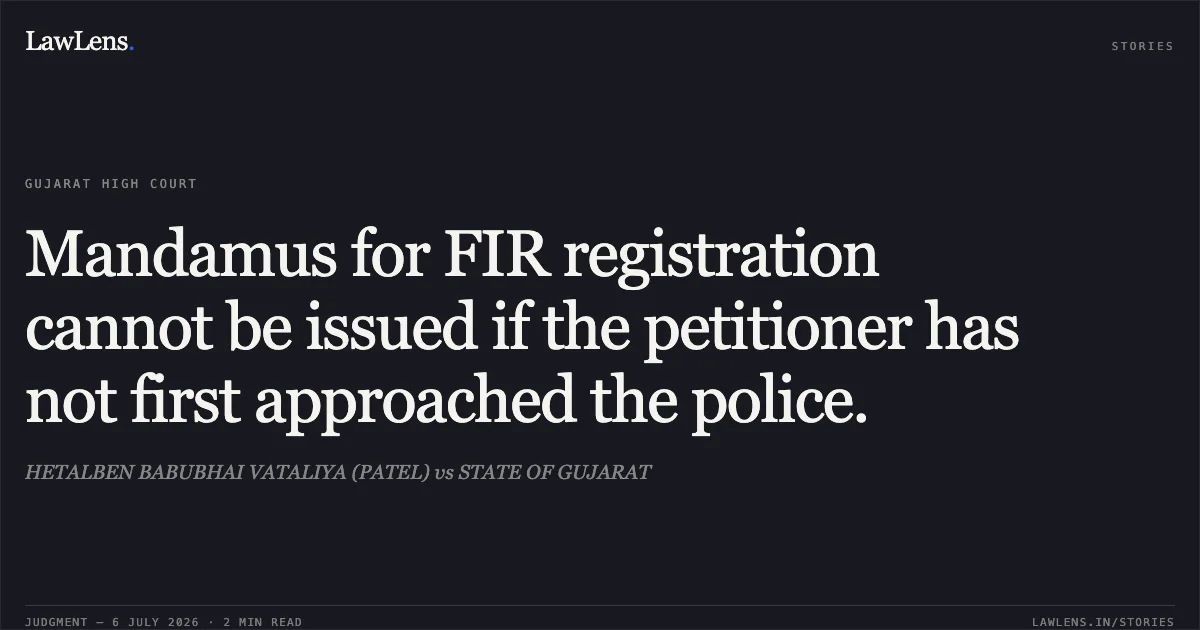
Source reference: para. 12In the absence of a refused request for an FIR, a writ of mandamus could not be issued.
Source reference: para. 12Holding
The Court held that no cognizable offence was clearly disclosed and the petition was an attempt to give a "criminal colour" to a civil property dispute.
The Court dismissed the petition, ruling that it would not exercise its extraordinary jurisdiction under Article 226 because the petitioner had not exhausted the primary step of requesting the police to register an FIR. The prayer for a detailed inquiry and restoration of possession was denied.
Source reference: para. 12-13Acts & Sections Cited
2 provisions across 2 statutes referred to in this judgment. Each provision opens on LawLens.
Bharatiya Nyaya Sanhita, 20231
Bharatiya Nagarik Suraksha Sanhita, 20231
Original Court PDF
HETALBEN BABUBHAI VATALIYA (PATEL)vsSTATE OF GUJARAT
Click to open original judgment
Original judgment, available to read, download and summarize on LawLens.in


