Facts
The Petitioner claims continuous, peaceful possession of Abadi land in District Bemetara since 2000, where he raised construction.
Source reference: para 2, 4His rights were initially recognized in revenue records and a 2024 Patwari report confirmed his possession.
Source reference: para 4Respondent No. 5 claims rights via a 2002 sale deed but allegedly never sought mutation or possession for 24 years.
Source reference: para 4In February 2026, the Tehsildar ordered the deletion of the Petitioner’s name from revenue records; however, on appeal, the SDO (Revenue) set aside this order on 13.04.2026 and remanded the matter to the Tehsildar for fresh adjudication on eight material issues.
Source reference: para 4Despite receiving the case on 22.04.2026, the Tehsildar failed to conclude the proceedings.
Source reference: para 4The Petitioner approached the High Court seeking a writ of mandamus for a time-bound disposal and protection against dispossession.
Source reference: para 2, 3Issues
1. Whether the High Court should exercise its extraordinary jurisdiction under Article 226 of the Constitution to direct a revenue authority to conclude remanded proceedings within a time-bound period.
Source reference: para 2, 82. Whether the Petitioner is entitled to interim protection against dispossession and the creation of third-party rights by Respondent No. 5 pending the final decision by the revenue authority.
Source reference: para 3, 4Law Applied
The Court exercised its extraordinary writ jurisdiction under Article 226 of the Constitution of India, which empowers High Courts to issue directions or writs for the enforcement of legal rights and to ensure that subordinate authorities perform their statutory duties.
Source reference: p. 2The court applied the administrative law principle of "expeditious disposal," which mandates that when a superior authority (SDO) remands a case with specific directions, the subordinate authority (Tehsildar) is duty-bound to adjudicate the matter within a reasonable timeframe to prevent prejudice to the parties.
Source reference: para 2, 8Reasoning
The Court noted that the grievance primarily stemmed from administrative "inaction and failure" of the Tehsildar to decide the remanded proceedings despite specific directions from the appellate authority (SDO).
Source reference: para 2The Petitioner argued that the delay left him vulnerable to "forcible interference" and the "creation of third-party rights" by Respondent No. 5.
Source reference: para 4During the hearing, the Petitioner limited his prayer to seeking a direction for the SDO/Tehsildar to decide the matter in accordance with the law.
Source reference: para 5The State counsel did not oppose this limited prayer.
Source reference: para 6The Court found that since the revenue proceedings were already pending post-remand, the appropriate remedy was to ensure the administrative process was completed rather than adjudicating the title or possession merits itself.
Source reference: para 8, 9Holding
The High Court disposed of the writ petition without expressing any opinion on the merits of the case.
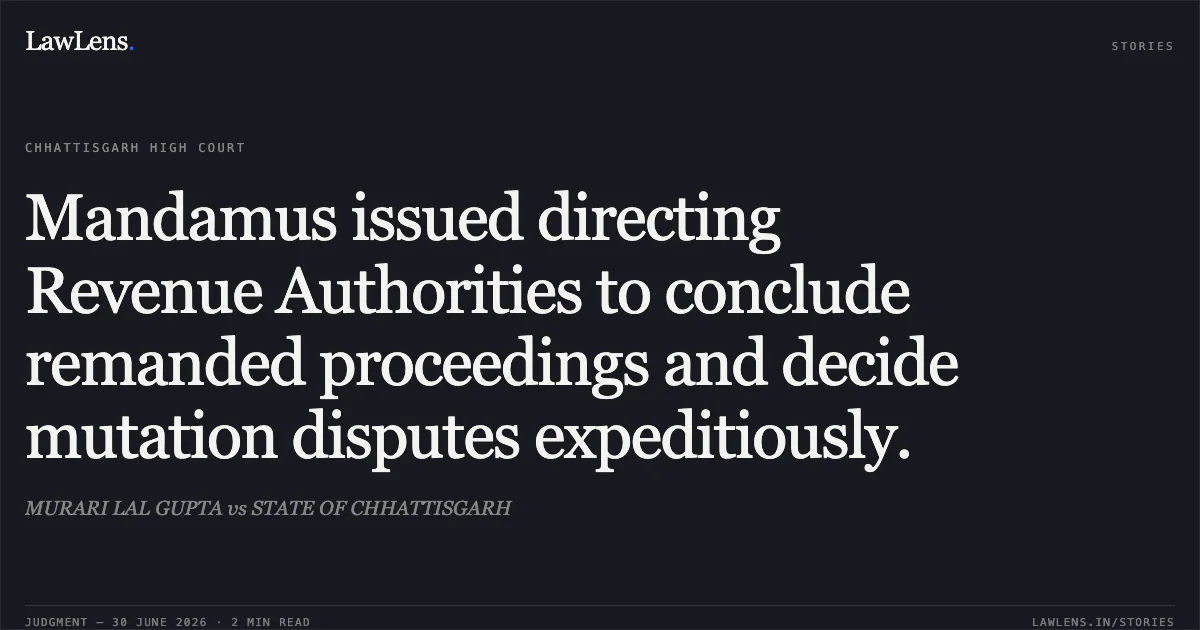
It directed the SDO (Revenue), Bemetara, to consider and decide the pending proceedings/application of the Petitioner expeditiously and strictly in accordance with the law.
Source reference: para 8The Court further mandated that the authority must afford a due opportunity of hearing to all concerned parties and arrive at an independent decision.
Source reference: para 8, 9Acts & Sections Cited
1 provisions across 1 statute referred to in this judgment. Linked provisions open on LawLens.
C.G. Land Revenue Code, 19591
Original Court PDF
MURARI LAL GUPTAvsSTATE OF CHHATTISGARH
Click to open original judgment
Original judgment, available to read, download and summarize on LawLens.in


