Facts
The petitioners, three minor girls (aged 15), alleged they were repeatedly sexually abused and threatened by five accused persons over two days in August 2022.
Source reference: p. 3An FIR was registered under various sections of the IPC and Section 6 of the POCSO Act.
Source reference: p. 3During the trial, the victims were summoned repeatedly—Petitioner No. 1 nine times, Petitioner No. 2 four times, and Petitioner No. 3 six times—to record evidence, often resulting in adjournments without progress.
Source reference: p. 5, 21Furthermore, a Trial Court issued bailable warrants against Petitioner No. 1 when she failed to appear due to emotional distress.
Source reference: p. 6The petitioners approached the High Court seeking to set aside the warrants and for directions to ensure strict compliance with safeguards for child victims, including the use of video-conferencing to prevent re-traumatization.
Source reference: p. 2Issues
Whether the Trial Court's repeated summoning of child victims and issuance of bailable warrants against a minor victim violated the mandate of Section 33(5) of the POCSO Act.
Source reference: p. 18-20Whether the Special Courts are required to utilize video-conferencing and other testimonial aids to record the evidence of vulnerable witnesses to prevent re-traumatization.
Source reference: p. 22-23Whether the mandatory presence of a victim is required during every hearing of a bail application in cases involving sexual offences.
Source reference: p. 31-32Law Applied
The Court primarily applied Section 33(5) of the POCSO Act, which mandates that a child shall not be called repeatedly to testify.
Source reference: p. 18It relied on Section 35 (timelines for trial) and Section 36 (child-friendly procedures/video-links) of the POCSO Act.
Source reference: p. 18-19The Court further applied the "Guidelines of the High Court of Delhi for Recording of Evidence of Vulnerable Witnesses, 2024," which define "live links" and "testimonial aids."
Source reference: p. 17, 24Judicial precedents included *Smruti Tukaram Badade v. State of Maharashtra*, which expanded the definition of vulnerable witnesses.
Source reference: p. 12And *XXXX v. State*, which provided practice directions regarding victim presence during bail hearings.
Source reference: p. 32-35Reasoning
The Court reasoned that the legislative intent of the POCSO Act is to protect children from the secondary trauma of the legal process.
Source reference: p. 18It observed that repeated summoning of victims for over a year without concluding evidence constitutes a systemic failure to adhere to Section 33(5).
Source reference: p. 21The Court emphasized that while the power to recall witnesses under Section 311 Cr.P.C. exists, it must be balanced against the child's right to privacy and dignity.
Source reference: p. 19-20Regarding technology, the Court noted that the 2024 Guidelines already provide a robust framework for "Live Links" and "Vulnerable Witness Deposition Centres (VWDCs)," rendering further specific guidelines unnecessary but necessitating stricter implementation.
Source reference: p. 23-30On bail hearings, the Court held that once a victim’s objections are recorded, their continuous presence is an unnecessary burden that leads to re-living the trauma in the presence of the accused.
Source reference: p. 35-36Holding
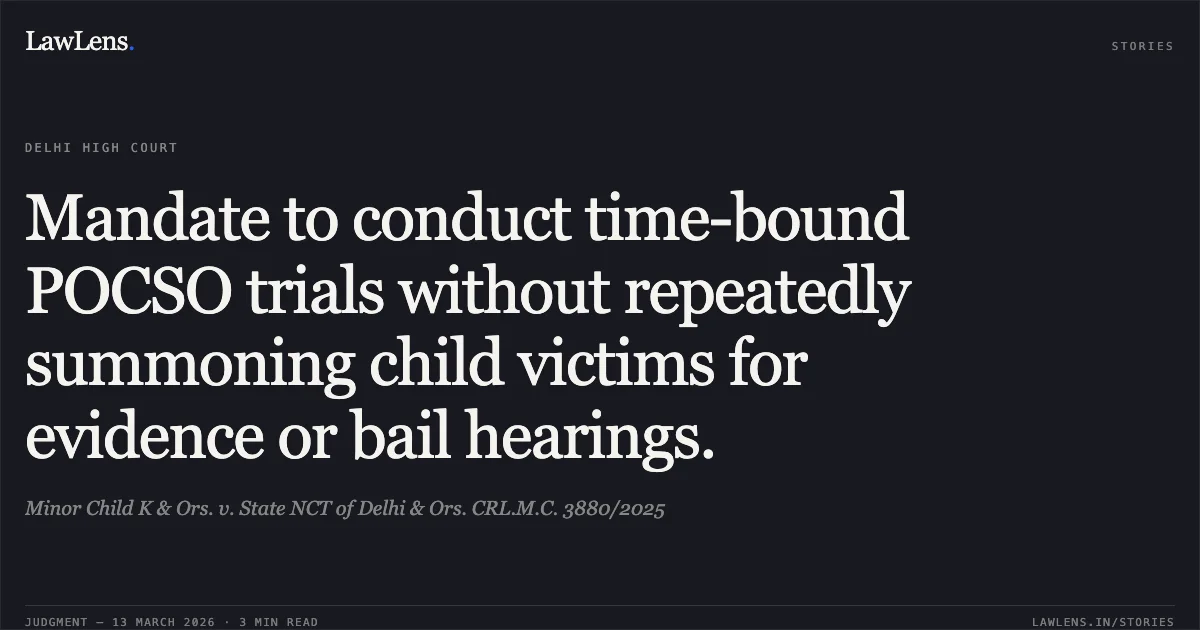
The Court held that Special Courts must strictly adhere to the time-bound mandate of Section 35 of the POCSO Act and minimize the physical appearance of child victims.
The Court ordered that: (i) bailable warrants against the minor victim be set aside (previously done via interim order).
Source reference: p. 4(ii) Trial Courts must fix specific dates to conclude testimony in a single block to avoid repeated summoning.
Source reference: p. 22(iii) video-conferencing must be liberally permitted upon request as per the 2024 Guidelines.
Source reference: p. 30And (iv) victim presence in bail hearings should not be insisted upon once initial objections are recorded.
Source reference: p. 36The judgment was directed to be circulated to all Judicial Officers in Delhi for guidance.
Source reference: p. 38Original Court PDF
Minor Child K & Ors. v. State NCT of Delhi & Ors. CRL.M.C. 3880/2025
Click to open original judgment
Original judgment, available to read, download and summarize on LawLens.in