Facts
The petitioner appeared in an examination conducted by the respondent-Commission and entered the numerically correct Question Book Number, “204103343”, in the OMR sheet.
Source reference: para. 2However, while marking the corresponding bubbles, the petitioner marked the first bubble representing “0” and inadvertently also marked the fourth bubble in the second column.
Source reference: para. 2The petitioner contended that, since the numerical entry was correct, the OMR sheet ought to have been evaluated manually or otherwise processed.
Source reference: para. 2The Commission stated that approximately 14,000 candidates had similarly committed errors in filling the OMR sheets and that the sheets were not evaluated because of non-compliance with the prescribed instructions.
Source reference: paras. 3 and 5The writ petition sought relief against the non-evaluation of the petitioner’s OMR sheet.
Source reference: no citationIssues
1. Whether an OMR sheet containing an incorrect or additional bubble marking in the Question Book Number column, despite a numerically correct written entry, could be manually evaluated or otherwise accepted for evaluation.
Source reference: para. 22. Whether the High Court could grant equitable or sympathetic relief by directing evaluation of the petitioner’s OMR sheet despite non-compliance with mandatory examination instructions.
Source reference: paras. 4, 6 and 83. Whether permitting physical or manual evaluation in the petitioner’s case would compromise the fairness, uniformity, and transparency of the examination process.
Source reference: para. 9Law Applied
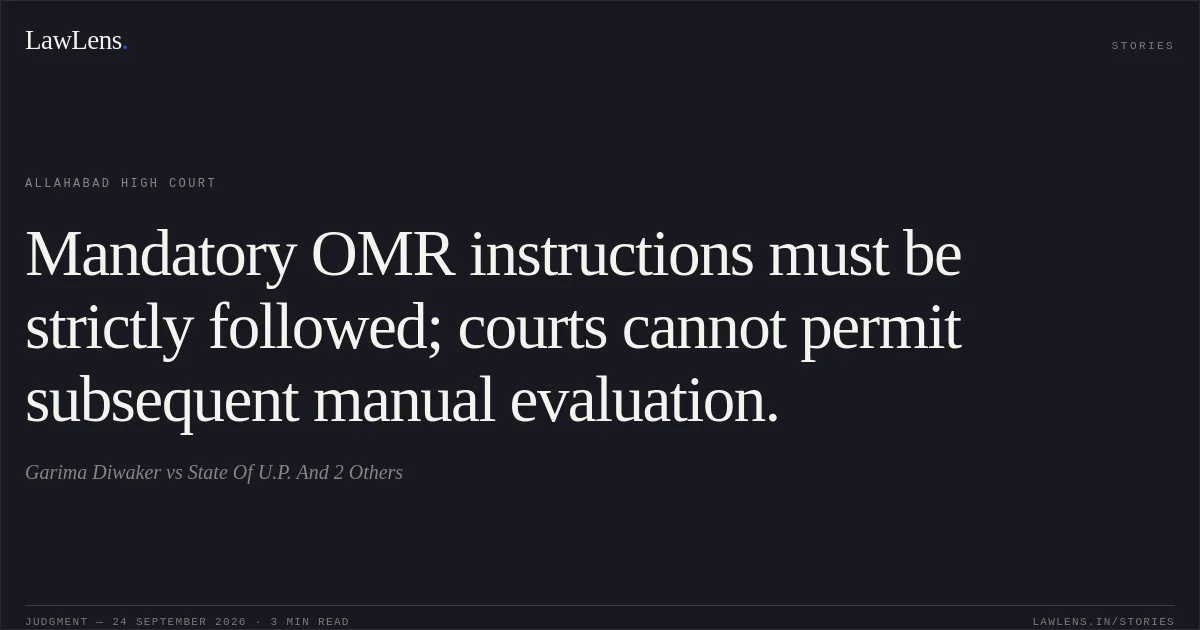
The Court held that examination instructions governing the filling of OMR sheets are mandatory and must be strictly complied with; candidates who fail to correctly fill identification particulars such as the registration number, roll number, Question Booklet Series, or language cannot ordinarily seek subsequent correction or manual evaluation.
Source reference: paras. 7–9Relying on U.P. Public Service Commission v. Rahul Singh, (2018) 3 ESC 377 (SC), the Court reiterated that judicial interference in academic and examination matters is limited.
Source reference: para. 3It also relied on State of Tamil Nadu v. G. Hemalathaa, 2019 SCC OnLine SC 1113, as considered in Vinay Kumar v. State of U.P., (2022) 4 ADJ 631 (DB), for the principle that mandatory examination instructions cannot be relaxed on sympathetic or humanitarian grounds.
Source reference: paras. 4 and 6The Court further followed Jai Karan Singh v. State of U.P., Special Appeal No. 90 of 2018, decided on 25 April 2018, and U.P. Secondary Education Services Selection Board v. State of U.P., 2022 (4) ADJ 7 (DB), which disapproved directions for manual checking where candidates had incorrectly filled essential OMR particulars.
Source reference: paras. 7 and 9Reasoning
The Court treated the additional bubble marking in the Question Book Number column as a failure to comply with the prescribed OMR instructions, notwithstanding the petitioner’s assertion that the numerical entry was correct.
Source reference: para. 2Since the examination system was designed for electronic scanning and the petitioner’s marking did not conform to the required format, the Court held that the error could not be regarded as a negligible or curable irregularity.
Source reference: paras. 7–8The fact that approximately 14,000 candidates had faced similar rejection reinforced the need for a uniform rule rather than a case-specific indulgence.
Source reference: paras. 3 and 5Directing manual evaluation only for the petitioner would undermine equal treatment, delay the examination process, and raise concerns regarding fairness and transparency.
Source reference: para. 9Accordingly, the Court declined to invoke equitable jurisdiction in the face of mandatory instructions.
Source reference: no citationHolding
The Court answered the issues against the petitioner and held that the OMR sheet could not be evaluated manually or otherwise accepted because of the petitioner’s failure to comply with the mandatory marking instructions.
The writ petition was dismissed, and no order was made as to costs.
Source reference: para. 11Original Court PDF
Garima DiwakervsState Of U.P. And 2 Others
Click to open original judgment
Original judgment, available to read, download and summarize on LawLens.in