Facts
The Petitioner, a convict under Section 138 of the Negotiable Instruments Act, 1881, was sentenced to one year of simple imprisonment and a fine/compensation.
Source reference: p. 2Having surrendered on May 3, 2025, he applied for parole leave on March 23, 2026.
Source reference: p. 2The prison authorities, however, directed him to withdraw the application citing Rule 14 of the Maharashtra Prisons (Furlough and Parole) Rules, 2024 ("Rules of 2024"), which mandates a minimum of one year of actual imprisonment before becoming eligible for regular parole.
Source reference: p. 3The Petitioner challenged the constitutional validity of this specific provision under Article 226 of the Constitution.
Source reference: p. 1-2Issues
1. Whether the provision in Rule 14(1) of the Rules of 2024, requiring completion of one year of actual imprisonment for parole eligibility, is unconstitutional and violative of Articles 14 and 21 of the Constitution of India.
Source reference: para. 6, 14Law Applied
The court relied on the Larger Bench decision in Kantilal Nadlal Jaiswal v. Divisional Commissioner (2020), which established that parole is a limited legal right, not a mere administrative concession.
Source reference: para. 11Any restriction on parole must have a rational nexus to the objective of the Rules.
Source reference: para. 12The principle from Asfaq v. State of Rajasthan (2017), which holds that parole/furlough are humanistic tools intended to help prisoners maintain social links and solve personal problems.
Source reference: para. 20The test of "manifest arbitrariness" under Article 14 as elucidated in Navtej Singh Johar v. Union of India (2018).
Source reference: para. 12-13Reasoning
The Court observed that Rule 12 and 13 of the 2024 Rules grant parole for urgent family contingencies such as serious illness, death, birth of a child, or natural calamities.
Source reference: para. 9Following the logic of the Kantilal Jaiswal precedent, the Court reasoned that a mandatory "one-year cap" of actual imprisonment bears no rational nexus to these humanitarian grounds.
Source reference: para. 15-16It found it "insensitive and even cruel" to bar a prisoner from attending to a dying relative or a destroyed home simply because they had not yet served 365 days.
Source reference: para. 12 quoting KantilalThe Court noted that unlike furlough, parole periods are not counted toward the sentence (Rule 19), and thus the restriction was an arbitrary barrier that defeated the "humanistic approach" mandated by the Supreme Court.
Source reference: para. 17-21Consequently, the restriction failed the classification test and was deemed manifestly arbitrary.
Source reference: para. 21Holding
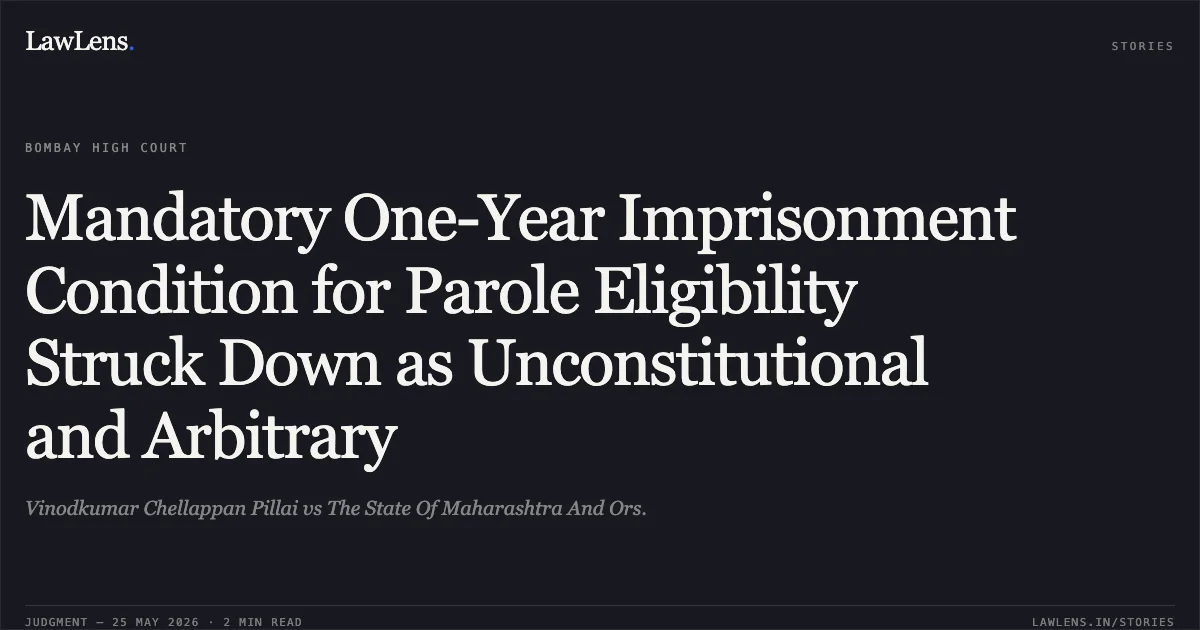
The Court held that the phrase "on completion of one year of actual imprisonment" in Rule 14(1) of the Maharashtra Prisons (Furlough and Parole) Rules, 2024, is ultra vires and violative of Articles 14 and 21 of the Constitution of India.
The Court struck down that specific portion of the Rule.
Source reference: para. 22The Respondents were directed to decide the Petitioner’s parole application in accordance with the law on or before May 15, 2026; the Writ Petition was disposed of accordingly.
Source reference: para. 23, 26Acts & Sections Cited
1 provisions across 1 statute referred to in this judgment. Each provision opens on LawLens.
Negotiable Instruments Act, 18811
Original Court PDF
Vinodkumar Chellappan PillaivsThe State Of Maharashtra And Ors.
Click to open original judgment
Original judgment, available to read, download and summarize on LawLens.in