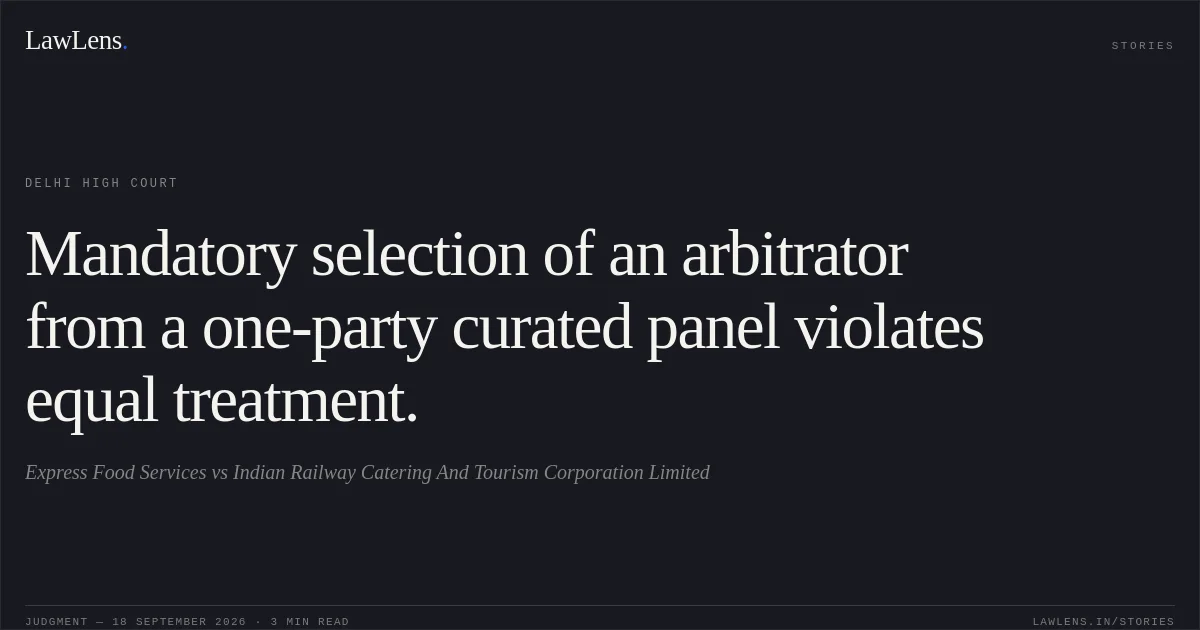
Facts
The petitioner, a partnership firm engaged in railway catering, was awarded 11 cluster-catering tenders by the respondent, IRCTC, after competitive bidding.
Source reference: p. 1–2As part of the technical eligibility requirements, the petitioner submitted ISO 22000:2018 certificates for catering units at Itarsi and Agra Cantt railway stations.
Source reference: p. 1–2The certificates were procured through an intermediary, which had engaged Otabu, the certifying body.
Source reference: p. 1–2The petitioner asserted that it had been represented that the certificates would remain valid for three years without further action; however, the certificates were subsequently cancelled for non-surveillance.
Source reference: p. 1–2IRCTC issued a show-cause notice dated 27 April 2026, proposing termination of all 11 tenders, forfeiture of the licence fee and security deposit, and debarment of the petitioner for three years.
Source reference: p. 2The petitioner replied on 10 May 2026, filed proceedings under Section 9 of the Arbitration and Conciliation Act, 1996, and invoked arbitration on 29 August 2026.
Source reference: p. 2The governing Master License Agreement contained an arbitration clause providing for appointment of a sole arbitrator from IRCTC’s panel of empanelled arbitrators.
Source reference: p. 3The existence of the arbitration agreement was admitted, but the petitioner challenged the appointment mechanism as unequal and impermissibly controlled by IRCTC.
Source reference: p. 3Issues
Whether the arbitration clause requiring appointment of a sole arbitrator from IRCTC’s panel of empanelled arbitrators was legally sustainable, having regard to the principle of equal participation and impartiality in arbitral appointments.
Source reference: p. 3–5; paras. 9–12Whether an independent sole arbitrator should be appointed by the High Court under Section 11 of the Arbitration and Conciliation Act, 1996.
Source reference: p. 1, 5; paras. 1, 13–14Law Applied
The Court applied Section 11 of the Arbitration and Conciliation Act, 1996, governing the appointment of arbitrators by the court, and Section 18, which embodies the principle of equal treatment of parties in arbitral proceedings.
Source reference: p. 1, 4Relying on Central Organisation for Railway Electrification v. ECI SPIC SMO MCML (JV), (2025) 4 SCC 641, the Court held that an appointment mechanism under which one party unilaterally curates a panel and the other party is compelled to select an arbitrator from that panel restricts equal participation and may give rise to justifiable doubts regarding independence and impartiality.
Source reference: p. 3–5; para. 10The Court also relied on Kalpataru Projects International Ltd. v. Northern Railway, 2026 SCC OnLine Del 110, which held that even where a three-member panel is contemplated, requiring one party to select its arbitrator from a panel curated by the other party is inconsistent with the principle of equal treatment and renders the appointment procedure unsustainable.
Source reference: p. 5; para. 11The appointed arbitrator was required to furnish disclosures under Section 12 of the A&C Act.
Source reference: p. 5–6; para. 15Reasoning
The Court found that although the arbitration agreement itself was undisputed, its appointment mechanism required the sole arbitrator to be selected from IRCTC’s own curated panel.
Source reference: p. 3–5; para. 10Applying the principle in Central Organisation for Railway Electrification, the Court recognised that such a mechanism restricts the petitioner’s freedom of choice and gives IRCTC exclusive control over the pool of eligible arbitrators, thereby undermining equal participation and creating concerns regarding independence and impartiality.
Source reference: p. 3–5; para. 10The Court further noted the coordinate Bench’s decision in Kalpataru Projects, which treated a similar clause as invalid.
Source reference: p. 5; para. 11In view of this legal position, and particularly because the Solicitor General appearing for IRCTC fairly consented to appointment of an independent sole arbitrator despite disputing the merits of the underlying controversy, the Court proceeded to appoint an arbitrator independently of the contractual panel.
Source reference: p. 5; paras. 11–13Holding
The Court held that the contractual mechanism requiring selection of the sole arbitrator from IRCTC’s empanelled list could not be sustained under the principle of equal treatment of parties.
Mr. Justice (Retd.) J. R. Midha, former Judge of the Delhi High Court, was appointed as the sole arbitrator to adjudicate the disputes between the parties under Section 11 of the A&C Act.
Source reference: p. 5; para. 14The arbitration was directed to take place under the aegis of, and in accordance with the rules of, the Delhi International Arbitration Centre.
Source reference: p. 5–6; paras. 15–18The arbitrator was required to furnish the disclosures mandated by Section 12, and all rights and contentions concerning the claims and counterclaims were kept open for determination on merits.
Source reference: p. 5–6; paras. 15–18The petition was accordingly disposed of.
Source reference: p. 6; para. 19Acts & Sections Cited
4 provisions across 1 statute referred to in this judgment. Each provision opens on LawLens.
Arbitration and Conciliation Act, 19964
Original Court PDF
Express Food ServicesvsIndian Railway Catering And Tourism Corporation Limited
Click to open original judgment
Original judgment, available to read, download and summarize on LawLens.in
![Competent authority must consider casual workers’ wage-benefit representation and issue a reasoned order.. Rati bhan singh and others vs DEPARTMENT OF CULTURE. CAT - ['Allahabad']. LawLens](/stories/thumbnails/competent-authority-must-consider-casual-workers-wage-benefit-representation-and-issue-a-r-ed76119895494f67a72a389de9ebe846.webp)
![Pay protection cannot be withdrawn or recovered without individual determination and prior hearing.. Mehraj Ud Din Wani vs D/o Education Ut Of J & K. CAT - ['Srinagar']. LawLens](/stories/thumbnails/pay-protection-cannot-be-withdrawn-or-recovered-without-individual-determination-and-prior-f1030926f7764c7fb6d8bce15c5054b2.webp)