Facts
The respondent-claimant, an employee of the Bhanvad Municipality, sustained injuries due to an electric shock on 30.04.2017 while repairing a streetlight
Source reference: p. 6He suffered permanent disability of 37.5% to the body as a whole
Source reference: p. 9The appellant-Municipality disputed the employer-employee relationship and contended the injury occurred during private work
Source reference: p. 2The Commissioner under the Workmen’s Compensation Act, Jamnagar, allowed the claim in Case No. 2 of 2018, awarding Rs. 3,66,220/- as compensation, 12% interest, medical expenses of Rs. 2,65,292/-, and a 50% penalty under Section 4A(3)(b)
Source reference: p. 1-2The appellant challenged this award, specifically the imposition of the penalty without a show-cause notice
Source reference: p. 3Issues
Whether the claimant sustained the injury in the course of employment with the appellant municipality?
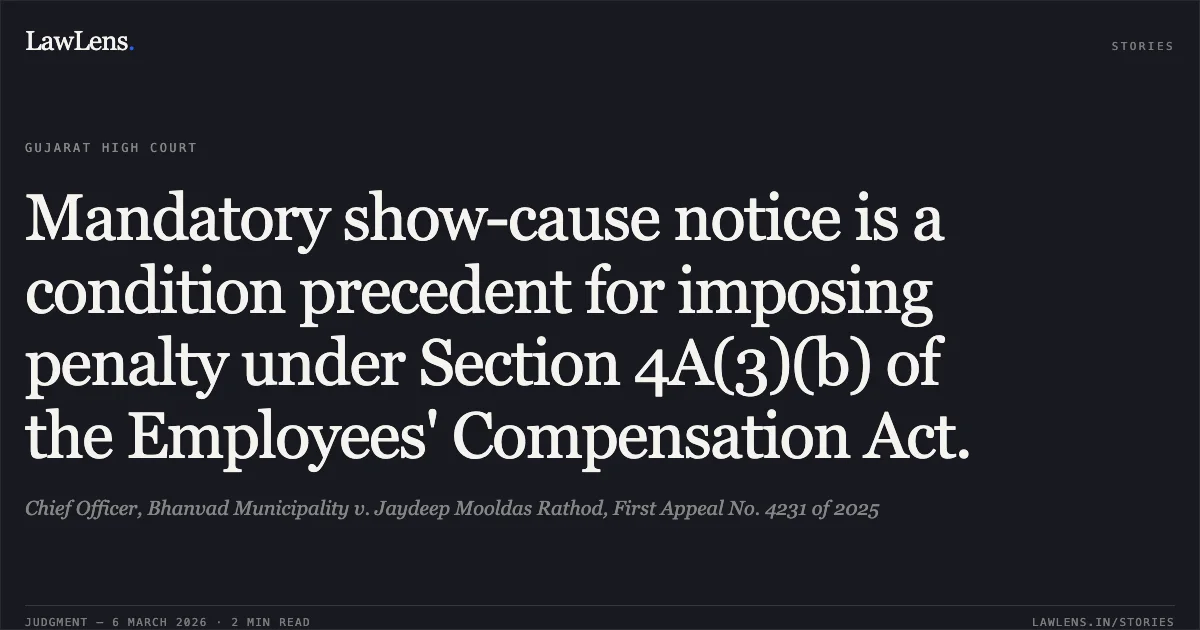
Source reference: p. 11Whether the learned Commissioner was justified in imposing a 50% penalty under Section 4A(3)(b) of the Act without granting the appellant an opportunity of hearing or issuing a show-cause notice?
Source reference: p. 11Law Applied
The court applied Section 3 and Section 4A of the Employees’ Compensation Act, 1923 (formerly Workmen’s Compensation Act), which mandates that compensation be paid as soon as it falls due
Source reference: p. 13It specifically relied on the proviso to Section 4A(3)(b), which stipulates that no order for penalty shall be passed without giving a reasonable opportunity to the employer to show cause
Source reference: p. 21The court followed the precedent in *Ved Prakash Garg v. Premi Devi* (1997) 8 SCC 1, which established that while interest on delayed compensation is almost automatic, the imposition of a penalty requires a finding of "no justification for delay" following a mandatory show-cause notice to the employer
Source reference: p. 11-20Reasoning
The Court upheld the Commissioner's finding on the employer-employee relationship, noting that the appellant’s own witness (Chief Officer) admitted the claimant was an employee and failed to provide concrete evidence that the repair work was "private"
Source reference: p. 10However, regarding the 50% penalty, the Court observed that the Commissioner failed to adhere to the statutory mandate of the proviso to Section 4A(3)(b)
Source reference: p. 21Citing *Ved Prakash Garg*, the Court reasoned that penalty is not an automatic consequence of default but is based on the "personal fault" of the employer, necessitating a specific opportunity for the employer to justify the delay
Source reference: p. 20Since no show-cause notice was issued prior to the penalty order in paragraph 4 of the impugned judgment, that specific direction was found to be legally unsustainable
Source reference: p. 21-22Holding
The High Court partly allowed the appeal
It affirmed the compensation, interest, and medical expenses awarded to the claimant, noting that the master-servant relationship was sufficiently established
Source reference: p. 11However, the court quashed and set aside the direction regarding the 50% penalty and remanded the matter to the learned Commissioner to decide the issue of penalty afresh after issuing a mandatory show-cause notice and affording the appellant a reasonable opportunity of hearing
Source reference: p. 21-22The deposited compensation and interest amounts were ordered to be disbursed to the claimant
Source reference: p. 22Acts & Sections Cited
3 provisions across 1 statute referred to in this judgment. Each provision opens on LawLens.
Motor Vehicles Act, 19883
Original Court PDF
Chief Officer, Bhanvad Municipality v. Jaydeep Mooldas Rathod, First Appeal No. 4231 of 2025
Click to open original judgment
Original judgment, available to read, download and summarize on LawLens.in