Facts
The appellant, a manufacturer of turbines, generators and related equipment, engaged contractors to design, supply, install, test and commission systems for a new plant within its factory. Each engagement was documented through a letter of intent followed by separate supply and erection orders. The appellant claimed CENVAT credit on excise duty shown in invoices for goods delivered to its factory, while the contractors separately charged service tax on erection and commissioning.
Source reference: para. 2–3, 16–17The Department alleged that the transactions were composite works contracts, that the goods became part of an immovable, non-excisable plant, and that the credit was barred by the service-tax valuation and exemption provisions. It confirmed demands for September 2010–March 2015 and April 2015–March 2016, with interest and penalties; the Commissioner (Appeals) upheld them. The appellant appealed to the Tribunal.
Source reference: para. 4–8Issues
1. Whether the engagements were, in substance, single works contracts despite separate supply and erection orders, and when property in the goods passed to the appellant
Source reference: para. 13(i)2. Whether the goods qualified as capital goods received and used in the appellant’s factory, entitling it to CENVAT credit under Rules 2(a) and 3(1) of the CENVAT Credit Rules, 2004 (CCR)
Source reference: para. 13(ii)3. Whether the credit was barred by the Explanation to Rule 3 of the CCR, read with Rule 2A of the Service Tax Valuation Rules, 2006, or Notification No. 12/2003-ST
Source reference: para. 13(iii)4. Whether the extended period of limitation was validly invoked
Source reference: para. 13(iv)5. Whether interest and penalties were sustainable
Source reference: para. 13(v)Law Applied
Rule 3(1) of the CCR allows a manufacturer credit on duty-paid capital goods received in its factory; Rule 2(a) defines qualifying capital goods by their description and use in the factory, without making ownership at receipt or the identity of the installer a condition.
Source reference: no citationThe Explanation to Rule 3 applies where a rule or notification grants an exemption subject to non-availability of credit.
Source reference: no citationUnder Kone Elevator India Pvt. Ltd. v. State of Tamil Nadu, a composite contract for supply and installation is a works contract, whereas genuinely separate sale and service agreements remain distinct; the substance of the contractual documents governs.
Source reference: para. 15CCE v. Larsen & Toubro Ltd. held that, for a works contract, the goods element lies outside the service-tax levy; Rule 2A measures the taxable service element rather than granting an exemption.
Source reference: para. 35Sarvesh Refractories and MDS Switchgear protect a recipient’s reliance on the supplier-side duty assessment, while not preventing scrutiny of the recipient’s own contract.
Source reference: para. 34For limitation, Anand Nishikawa requires deliberate non-disclosure or a positive act to establish suppression; a bare allegation is insufficient.
Source reference: para. 45Rule 14 governs recovery and interest on wrongly availed credit, while Rules 15(1) and 15(2), read with Section 11AC of the Central Excise Act, require the relevant wrongful availment and, for the latter provision, the specified culpable conduct.
Source reference: para. 47Reasoning
The Tribunal found that the letters of intent accepted a single price and that the supply and erection orders incorporated common terms, linked payment and performance security, and tied completion and defects liability to commissioning. The engagements were therefore single works contracts in substance, although the separate orders were not shown to be sham; property passed no later than incorporation of the goods into the systems.
Source reference: para. 16–24That conclusion did not defeat credit: the duty-paid goods were consigned to the appellant’s factory, fell within the capital-goods definition as pleaded, and were used there in manufacturing dutiable products. Ownership at the time of receipt and the contractors’ handling during installation were not statutory disqualifications.
Source reference: para. 25–32The non-excisability of the completed plant concerned the contractors’ output, not the appellant’s capital-goods credit. Further, Rule 2A was a valuation measure, not an exemption, and its post-1 July 2012 restriction was directed to the service provider; the Department also failed to establish that the contractors had claimed Notification No. 12/2003-ST on the goods.
Source reference: para. 33–43The extended period was independently unavailable because the credit was recorded in statutory documents and returns, the contracts were available to the Department, and the notice identified no deliberate concealment or positive act.
Source reference: para. 44–46Holding
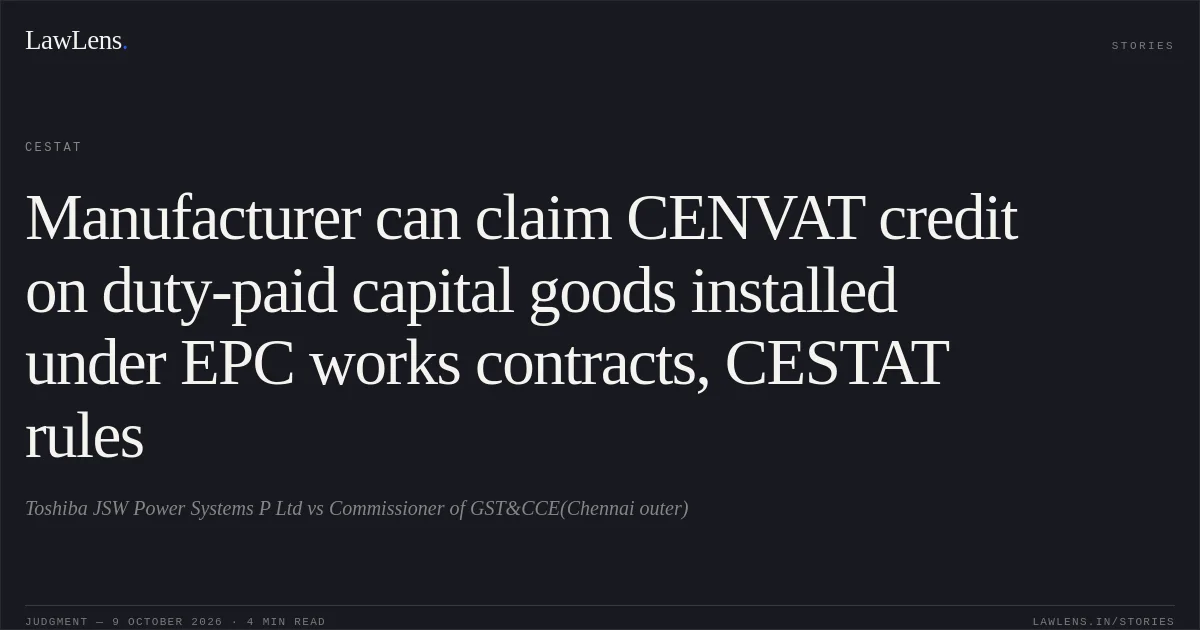
The Tribunal held that the contracts were composite works contracts but that the appellant was nevertheless entitled to CENVAT credit on the duty-paid capital goods received and used in its factory.
The Explanation to Rule 3 did not bar the credit, and the extended limitation period was invalidly invoked.
Source reference: para. 47–49As no credit was recoverable, the demands, interest and penalties could not stand. The impugned appellate order was set aside, and both appeals were allowed with consequential relief in law.
Source reference: para. 47–49Acts & Sections Cited
10 provisions across 3 statutes referred to in this judgment. Each provision opens on LawLens.
Central Excise Act, 19442
Indian Contract Act, 18721
Sale of Goods Act, 19307
Original Court PDF
Toshiba JSW Power Systems P LtdvsCommissioner of GST&CCE(Chennai outer)
Click to open original judgment
Original judgment, available to read, download and summarize on LawLens.in