Facts
The respondent manufactured sponge iron classifiable under tariff item 72031000. During manufacture, dolochar, fly ash, iron ore fines and other waste materials arose and were cleared without payment of Central Excise duty.
Source reference: para. 2The Department treated these materials as marketable excisable goods and issued a show-cause notice covering April 2010 to January 2015.
Source reference: para. 2The adjudicating authority confirmed a Central Excise duty demand of ₹1,91,54,979, together with interest and penalties, including personal penalties on the respondent’s Managing Director and authorised signatory.
Source reference: paras. 1, 3The Commissioner (Appeals) set aside the demand on the ground that the disputed materials did not arise from any process amounting to manufacture. The Department challenged that order before the Tribunal.
Source reference: para. 3Issues
1. Whether dolochar, fly ash, iron ore fines and other waste materials arising incidentally during the manufacture of sponge iron were “manufactured or produced” goods liable to Central Excise duty merely because they were marketable and covered by tariff entries?
Source reference: paras. 8–102. Whether dolochar was in any event covered by the unconditional exemptions under Notification No. 4/2006-CE and Notification No. 12/2012-CE?
Source reference: paras. 18–193. Whether the extended period of limitation and the penalties imposed under Section 11AC of the Central Excise Act, 1944 and Rule 26 of the Central Excise Rules, 2002 were sustainable?
Source reference: paras. 20–21Law Applied
Section 3 of the Central Excise Act, 1944 subjects goods manufactured or produced in India to excise duty; therefore, manufacture or production is an essential taxable event.
Source reference: para. 9Manufacture requires the emergence of a new and distinct commodity having a different name, character or use from the original material.
Source reference: para. 9The explanation to Section 2(d), deeming an article capable of being bought and sold for consideration to be marketable goods, does not dispense with the separate requirement of manufacture or production.
Source reference: para. 10The Tribunal relied on Moti Laminates v. CCE, 1995 (76) E.L.T. 241 (S.C.); Union of India v. Ahmedabad Electricity Co. Ltd., 2003 (158) E.L.T. 3 (S.C.); Union of India v. DSL Sugar Ltd., 2015 (322) E.L.T. 769 (S.C.); and Hindalco Industries Ltd. v. Union of India, 2015 (315) E.L.T. 10 (Bom.), affirmed by the Supreme Court, for the principle that waste or residue arising inevitably during manufacture is not dutiable absent a process amounting to manufacture.
Source reference: para. 11Dolochar was also considered under the exemptions for “slag, dross, scaling and other waste from the manufacture of iron or steel” in Notifications No. 4/2006-CE and 12/2012-CE.
Source reference: paras. 18–19Extended limitation requires fraud, collusion, wilful misstatement, suppression of facts or intent to evade duty; mere non-payment in an interpretational dispute is insufficient, applying CCE v. Chemphar Drugs & Liniments, 1989 (40) E.L.T. 276 (S.C.), and Continental Foundation Jt. Venture v. CCE, 2007 (216) E.L.T. 177 (S.C.).
Source reference: para. 20Reasoning
The Tribunal held that the Department had established marketability and tariff coverage but had not identified any independent process undertaken by the respondent to manufacture the disputed materials.
Source reference: para. 17Dolochar was partially burnt coal or char inevitably remaining in the rotary kiln during sponge-iron manufacture, and its subsequent sale as low-grade fuel did not establish manufacture of a new commodity.
Source reference: para. 12Fly ash resulted from the burning of coal and its collection through pollution-control equipment; combustion undertaken to generate heat or electricity was not a process for manufacturing fly ash.
Source reference: para. 14Iron ore fines arose through handling, screening or segregation, and there was no evidence of beneficiation, enrichment or any process producing a commercially distinct product.
Source reference: para. 16The Tribunal further held that subsequent payment of duty on fly ash and ESP dust was a precautionary measure and could not operate as an admission or create estoppel against the correct legal position.
Source reference: para. 15Independently, if dolochar were treated as excisable waste under Chapter 26, it would fall within the relevant unconditional exemption notifications.
Source reference: para. 19The interpretational nature of the dispute, divergent administrative views and the absence of evidence of deliberate suppression or intent to evade duty also defeated the extended limitation and penalties.
Source reference: para. 20Holding
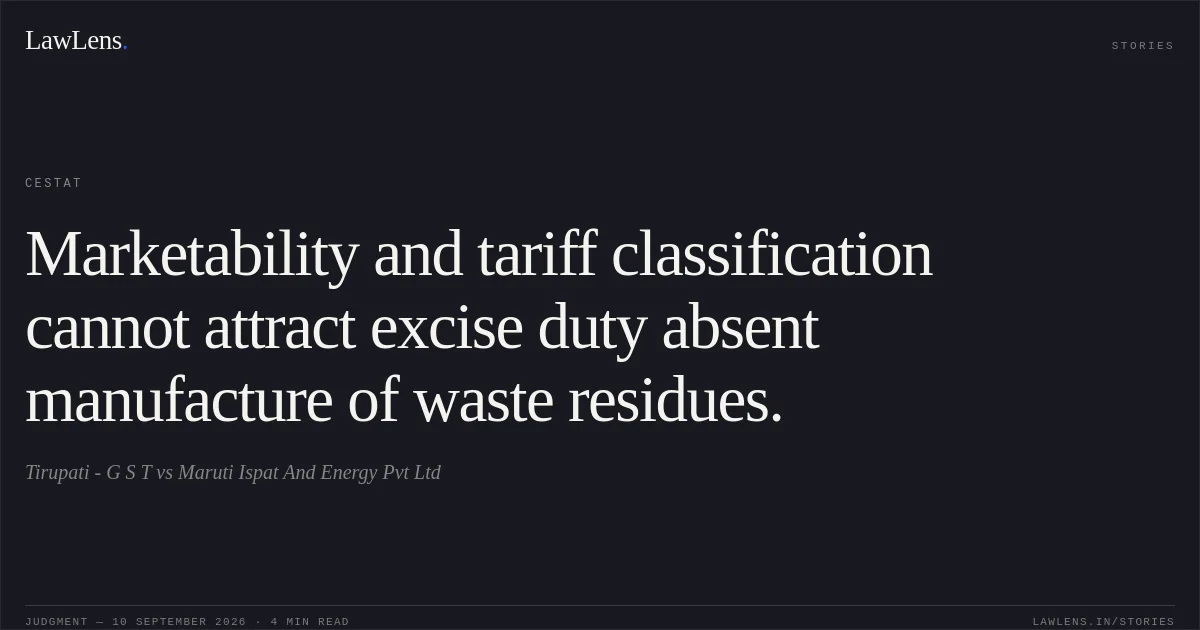
The Tribunal answered the principal issue in favour of the respondent, holding that dolochar, fly ash, iron ore fines and other incidental waste materials were not liable to Central Excise duty because the Department failed to establish that they were manufactured or produced goods.
It further held that dolochar was alternatively covered by the applicable exemption notifications, subject to its classification as waste under Chapter 26.
Source reference: para. 19The extended-period demand, interest and penalties under Section 11AC, as well as the personal penalties under Rule 26, were unsustainable.
Source reference: paras. 20–21Accordingly, the Department’s appeal was dismissed, the Commissioner (Appeals)’s order was upheld, and the respondent’s cross-objection was disposed of.
Source reference: paras. 22–23Acts & Sections Cited
3 provisions across 1 statute referred to in this judgment. Each provision opens on LawLens.
Central Excise Act, 19443
Original Court PDF
Tirupati - G S TvsMaruti Ispat And Energy Pvt Ltd
Click to open original judgment
Original judgment, available to read, download and summarize on LawLens.in