Facts
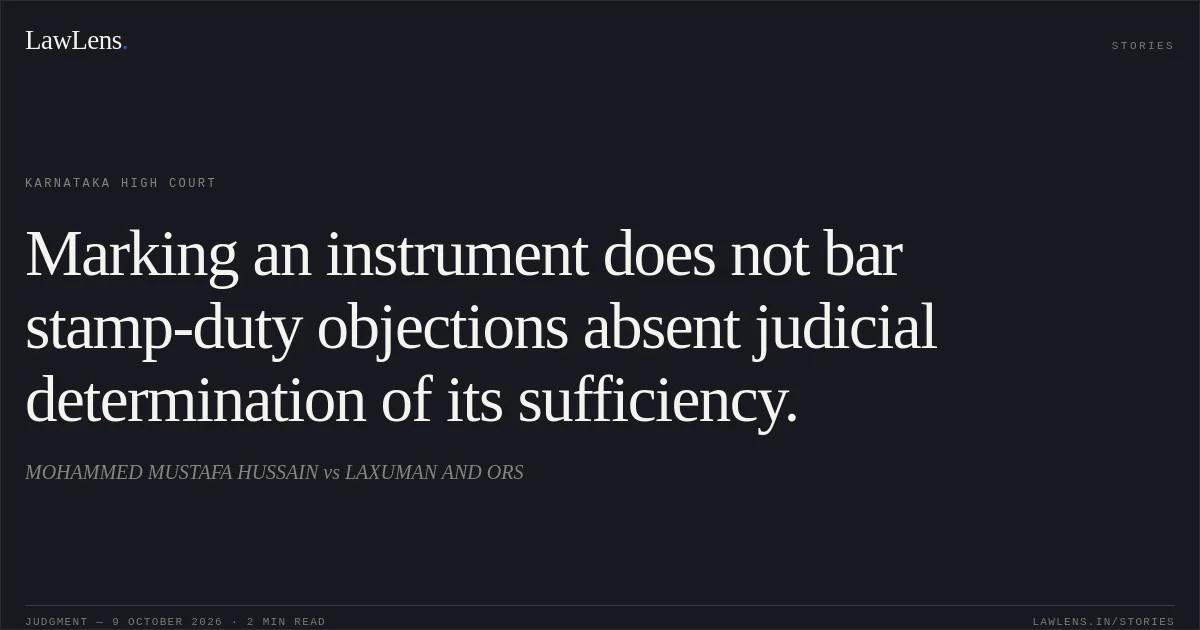
The petitioner filed a suit for specific performance, relying on an agreement of sale with respondent No. 1. Respondent No. 1 tendered two other sale agreements in evidence; the petitioner objected that they were insufficiently stamped.
Source reference: paras. 3–5; pp. 4–5The Trial Court marked the documents as Exhibits D1 and D2 despite the objection, without determining whether the stamp duty was sufficient. It later rejected the petitioner’s application under Sections 32, 33 and 34 of the Karnataka Stamp Act, reasoning that the documents had already been marked and that the petitioner’s remedy lay under Section 58. The petitioner challenged that order by writ petition.
Source reference: paras. 12–16; pp. 7–8, 15–16Issues
Whether the Trial Court could reject the petitioner’s application solely because the disputed documents had already been marked and the petitioner could seek revision under Section 58 of the Karnataka Stamp Act.
Source reference: paras. 13–16Whether the Trial Court was required to judicially determine the sufficiency of stamp duty on the documents despite their having been marked in evidence.
Source reference: paras. 17–19Law Applied
Sections 33 and 34 of the Karnataka Stamp Act, 1957 require a court receiving evidence to examine a chargeable instrument and impound it if it is not duly stamped; such an instrument cannot be admitted in evidence unless duly stamped. Section 35 bars a challenge to an instrument’s admissibility on the ground of insufficient stamping after it has been admitted, subject to Section 58.
Source reference: para. 15; pp. 8–15Section 58 provides the mechanism for review of a court’s decision admitting an instrument as duly stamped or on payment of duty and penalty. Relying on G.M. Shahul Hameed v. Jayanthi R. Hegde, (2024) 7 SCC 719, and C.P. Selvaraj v. K.M. Rajendran, W.P. No. 2383 of 2023, decided on 13 October 2025, the Court held that the question of admissibility must be judicially determined; mere marking does not substitute for that determination. Once a decision on the objection is rendered, Section 35 applies and the aggrieved party must pursue the remedy under Section 58.
Source reference: paras. 15, 18; pp. 8–15, 16Reasoning
The Trial Court rejected I.A. No. 8 because Exhibits D1 and D2 had already been marked and referred the petitioner to Section 58. However, the record showed that the petitioner had objected to the documents and that the Trial Court had marked them without determining stamp-duty sufficiency.
Source reference: paras. 16–19; pp. 15–17Applying G.M. Shahul Hameed, the High Court held that the court must decide the stamping objection judicially; the fact that the documents were marked did not itself resolve that question. Since no such determination had been made, the Trial Court’s reliance on Section 58 to reject the application was misplaced.
Source reference: paras. 16–19; pp. 15–17Holding
The High Court allowed the writ petition and set aside the order dated 8 November 2024.
It restored I.A. No. 8 and directed the Trial Court to determine the petitioner’s objections, assess the sufficiency of stamp duty, and pass an appropriate order in accordance with law, considering the cited decisions. All parties’ contentions were kept open.
Source reference: para. 20; pp. 17–18Acts & Sections Cited
8 provisions across 2 statutes referred to in this judgment. Each provision opens on LawLens.
KARNATAKA STAMP ACT, 19577
Limitation Act, 19631
Original Court PDF
MOHAMMED MUSTAFA HUSSAINvsLAXUMAN AND ORS
Click to open original judgment
Original judgment, available to read, download and summarize on LawLens.in