01Facts
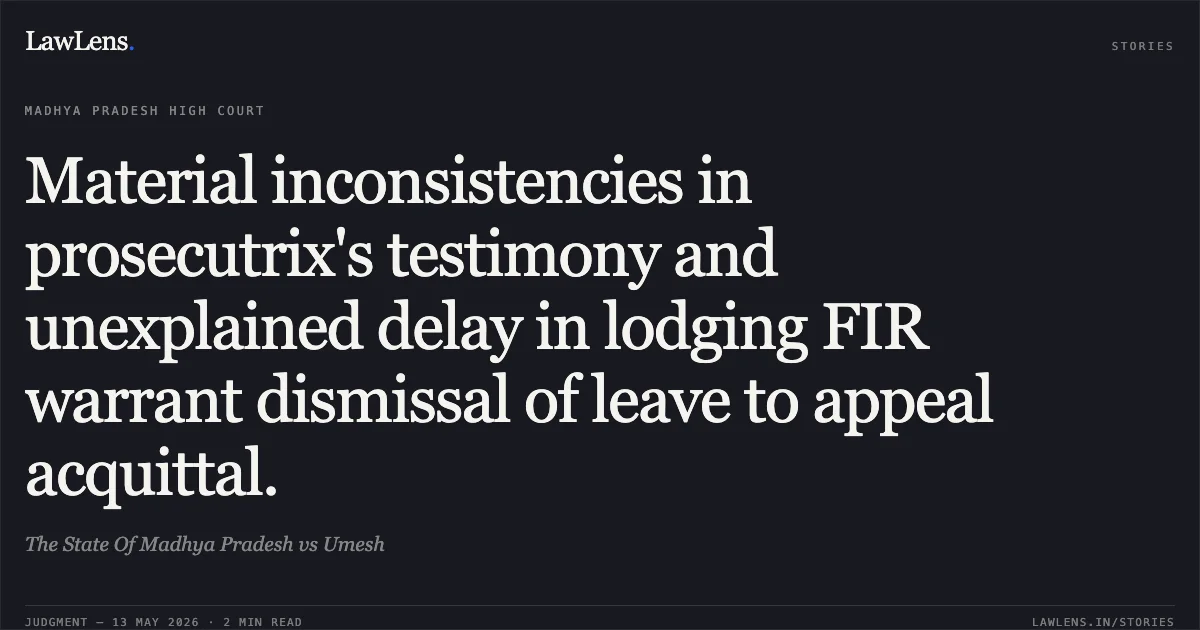
The State filed an application under Section 378(3) of the Cr.P.C. seeking leave to appeal against the judgment dated 29.11.2016 passed by the Additional Sessions Judge, Beena.
¶ 1The prosecution alleged that on 31.12.2015, the respondent attempted to sexually assault the minor prosecutrix (P.W.3) near Maruti Temple, Beena.
¶ 2Following an investigation and a three-day delay in filing the FIR, the respondent was charged under Sections 354 and 354D of the IPC and Sections 8 and 12 of the POCSO Act, 2012.
¶ 1-2The Trial Court acquitted the respondent, citing material contradictions between the prosecutrix's Section 164 Cr.P.C. statement and her court testimony.
¶ 302Issues
i.1. Whether the State has made out strong and compelling reasons to grant leave to appeal against the judgment of acquittal.
¶ 8ii.2. Whether the Trial Court’s findings regarding the unreliability of the prosecutrix’s testimony were perverse or manifestly illegal.
¶ 5-703Law Applied
The court primarily applied Section 378(3) of the Cr.P.C. regarding the grant of leave to appeal against acquittal.
¶ 1If two reasonable views are possible, the view favourable to the accused must be adopted.
¶ 7The court also considered the statutory presumption under Section 29 of the POCSO Act, 2012, noting it stands rebutted if the foundational testimony is found to be untrustworthy.
¶ 7Provisions in the judgment · 7 · Linked ones open on LawLens
Code of Criminal Procedure, 1973 Section 378Section 164
Indian Penal Code, 1860 Section 354
Protection of Children from Sexual Offences Act, 2012 Section 8Section 12Section 29Section 7
04Reasoning
The High Court examined the Trial Court’s reasoning and found it to be based on a detailed evaluation of evidence.
The court noted substantial inconsistencies between the prosecutrix’s (P.W.3) statement under Section 164 Cr.P.C. and her deposition during the trial, which affected the core of the prosecution's case.
¶ 3, 6The court highlighted that the three-day delay in lodging the FIR remained unsatisfactorily explained.
¶ 7The High Court reasoned that because the testimony of P.W.3 and her mother (P.W.2) was unreliable and lacked corroboration, the prosecution failed to prove the charges beyond a reasonable doubt.
¶ 7Applying the standard for appeals against acquittal, the court determined that the Trial Court's view was plausible and did not suffer from perversity or legal error.
¶ 7-805Holding
The High Court answered both issues in the negative, holding that the appellant failed to demonstrate any manifest error or illegality in the Trial Court's judgment.
¶ 5, 8The presumption of innocence is strengthened by an acquittal and should not be interfered with unless the findings are wholly unreasonable. Consequently, the application for grant of leave under Section 378(3) Cr.P.C. was dismissed, and the proposed criminal appeal was rejected at the threshold.
¶ 9Original Court PDF
The State Of Madhya PradeshvsUmesh
Click to open original judgment
Original judgment, available to read, download and summarize on LawLens.in



