Facts
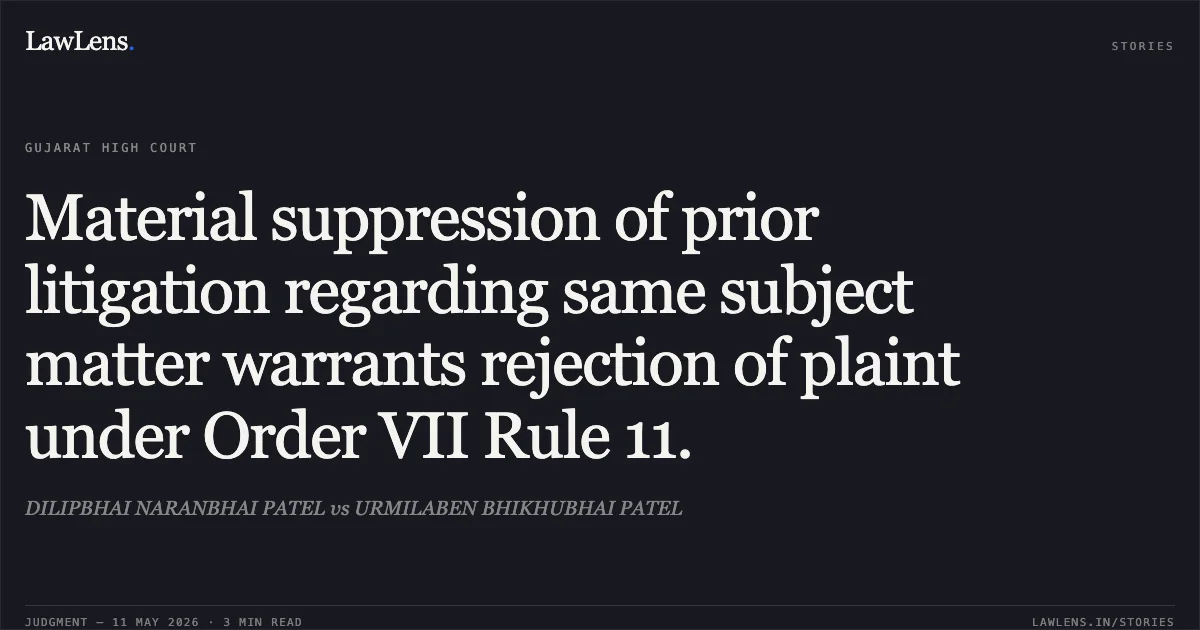
The appellant (original plaintiff) filed Special Civil Suit No. 137 of 2022 seeking specific performance of a "Token Agreement" dated 05.02.2016 for land in Sayajipura, Vadodara, and cancellation of a subsequent sale deed dated 02.01.2021 executed in favor of defendant Nos. 10 and 11.
Source reference: p. 2-3The defendants filed an application under Order VII Rule 11 of the CPC for rejection of the plaint.
Source reference: p. 4They contended that the plaintiff had suppressed the fact that he, along with another party, had previously filed Special Civil Suit No. 92 of 2018 for the same land based on a later agreement (11.04.2016), which suit was unconditionally withdrawn on 07.11.2020 following a registered deed of cancellation.
Source reference: p. 5-6, 16The trial Court allowed the application and rejected the plaint.
Source reference: p. 7Issues
1. Whether the alleged Token Agreement dated 05.02.2016 constitutes a valid, concluded, and enforceable contract for specific performance?
Source reference: p. 12, para 6(i)2. Whether the trial Court erred in rejecting the plaint under Order VII Rule 11 of the CPC on the ground of suppression of material facts regarding prior litigation and cancellation of agreements?
Source reference: p. 13, para 6(ii)Law Applied
The Court applied Order VII Rule 11(a) and (d) of the Code of Civil Procedure, 1908, regarding the rejection of a plaint that fails to disclose a cause of action or is barred by law.
Source reference: p. 2, 21It relied on the principle from T. Arivandandam v. T.V. Satyapal, holding that "clever drafting" to create an illusion of a cause of action should be nipped in the bud.
Source reference: p. 21The Court further applied the doctrine from Dahiben v. Arvindbhai Kalyanji Bhanusali, emphasizing that the Court must be vigilant against camouflage or suppression of material facts to prevent abuse of the process of the Court.
Source reference: p. 22-24Additionally, it followed Jagdishbhai Haribhai Patel v. LH of Decd. Ramanlal Shankarlal Patel, which establishes that a plaintiff is obligated to plead all material facts and cannot selectively produce documents to overcome legal bars.
Source reference: p. 21, 26-28Reasoning
The Court analyzed the "Token Agreement" (Mark 4/3) and determined it was merely a receipt for earnest money contemplating a future formal agreement, thus lacking the status of a concluded contract.
Source reference: p. 14-15Regarding suppression, the Court noted that the plaintiff had initiated and unconditionally withdrawn a prior suit (SCS No. 92/2018) for the same property and had executed a registered cancellation deed for a subsequent agreement dated 11.04.2016.
Source reference: p. 16, 19The Court reasoned that while Rule 11 assessments generally focus on the plaint's face, the intentional omission of prior failed litigation and the cancellation of rights in the property constitutes "clever drafting" and "material suppression".
Source reference: p. 20Since the plaintiff had already surrendered his rights via the 2020 cancellation deed, the suit was deemed an abuse of process designed to circumvent the fact that he no longer held any interest in the land.
Source reference: p. 28Holding
The High Court answered both issues in the negative, holding that the trial Court committed no error.
The Court affirmed that the suit was based on a non-enforceable document and was tainted by the suppression of material facts regarding the prior withdrawal of litigation and cancellation of sale agreements.
Source reference: p. 28-29The First Appeal was dismissed, and the rejection of the plaint under Order VII Rule 11 was upheld.
Source reference: p. 30Acts & Sections Cited
1 provisions across 1 statute referred to in this judgment. Each provision opens on LawLens.
Code of Civil Procedure, 19081
Original Court PDF
DILIPBHAI NARANBHAI PATELvsURMILABEN BHIKHUBHAI PATEL
Click to open original judgment
Original judgment, available to read, download and summarize on LawLens.in