Facts
The prosecution alleged that on the night of 25/26.06.1992, around 10 dacoits entered the house of the informant (P.W.6), assaulted family members, and looted articles worth Rs. 5,625/-
Source reference: pp. 2-5The informant (P.W.6) fled the house during the incident to raise an alarm
Source reference: p. 4The F.I.R. was registered against unknown offenders
Source reference: p. 6During the trial, the prosecution examined eight witnesses, three of whom (P.W.s 2, 4, and 5) were "tendered" for cross-examination without examination-in-chief
Source reference: p. 7The Trial Court (Addl. Sessions Judge, Fast Track Court No. 1, Madhubani) convicted the appellants under Section 395 IPC and sentenced them to 7 years of rigorous imprisonment via judgment dated 12.01.2005
Source reference: p. 2Issues
1. Whether the prosecution proved the guilt of the accused under Section 395 IPC beyond reasonable doubt given the material contradictions and delayed Test Identification Parade (TIP)
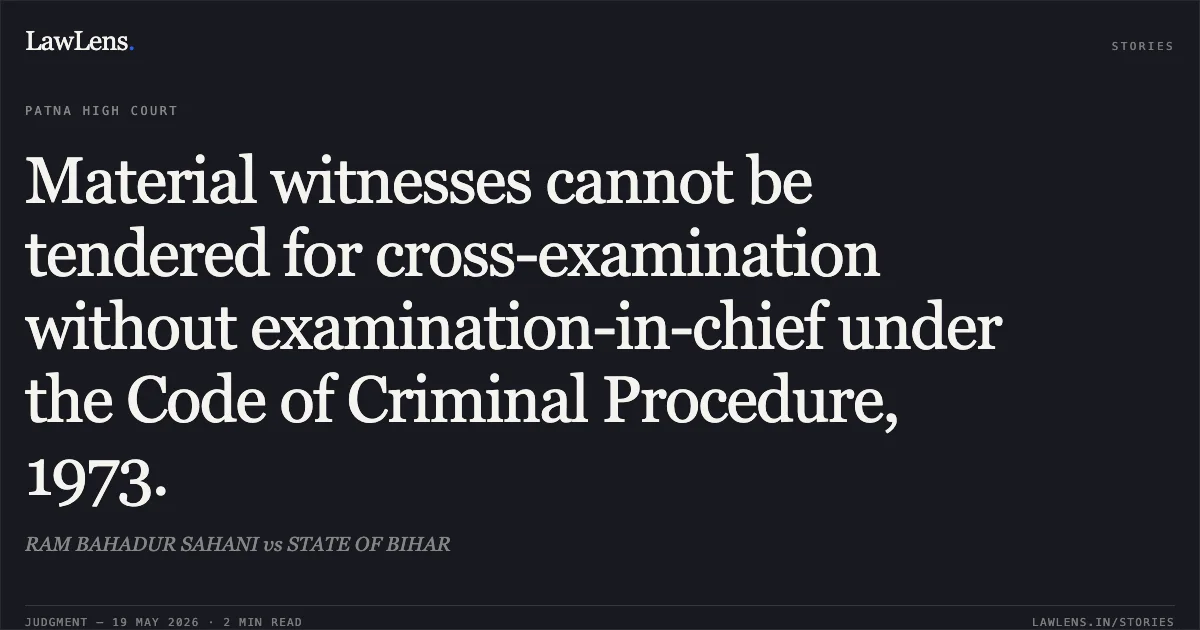
Source reference: p. 82. Whether the Court can legally "tender" witnesses for cross-examination (P.W.s 2, 4, and 5) without recording their examination-in-chief under the Cr.P.C. 1973
Source reference: p. 83. Whether the Trial Court erred in examining the accused under Section 342 of the old Code instead of Section 313 of the Cr.P.C. 1973
Source reference: p. 9Law Applied
The Court applied Section 138 of the Indian Evidence Act, which mandates the order of examination (chief, then cross)
Source reference: p. 12It relied on Sukhwant Singh v. State of Punjab (1995), which held that "tendering" a witness for cross-examination without chief examination is inconsistent with Section 138 and amounts to giving up the witness
Source reference: pp. 12-22Regarding identification, the Court cited Rajesh Govind Jagesha v. State of Maharashtra (1999) and Wakil Singh v. State of Bihar (1981) to establish that inordinate, unexplained delays in conducting a TIP (three years in this case) and identification by a single witness in darkness make the conviction unsafe
Source reference: pp. 30-34The Court further applied Section 313 of the Cr.P.C. 1973, which mandates a dialogue between the court and the accused to explain incriminating circumstances
Source reference: p. 36Reasoning
The High Court found the identification of the appellants highly suspect because the informant (P.W.6) did not name them in the initial fardbeyan despite previous enmity
Source reference: p. 25, 35The Court noted that P.W.6's claim of identifying the dacoits via a torch held by the dacoits was logically unsustainable as the light would have blinded him
Source reference: p. 26Crucially, the TIP was conducted in August 1995, over three years after the 1992 incident, and the Magistrate failed to follow Rule 34 of the Criminal Rules of Practice regarding the similarity of non-suspects
Source reference: pp. 27-29The Court held that the legal procedure was vitiated by the Trial Court "tendering" P.W.s 2, 4, and 5 for cross-examination, which is not permitted under the 1973 Code
Source reference: p. 21Furthermore, the Trial Court incorrectly examined the accused under a defunct section (342 of the old Code) rather than Section 313 Cr.P.C.
Source reference: p. 36Holding
The Court held that the prosecution miserably failed to prove the charges beyond reasonable doubt due to procedural illegalities and unreliable identification
The appeals were allowed, the judgment of conviction dated 12.01.2005 and order of sentence dated 15.01.2005 were set aside, and the appellants were acquitted of all charges
Source reference: p. 39Acts & Sections Cited
7 provisions across 2 statutes referred to in this judgment. Each provision opens on LawLens.
Code of Criminal Procedure, 19736
Indian Penal Code, 18601
Original Court PDF
RAM BAHADUR SAHANIvsSTATE OF BIHAR
Click to open original judgment
Original judgment, available to read, download and summarize on LawLens.in


