Facts
The appeals arose from the conviction of the appellants for offences including rioting and murder with common object under Sections 147 and 302/149 IPC, with certain appellants also convicted under Section 323 IPC and Section 3(1)(r) of the SC/ST Act.
Source reference: para. 2–5, 14The prosecution alleged that, following an assault on labourer Govardhan Manjhi near a shop, the appellants took Bipin Yadav to a field and killed him with a gadasa.
Source reference: para. 2–5, 14The trial court imposed life imprisonment for the murder conviction.
Source reference: para. 2–5, 14On appeal, the High Court examined the prosecution and defence evidence, including the testimony of the informant and other witnesses, the post-mortem report, and the investigation and seizure evidence.
Source reference: para. 26–37Issues
1. Whether the prosecution evidence established the appellants’ participation in the murder and their common object under Section 149 IPC beyond reasonable doubt.
Source reference: para. 27–382. Whether the discrepancies in the eyewitness accounts, the absence of independent corroboration, and the investigative deficiencies created reasonable doubt requiring the convictions to be set aside.
Source reference: para. 29–37Law Applied
The Court considered Sections 147, 302/149 and 323 IPC and Section 3(1)(r) of the SC/ST Act, under which the appellants had been convicted.
Source reference: para. 2, 14A conviction must rest on prosecution evidence that proves guilt beyond reasonable doubt; where the evidence does not reliably establish participation and common object, the accused are entitled to the benefit of doubt.
Source reference: para. 38In assessing witness credibility, the Court considered the need for caution where witnesses were related to the deceased or affected by enmity, and referred to Section 134 of the Indian Evidence Act in evaluating whether the evidence was reliable.
Source reference: para. 36–37Reasoning
The Court found material weaknesses in the prosecution case.
Source reference: para. 29–37PW-1 had not witnessed the initial incident at the shop, and her account of who was present there conflicted with PW-5’s testimony; PW-5’s claimed injuries were not supported by medical evidence, and the investigating officer had not verified the alleged foundation work.
Source reference: para. 29, 36The shopkeeper, a potentially material witness, was not called by the prosecution and instead testified for the defence, denying that the alleged events occurred at his shop.
Source reference: para. 31–32The seized weapons and other articles were not produced at trial, and neither the FSL report nor the report concerning the cartridges was produced.
Source reference: para. 33The Court also treated the evidence of the informant and PW-1 with caution in light of the disclosed prior enmity.
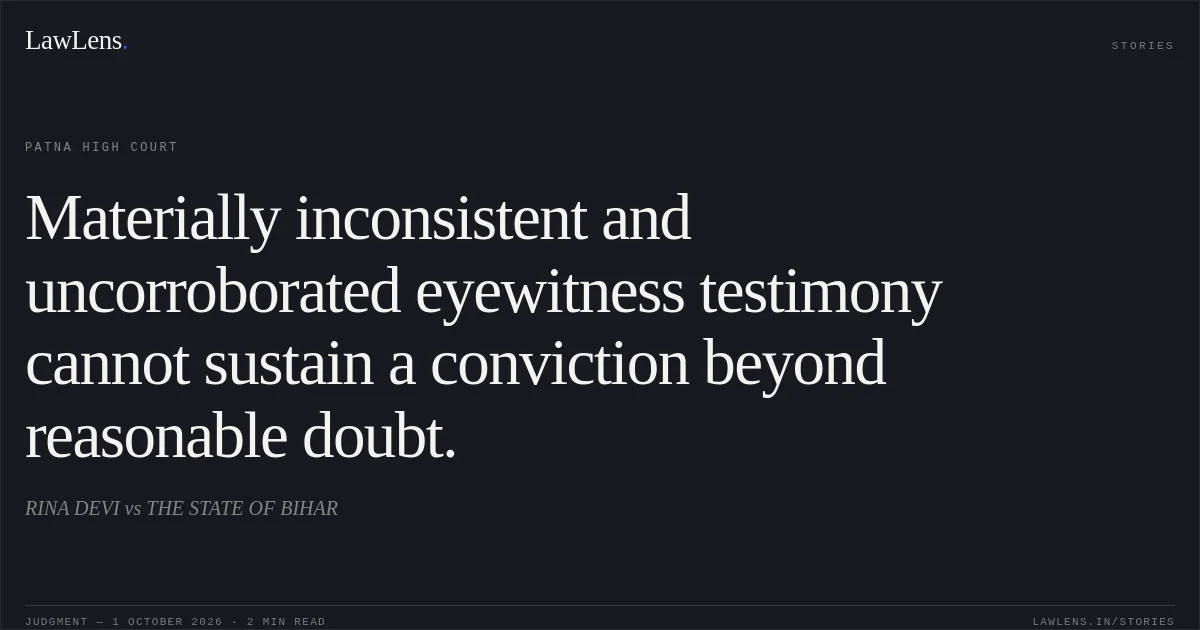
Source reference: para. 37Taken together, these deficiencies meant the prosecution had not proved its case beyond reasonable doubt.
Source reference: para. 38Holding
The Court answered the issues in favour of the appellants, holding that the prosecution had failed to establish guilt beyond reasonable doubt.
It set aside the judgment of conviction dated 13 December 2022 and the order of sentence dated 20 December 2022, acquitted the appellants by giving them the benefit of doubt, directed the release of Sanoj Yadav unless required in another case, and discharged the other appellants from their bail bonds.
Source reference: para. 38–42Acts & Sections Cited
12 provisions across 4 statutes referred to in this judgment. Each provision opens on LawLens.
Indian Penal Code, 1860
Scheduled Castes and the Scheduled Tribes (Prevention of Atrocities) Act, 19891
Arms Act, 19591
Code of Criminal Procedure, 19731
Original Court PDF
RINA DEVIvsTHE STATE OF BIHAR
Click to open original judgment
Original judgment, available to read, download and summarize on LawLens.in