01Facts
On 20.11.2021, the ten-year-old differently abled victim was left at the appellant’s house while her parents and brother visited a doctor. The appellant, who was her neighbour, allegedly subjected her to sexual assault.
p. 2The victim’s father lodged an FIR, following which the police filed a charge-sheet under Section 376AB of the IPC read with Section 6 of the POCSO Act.
p. 2The trial court framed a charge under Section 6 of the POCSO Act and examined seven prosecution witnesses, including the victim, as well as one defence witness.
p. 3The victim’s birth certificate recorded her date of birth as 25.07.2011, and her father testified that she had 90% locomotor disability.
p. 3By judgment dated 18.12.2024 in POCSO Case No. 62/2022, the learned Additional Sessions Judge-cum-Special Judge (POCSO), Tinsukia convicted the appellant under Section 10 of the POCSO Act.
p. 2The appellant preferred the present appeal under Section 415(2) of the BNSS, 2023.
p. 202Issues
i.Whether the prosecution proved beyond reasonable doubt that the appellant had committed the charged sexual offence against the minor victim under the POCSO Act
pp. 2–4 · ¶ 16–19ii.Whether the contradictions and inconsistencies in the victim’s account and the statements attributed to her by other witnesses rendered the prosecution evidence unreliable
p. 4 · ¶ 16–1803Law Applied
The Court applied the statutory provisions under which the appellant was prosecuted and convicted, namely Section 376AB of the IPC read with Section 6 of the POCSO Act, and noted the trial conviction under Section 10 of the POCSO Act.
p. 2The governing criminal-law principle applied was that the prosecution must establish the guilt of the accused beyond reasonable doubt; material inconsistencies in the prosecution evidence may create reasonable doubt and entitle the accused to acquittal.
p. 4 · ¶ 16–19The Court also considered the evidentiary value of the victim’s testimony in light of the medical evidence and the corroborative statements of other prosecution witnesses.
p. 4 · ¶ 17–18Provisions in the judgment · 4 · Linked ones open on LawLens
Bharatiya Nagarik Suraksha Sanhita, 2023 Section 415
Protection of Children from Sexual Offences Act, 2012 Section 10Section 6
Code of Criminal Procedure, 1973 Section 164
04Reasoning
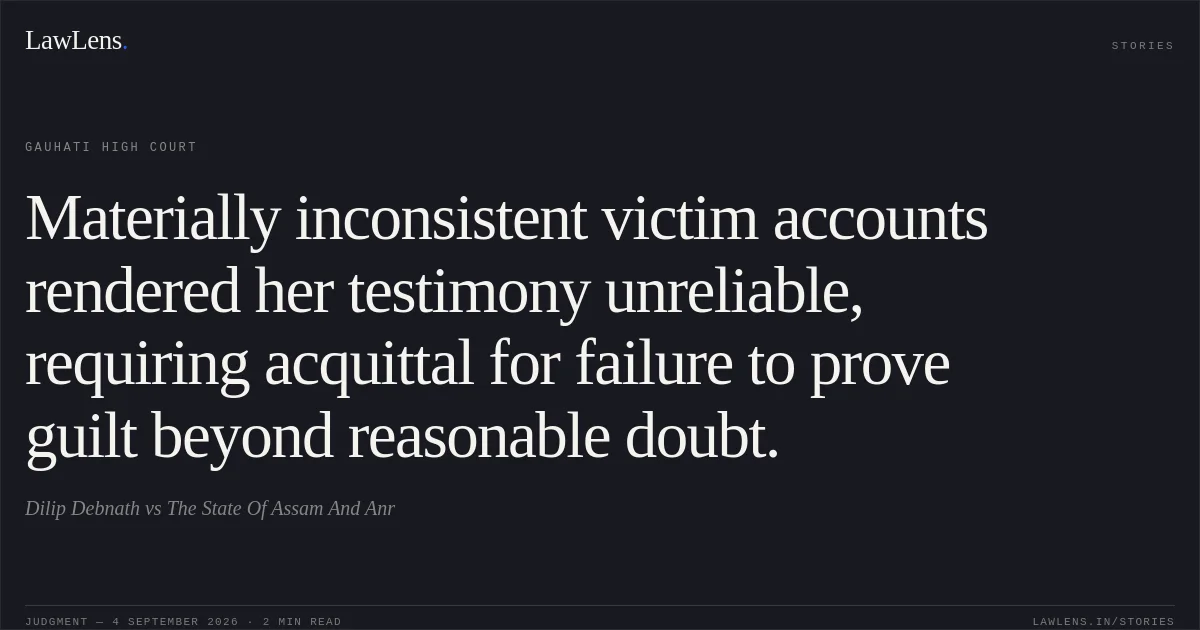
The Court found two materially different versions of the alleged occurrence: the victim stated that the appellant inserted a finger into her vagina and pressed her breast, whereas PW-5 attributed to her a disclosure that the appellant had inserted his penis, and PW-6 stated that she had disclosed that the appellant removed her pants and touched her vagina.
p. 4 · ¶ 9, 11–12, 16–18The Court also noted that PW-5 gave inconsistent descriptions in cross-examination and that the medical evidence disclosed no injuries.
p. 4 · ¶ 17In view of these discrepancies, the Court held that the victim had given different versions before different persons and concluded that her evidence was not sufficiently reliable to sustain a conviction.
p. 4 · ¶ 18–19Since the prosecution failed to prove the offence beyond reasonable doubt, the trial court’s finding was held to be erroneous.
p. 4 · ¶ 18–1905Holding
The High Court held that the prosecution had failed to prove the charge against Dilip Debnath beyond reasonable doubt.
p. 4 · ¶ 20The appeal was allowed. The High Court set aside the conviction, acquitted him, and directed that he be set at liberty forthwith. The trial court records were ordered to be returned.
p. 4 · ¶ 20Original Court PDF
Dilip DebnathvsThe State Of Assam And Anr
Click to open original judgment
Original judgment, available to read, download and summarize on LawLens.in