01Facts
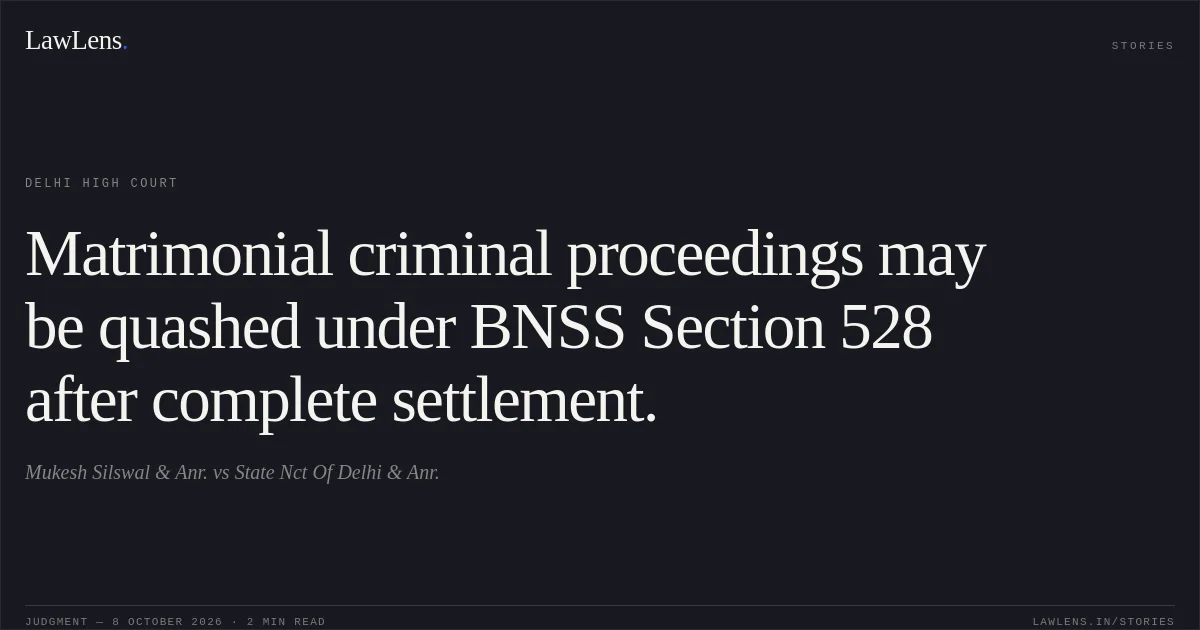
The petitioners sought quashing under Section 528 of the Bharatiya Nagarik Suraksha Sanhita, 2023 (BNSS), of FIR No. 0555/2021, registered under Sections 498A/406/34 IPC, and the proceedings arising from it.
p. 1The FIR arose from matrimonial disputes between Petitioner No. 1 and Respondent No. 2, who had been living separately since 17 September 2019.
p. 1The parties reached a mediated settlement providing for payment of Rs. 4,25,000, divorce by mutual consent and withdrawal of inter se litigation; the marriage was dissolved, and the full settlement amount was paid during the hearing.
pp. 4–5Respondent No. 2, identified by the Investigating Officer, confirmed that the settlement was voluntary and that she did not wish to pursue the FIR.
p. 502Issues
i.1. Whether the High Court should exercise its inherent jurisdiction under Section 528 BNSS to quash the non-compoundable offences alleged under Sections 498A/406/34 IPC in view of the parties’ settlement.
pp. 5–9ii.2. Whether, in the circumstances, continuation of the prosecution would serve any useful purpose or amount to an abuse of process.
pp. 9–1003Law Applied
Section 528 BNSS, corresponding to Section 482 CrPC, empowers the High Court to quash criminal proceedings to secure the ends of justice or prevent abuse of process, including in appropriate cases involving non-compoundable offences.
pp. 6–9Under Gian Singh v. State of Punjab, (2012) 10 SCC 303, Jitendra Raghuvanshi v. Babita Raghuvanshi, (2013) 4 SCC 58, and Narinder Singh v. State of Punjab, (2014) 6 SCC 466, matrimonial and family disputes of a predominantly private character may be quashed following a genuine settlement, provided the offence is not of a heinous or otherwise public character and the court considers the nature and gravity of the allegations, the likelihood of conviction, and the interests of justice.
pp. 6–9Provisions in the judgment · 5 · Linked ones open on LawLens
Bharatiya Nagarik Suraksha Sanhita, 2023 Section 528
Code of Criminal Procedure, 1973 Section 482Section 320
Indian Penal Code, 1860 Section 406Section 34
04Reasoning
The Court treated the case as arising from a matrimonial dispute that the parties had fully resolved.
pp. 4–5, 9The marriage had been dissolved by mutual consent, the entire settlement sum had been paid, and Respondent No. 2 affirmed the voluntary settlement and her wish not to pursue the FIR.
pp. 4–5, 9Applying the cited principles, the Court concluded that the possibility of conviction was remote and bleak and that continuing the prosecution would serve no useful purpose and amount to an abuse of process.
p. 905Holding
The Court allowed the petition and quashed FIR No. 0555/2021, registered at Police Station Dabri under Sections 498A/406/34 IPC, together with all consequential proceedings.
p. 10It clarified that the order does not affect the rights of the minor child.
p. 10Original Court PDF
Mukesh Silswal & Anr.vsState Nct Of Delhi & Anr.
Click to open original judgment
Original judgment, available to read, download and summarize on LawLens.in